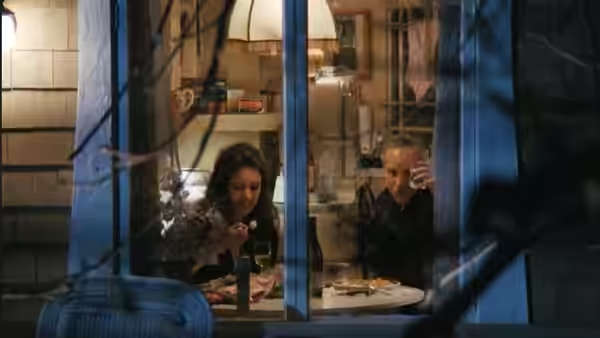
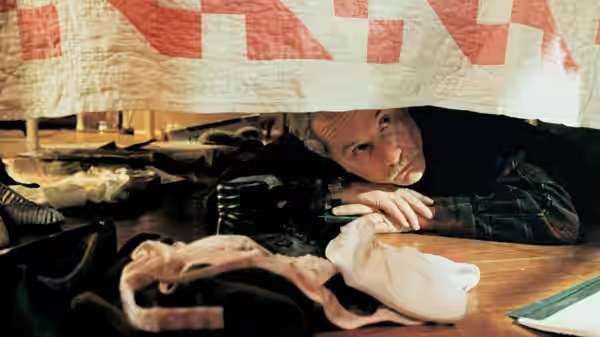
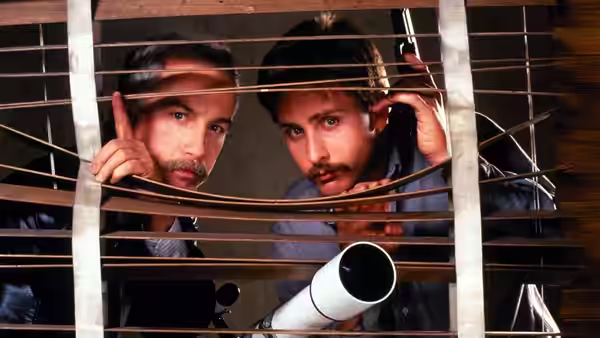
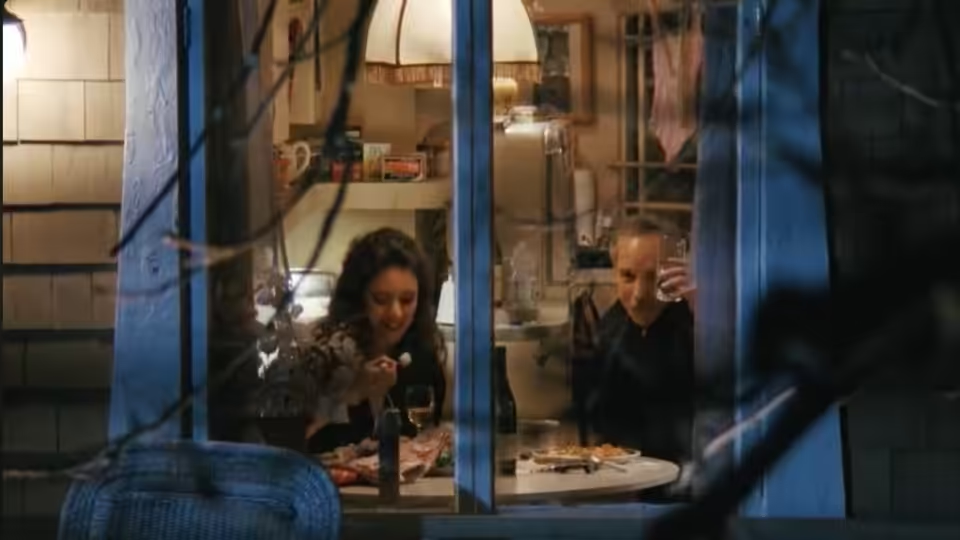
Chris Lecce (Richard Dreyfuss) and Maria McGuire (Madeleine Stowe) dine at a table, seen through a window
Film review

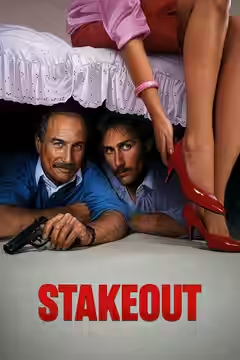
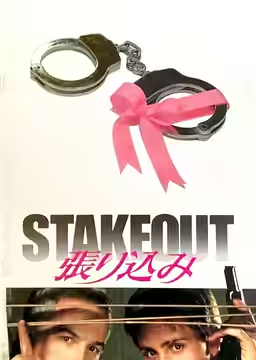
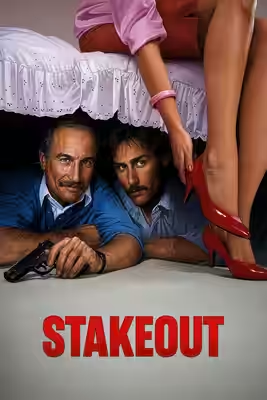
Stakeout

1987 · Directed by John Badham · 1h 56m

In a sentenceRichard Dreyfuss makes romantic embarrassment look like the most demanding part of a detective’s job

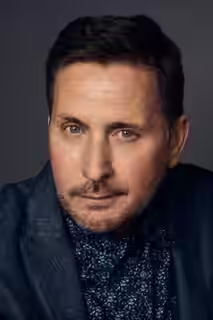
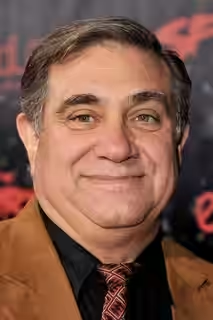
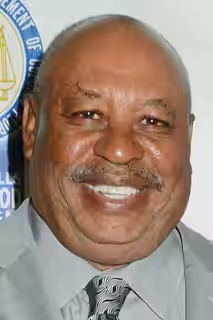
Det. Chris Lecce (Richard Dreyfuss) juggles police work and romantic troubles, with Det. Bill Reimers (Emilio Estevez) as his fellow detective. Maria McGuire (Madeleine Stowe) shares the romantic side of his story, while Richard “Stick” Montgomery (Aidan Quinn) brings a threat of violence. The opening is brutal; the detectives’ exchanges and Lecce’s lovelorn difficulties introduce the comedy. Their police circle also includes Det. Phil Coldshank (Dan Lauria), Det. Jack Pismo (Forest Whitaker) and Capt. Giles (Earl Billings).

Fi1m review

Richard Dreyfuss makes Stakeout worth the evening, especially when police business gives way to romantic embarrassment. John Badham’s comedy thriller is less convincing at joining its jokes to its violence, but the company mostly compensates.

Stakeout is worth an evening for its comic performances, provided a tidy plot is not a condition of entry. John Badham sets himself the awkward job of making police comedy, adult romance and harsh violence fit comfortably within the same film. They do not always fit, and the brutality of the opening makes the subsequent good humour harder to settle into. Still, there is enough pleasure in watching these people together to forgive some fairly loose writing.

Richard Dreyfuss does most of the persuading as Det. Chris Lecce, whose romantic discomfort gives the film its warmth. We laughed at his lovelorn awkwardness, because he makes the effort to retain a little dignity so plainly visible. The timing is precise without making the character seem to know that he is funny, and that keeps the comedy kind. Madeleine Stowe, as Maria McGuire, gives him someone worth attending to; their scenes are more engaging than the business of establishing and maintaining a threat.

Emilio Estevez has a less rewarding task as Det. Bill Reimers, though the partnership remains likeable. He cannot always match the ease of his colleague’s verbal timing, and a few exchanges feel as though one actor has arrived at the joke before the other. Yet their familiarity is persuasive enough to carry the lighter passages without demanding that every line land. The pleasure lies in the sense that these two enjoy one another’s company, even when the writing is doing little to help.

Aidan Quinn brings a useful nastiness to Richard “Stick” Montgomery, giving the danger some weight when the film needs it. The difficulty is how often that danger seems to belong to a harsher film than the one the detectives are enjoying. Jim Kouf’s screenplay is more convincing about embarrassment and companionship than it is about keeping its thriller business plausible. We can accept a comedy taking shortcuts, but here those shortcuts weaken the tension just when the violence asks to be taken seriously.

John Seale’s cinematography has the clean assurance this sort of entertainment needs, making the action easy to watch without asking us to admire every image. Philip Harrison’s production design is similarly unobtrusive, leaving the performers room to hold our attention. There is a cost to all that efficiency. The surroundings seldom become memorable in their own right, and the film can look more anonymous than its central performances deserve.

Editors Michael Ripps and Tom Rolf keep the comedy moving, though pace cannot solve the awkward changes in tone. The movement between humour and brutality can leave too little room for either to register properly. Arthur B. Rubinstein’s score helps sustain the momentum without making those changes feel much more comfortable. The film remains easy enough to watch, but less satisfying whenever it asks us to worry.

At 116 minutes, there is also a little more of it than the material comfortably supports. By the standards of the buddy-police comedy, its advantage is the attention paid to a grown man’s romantic vulnerability, and its weakness is the familiar assumption that action will take care of itself. The affection survives the unevenness. Choose it for the romantic awkwardness and the companionable comedy, with modest expectations of the detective work.
Critical consensus AI synthesised

57
Positive
2
Mixed
3
Negative
1

The reviews lean towards a mixed response to Stakeout, with Richard Dreyfuss providing the most consistent reason for approval. Critics praise his comic timing, lovelorn performance and scenes with Madeleine Stowe, though enthusiasm for the surrounding thriller is less secure. The more favourable accounts find an entertaining combination of buddy comedy and action, helped by slick handling. Even those who enjoy it acknowledge weaknesses in the plotting or an awkward balance between humour and violence.

The spread is wide, and the disagreements concern some basic ingredients. Empire enjoys the chemistry between Dreyfuss and Emilio Estevez, while Variety finds that connection lacking and questions Dreyfuss’s effectiveness in the rougher scenes. Time Out responds to the opening brutality and Aidan Quinn’s threatening performance. The Los Angeles Times takes the strongest opposing position: despite enjoying the leads’ playful rapport, it finds the film predictable, largely empty and short on suspense.

Empire
1 January 2000 · William Thomas
70*

The review finds the comedy thriller entertaining despite its sizeable plot weaknesses. It singles out the chemistry between Richard Dreyfuss and Emilio Estevez, especially Dreyfuss’s lovelorn performance.

Read the full review →
Time Out
· EP
70*

The review presents the film as surprisingly thrilling and highlights Aidan Quinn’s performance as a crazed murderer. It also singles out the bone-crushing brutality of the opening sequence for praise.

Read the full review →
The New York Times
5 August 1987 · Janet Maslin
64*

The article is identifiable as a review, but its verdict cannot be determined from the inaccessible page. The available text does not reveal what the critic singled out for praise or complaint.

Read the full review →
Radio Times
★★★ · David Parkinson
60

Parkinson finds the thriller elevated by Richard Dreyfuss but uneven in its balance of comedy and violence. He praises Dreyfuss’s scenes with Madeleine Stowe, while noting Emilio Estevez struggles with the verbal exchanges.

Read the full review →
Variety
31 December 1986 · Variety Staff
60*

The review finds the film slick and sure-footed, but says the leads lack chemistry. It praises the buddy-comedy and action mix while noting Dreyfuss struggles when the story turns to rough stuff.

Read the full review →
Los Angeles Times
5 August 1987 · SHEILA BENSON
20*

Benson finds the film slick, predictable and largely empty, with little suspense. She praises Richard Dreyfuss’s comic timing and the playful ease between him and Emilio Estevez.

Read the full review →

Straight answers AI written, from our review

Is Stakeout worth watching?
Stakeout is worth watching for Richard Dreyfuss’s romantic awkwardness and the likeable detective partnership; we score it 70 out of 100. We recommend it for companionable comedy rather than convincing police work: the plotting is loose, the shifts into harsh violence are awkward, and 116 minutes stretches the material.
How long is Stakeout, and what is it rated?
Stakeout runs 1h 56m. It is an action and comedy film.
Where can I watch Stakeout in Azerbaijan?
Stakeout is not on any streaming or rental service in Azerbaijan at the moment. It is available in 12 other countries; change your country at the top of the page to see where. Availability is checked daily.
How violent or frightening is Stakeout, and is it suitable for children?
Stakeout carries a UK 15 certificate and is not suitable for children, with a brutal opening and harsh violence alongside its comedy and adult romance. We find the shifts from brutality to good humour uncomfortable; squeamish viewers should not take the likeable detectives or romantic awkwardness as signs of a consistently gentle film.
How does Stakeout compare to Midnight Run?
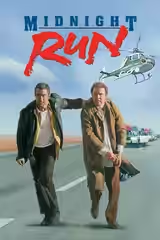
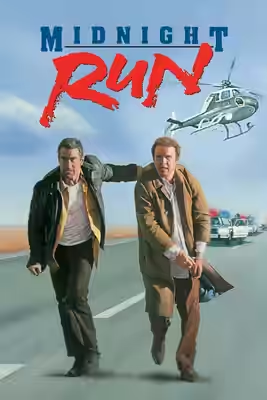
Stakeout is the choice for romantic embarrassment, but we recommend Midnight Run as the stronger partnership comedy, with more patience for the people beneath the bickering. Dreyfuss gives Stakeout warmth despite its awkward shifts into violence; De Niro and Grodin have more room to develop their quarrelling, though the pursuit sometimes interrupts conversations we would rather keep hearing.
What should I watch after Stakeout?
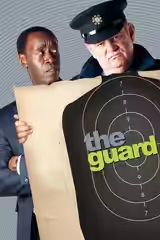
After Stakeout, try Midnight Run (1988, Fi1m 88): Another mismatched partnership, with more patience for the people beneath the bickering. Then The Guard (2011, Fi1m 78): An abrasive police comedy that gives its unlikely partnership room to develop.

Cast

If you liked this, try…

  1. Midnight Run (1988, Fi1m 88)Another mismatched partnership, with more patience for the people beneath the bickering.

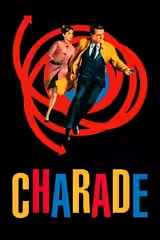
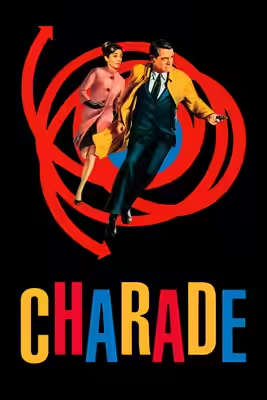
  2. Charade (1963) · not reviewed yetRomance and danger share the screen, with considerably better manners.

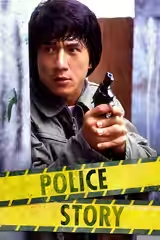
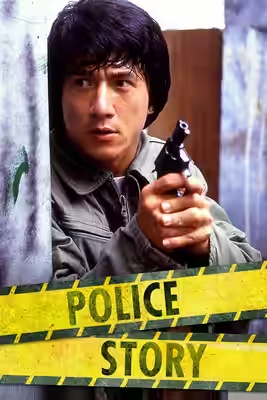
  3. Police Story (1985) · not reviewed yetPolice comedy meets action whose physical risks are difficult to ignore.

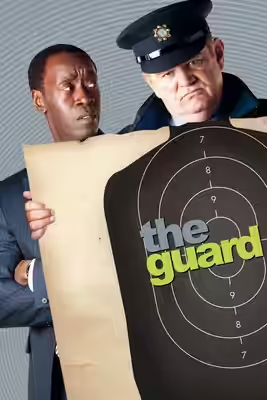
  4. The Guard (2011, Fi1m 78)An abrasive police comedy that gives its unlikely partnership room to develop.

  5. The Big Easy (1986) · not reviewed yetMore room for the attraction between adults who should know better.

Free account

Know what to watch tonight

Two lists that know where things are streaming, collections you can share, your own score beside ours, and Discover that remembers what you have seen.

  • Want to see, sorted by what is streaming now
  • Seen, with your score out of ten
  • No adverts, ever