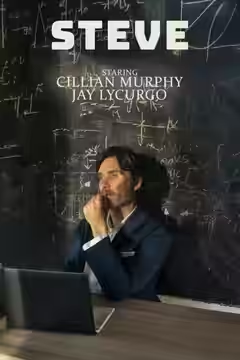
Cillian Murphy and Jay Lycurgo give Steve enough feeling to make its shortcomings frustrating. This school drama cares about its people, but its restless direction leaves too little time to know them.
Steve is worth considering for its performances, with a substantial reservation about how hurriedly it treats the people surrounding them. Tim Mielants directs a school drama in which caring for students has become exhausting, precarious work. Max Porter’s screenplay gives that pressure a compelling human centre in Steve, played by Cillian Murphy. We believe the exhaustion more readily than we understand the school, and that limits how far the film can take us.
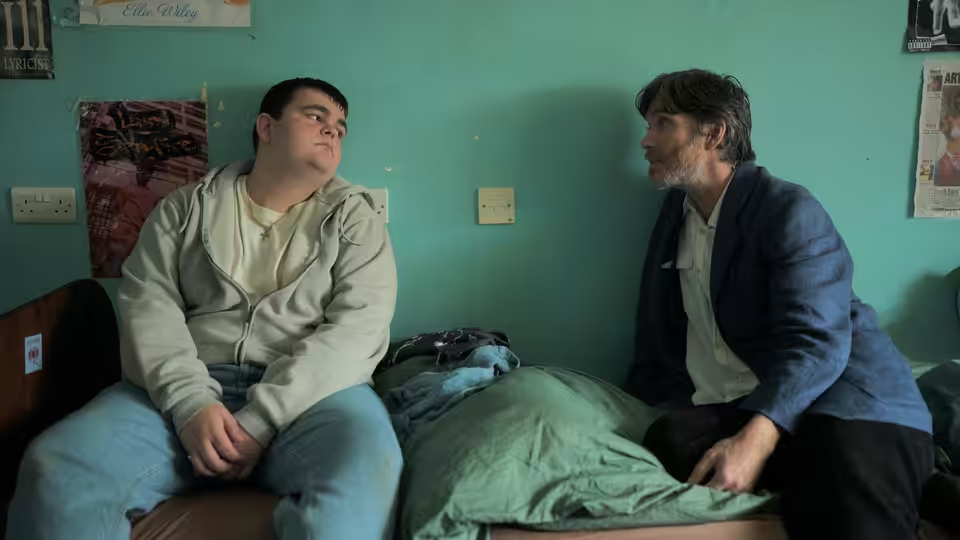
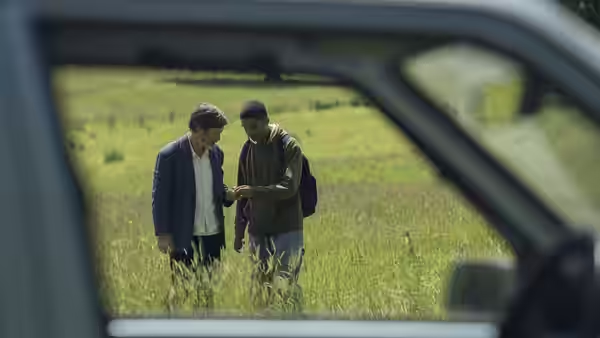
Cillian Murphy makes Steve’s continuing concern for his students matter even when personal strain threatens to overwhelm it. The performance allows frustration into the picture without making care seem fraudulent, or asking for applause simply because a teacher persists. Jay Lycurgo gives Shy a vulnerability that deserves the attention the film gives its adult lead. We were moved by the moments that let Steve and Shy appear vulnerable; for once, the film gives us enough space to worry about someone rather than merely register the pressure on them.
The younger performers also bring humour and an ease with one another that help the school feel inhabited. Their company is welcome because a film this concerned with distress needs some sense of what these people are like when they are not suffering. Tracey Ullman, as Amanda, contributes a similarly valuable warmth and nuance. Yet the supporting characters too often remain people we would like to know better, and a convincing ensemble cannot entirely compensate for the limited attention each person receives.
Robrecht Heyvaert’s cinematography makes disorientation an insistent part of the experience, successfully conveying how difficult it is to find a moment’s peace. The aerial views are less persuasive: they enlarge the presentation without deepening our understanding of the people below. Danielle Palmer’s editing has the difficult task of accommodating this divided attention within 92 minutes, and the result feels compressed rather than economical. Neither the score by Ben Salisbury and Geoff Barrow nor Paki Smith’s production design can supply the ordinary detail about school life that the writing leaves underexplored.
That omission matters particularly in a drama about education. We get too little sense of the actual teaching, or of how the school’s work might help these particular students. Max Porter gives us forceful emotion, but the pupils need more individual definition if the film’s concern for them is to carry its full weight. Tim Mielants keeps the distress close enough to feel, yet the restless presentation sometimes makes it harder to distinguish one person’s difficulties from another’s.
The familiar school-drama temptation is to make the institution legible through one exceptional adult, and Cillian Murphy is persuasive enough to make that approach work for stretches. But Steve also asks us to care about a wider group, then struggles to make room for them. Its compassion is welcome, and its actors repeatedly earn feelings that the hurried storytelling cannot sustain. Choose it for the performances, provided an underdeveloped school and several insufficiently explored lives will not outweigh them.