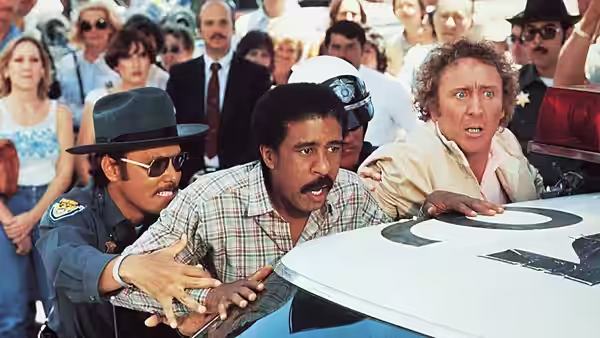
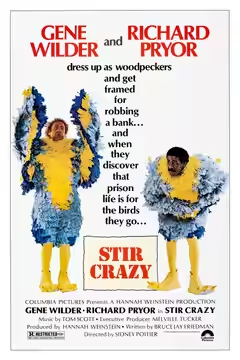
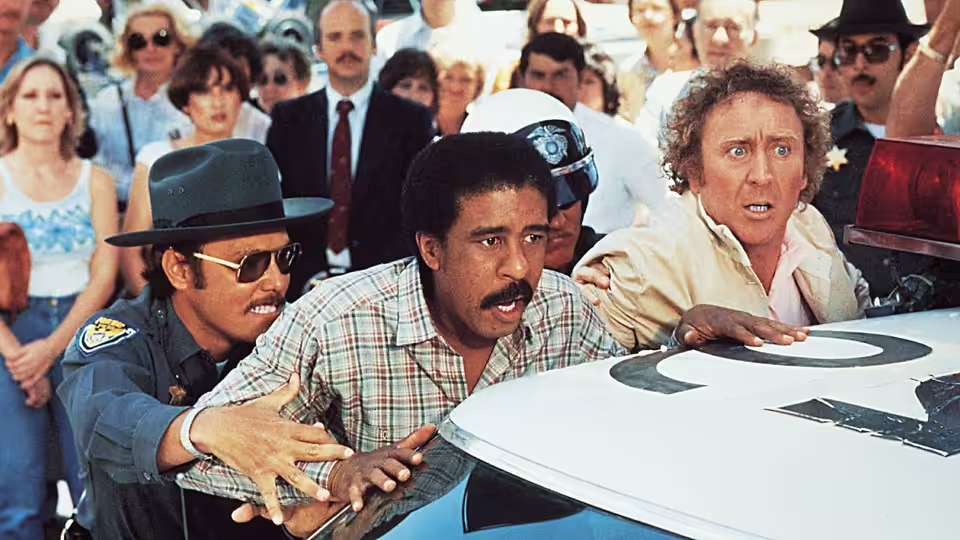
Harry Monroe (Richard Pryor) and Skip Donahue (Gene Wilder) scramble over a car as an officer restrains them
Film review

Stir Crazy

1980 · Directed by Sidney Poitier · 1h 51m

In a sentenceRichard Pryor walking into a cell block insisting he is bad is funnier than anything the film finds to do afterwards

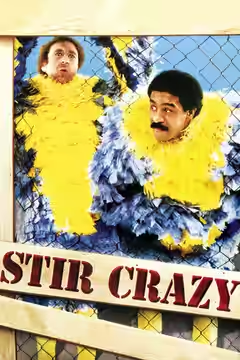
New York, 1980. Skip Donahue (Gene Wilder), a would-be playwright, and Harry Monroe (Richard Pryor), an actor between parts, are both sacked on the same day and decide the answer is California. Harry’s car gets them as far as Arizona, where the only work going is a promotion for a local bank: two men in woodpecker costumes dancing on the pavement. During their lunch break a pair of robbers borrow the suits, empty the bank, and Skip and Harry are arrested in feathers. Their lawyer, Len Garber (Joel Brooks), cannot stop a sentence of 125 years. Inside, they meet Rory Schultebrand (Georg Stanford Brown), Jesus Ramirez (Miguel Ángel Suárez), the silent giant Grossberger (Erland van Lidth), Warden Walter Beatty (Barry Corbin) and his deputy, Ward Wilson (Craig T. Nelson).

Plays from YouTube when you press play; nothing loads from them until then.

Fi1m review

Gene Wilder and Richard Pryor are the whole show, and for an hour that is enough. Then Sidney Poitier’s prison comedy finds one gag it likes and repeats it until we had stopped laughing and started checking our watches.

Sidney Poitier directs Gene Wilder and Richard Pryor in their second film together, four years after Silver Streak, and Bruce Jay Friedman’s script knows exactly what it has. Two New Yorkers lose their jobs, drive west, take a day’s work as dancing woodpeckers outside an Arizona bank, and are in prison for 125 years before they have got the feathers off. The verdict is simple. When Wilder and Pryor are in a frame together, Stir Crazy is funny. When the film has to do anything else, it stands around waiting for them to come back.

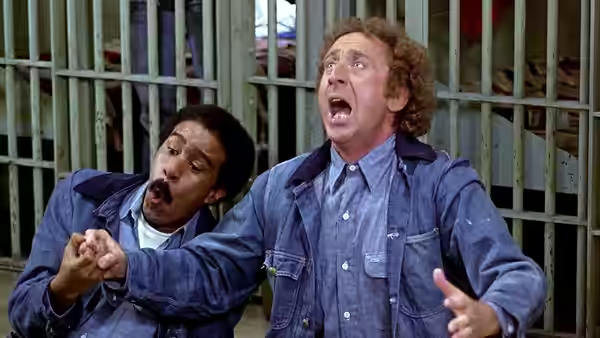
The pairing works because they panic in opposite directions. Wilder’s Skip meets every disaster with a wide, trusting smile and the belief that it will all be sorted out by lunchtime. Pryor’s Harry sees the disaster coming three scenes early and talks faster the closer it gets. The moment everyone remembers is the walk into the cell block, Harry coaching Skip to strut and scowl and announce how bad they are, while Skip does it like a man trying on a coat in a shop. We laughed out loud, properly and more than once, and it was all in the two bodies: Pryor’s loose, nervous bounce and Wilder’s stiff attempt to copy it.

The prisoners around them are better than the usual furniture. Georg Stanford Brown gives Rory a swishing confidence that the film, to its credit, lets him keep rather than mocking. Miguel Ángel Suárez’s Jesus Ramirez is the quiet one who can actually get things done. Erland van Lidth’s Grossberger, the enormous murderer nobody will sit near, is a very good joke with a soft centre. Barry Corbin’s warden and Craig T. Nelson’s deputy are stock, but Corbin plays his as a man who has found the one thing in life he cares about, and it is not justice.

Fred Schuler shoots it bright and flat, the cells a hard grey, the Arizona exteriors bleached nearly white, and he keeps the camera back far enough to let the two men use their whole bodies, which is the right decision for these two performers. Alfred Sweeney’s prison is all painted bars and open yard, a place for running about rather than a place anyone fears. Patricia Edwards’s costumes earn their keep with the woodpecker suits alone. Tom Scott’s score is cheerful saxophone and electric piano, laid over everything whether or not a scene needs lifting. Harry Keller cuts the comedy loosely, holding on reactions long after the laugh has landed, and in the second half that looseness becomes the problem.

The second half leaves the cell block for a competition we will not describe, and the film stays with it far too long. We watched the same gag, Wilder in physical peril with his face serene, four or five times, and by the third we were no longer laughing but waiting for the next one, and then slightly annoyed with ourselves for waiting. Wilder’s innocence, which is sweet for an hour, has by this point become a single note held too long. JoBeth Williams’s Meredith, the lawyer’s cousin who takes up their case, arrives to give the film a romance and is handed almost nothing to do with it.

Poitier’s direction gives his two stars room and very little shape. That is a choice, and with these two it is not a bad one, but Silver Streak had a plot that kept moving under the jokes, and this has a sequence of sketches, each good for a scene and none of them going anywhere in particular. The prison clichés are sent up with affection, the gang, the hard-faced deputy, the escape plan, but sending them up is not the same as doing something with them. Most critics have been lukewarm about this film and we find ourselves in the same place, if a little warmer about the first hour.

See it for Wilder and Pryor, and for Georg Stanford Brown, and be prepared to have the kettle on once they leave the cell block. It runs 111 minutes and carries a 15.
Critical consensus AI synthesised

55
Positive
1
Mixed
3
Negative
1
The New York Times
12 December 1980 · Vincent Canby
70*

Canby finds the comedy entertaining, though not consistently successful. He singles out the comic pairing of Richard Pryor and Gene Wilder as its main strength.

Read the full review →
Empire
23 March 2007 · William Thomas
60*

Thomas finds the film enjoyable but says it falls short of its premise and performers. He praises the chemistry between Wilder and Pryor, while criticizing the repetitive rodeo sequence.

Read the full review →
Radio Times
★★★ · John Marriott
60

Marriott says the film’s appeal depends on whether viewers enjoy the Wilder–Pryor style, but finds its prison clichés cleverly lampooned. He singles out Pryor’s chicken scene as especially memorable.

Read the full review →
Variety
31 December 1979 · Variety Staff
45*

The review finds the film’s story scant and its prison characters fairly stereotypical. It singles out Poitier’s direction as mainly giving Pryor and Wilder room for their comic antics.

Read the full review →
Time Out
· FL
40*

The excerpt is mildly negative, describing the central pairing as less effective because Wilder’s naïve character has become tedious. It singles out Pryor’s streetwise cynicism as an effective foil for Wilder.

Read the full review →

Straight answers AI written, from our review

Is Stir Crazy worth watching?
Stir Crazy is worth watching for anyone who wants to see Gene Wilder and Richard Pryor in a frame together, and we scored it 60. The first hour is funny, with the cell-block walk the best thing in it. The second half leaves the cells for one gag repeated until we stopped laughing, so keep expectations modest.
How long is Stir Crazy, and what is it rated?
Stir Crazy runs 1h 51m. It is a comedy and crime film.
Where can I watch Stir Crazy in Thailand?
Stir Crazy is not on any streaming or rental service in Thailand at the moment. It is available in 22 other countries; change your country at the top of the page to see where. Availability is checked daily.
How violent or frightening is Stir Crazy, and is it suitable for children?
Stir Crazy carries a UK 15 certificate and a US R, so it is not for children. The prison is painted bars and open yard, a place for running about rather than a place anyone fears, and the review finds nothing frightening in it. The certificate reflects adult language and comedy rather than violence, and older teenagers should be fine.
How does Stir Crazy compare to Trading Places?
Stir Crazy is the looser and lazier of the two, and Trading Places is the better film. Both are comedies about men dropped into the wrong lives, but Landis builds a plot that keeps moving under the jokes while Poitier offers a run of sketches. Choose Stir Crazy only for Wilder and Pryor together; for a comedy that holds together, choose the other.
What should I watch after Stir Crazy?
After Stir Crazy, try Trading Places (1983, Fi1m 80): Another two-hander about men swapped into the wrong lives, far tighter in its construction. Then Midnight Run (1988, Fi1m 88): De Niro and Grodin bicker across America; the odd-couple road comedy done properly.

Cast

Awards

Golden Raspberry Award for Worst Supporting Actress, 1981

Nominated
Golden Raspberry Award for Worst Supporting Actress

If you liked this, try…

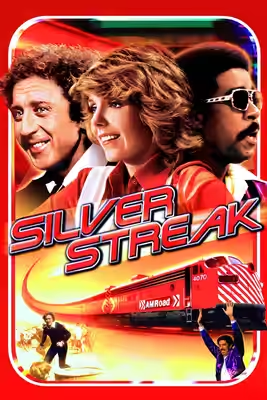
  1. Silver Streak (1976) · not reviewed yetWilder and Pryor’s first outing, with a train and a plot to hold the jokes up.

  2. Porridge (1974) · not reviewed yetRonnie Barker’s prison, where the clichés are sent up with real affection and better writing.

  3. Trading Places (1983, Fi1m 80)Another two-hander about men swapped into the wrong lives, far tighter in its construction.

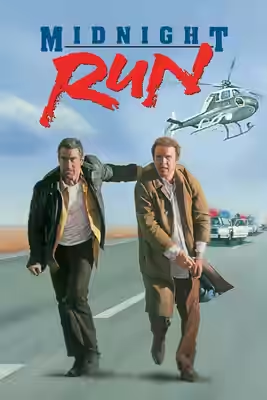
  4. Midnight Run (1988, Fi1m 88)De Niro and Grodin bicker across America; the odd-couple road comedy done properly.

  5. La Grande Vadrouille (1966) · not reviewed yetBourvil and de Funès, two mismatched Frenchmen on the run, in a comedy that never stops moving.

Free account

Know what to watch tonight

Two lists that know where things are streaming, collections you can share, your own score beside ours, and Discover that remembers what you have seen.

  • Want to see, sorted by what is streaming now
  • Seen, with your score out of ten
  • No adverts, ever