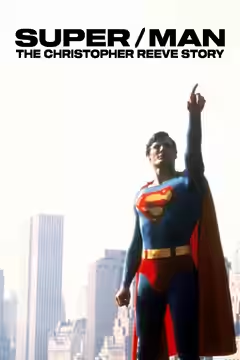
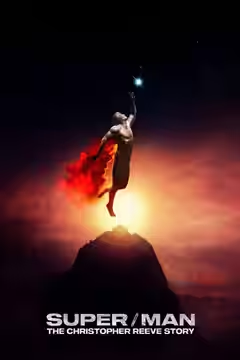
Ian Bonhôte and Peter Ettedgui make a moving family portrait that allows Christopher Reeve his flaws. The heroic framing is sometimes too insistent, but the archive and his children’s memories give the admiration substance.
Super/Man: The Christopher Reeve Story is a moving family portrait, with a tendency to press its admiration harder than necessary. Directors Ian Bonhôte and Peter Ettedgui are most persuasive when they let the people close to Christopher Reeve describe him. Those recollections make room for flaws as well as courage. The film is worth seeing, although its insistence on being inspirational occasionally gets in the way of the people speaking.
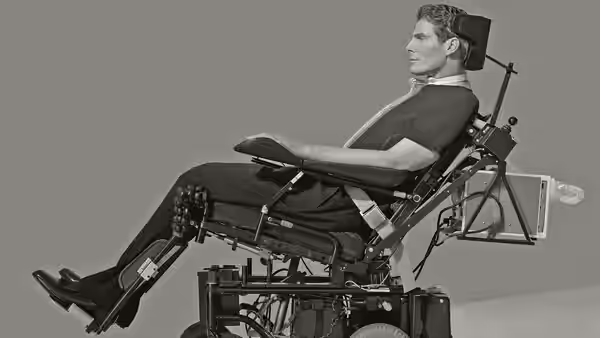
The useful decision is to connect the life before the accident with the life after it, rather than treat them as separate biographies. Otto Burnham’s nonlinear editing brings the home videos, film scenes and interviews together without turning the chronology into a puzzle. Public recognition and private relationships remain in view together. That matters because a story of recovery can too easily reduce everything that came before it to preparation for the injury.
We were moved by his son Will Reeve and his daughter Alexandra Reeve Givens remembering their father. Their affection is clear, but the documentary also allows his flaws into the account, which makes that affection more convincing. The children have a different reason for valuing him from an audience familiar with his acting, and the film gives that distinction proper attention. Their contributions keep the private relationships in view alongside the public achievements.
Will Pugh, Brett Wiley and Bryan Twz Brousseau share the cinematography credit, but the images that matter most are the home videos. Those recordings give the family testimony something concrete to work with, rather than leaving the contributors to carry the entire film in words. The new photography does its job without competing with that material. There is pleasure in seeing an archive used to establish relationships, rather than merely to confirm that its subject was once young and famous.
Ilan Eshkeri’s music is less persuasive. The film has enough feeling in its archive and interviews without needing quite so much encouragement to respond, and the score contributes to that pressure. The title has already suggested the heroic comparison; the testimony does not require it to be underlined. This is a modest complaint, but it becomes noticeable when the family material has been so effective on its own.
As a celebrity documentary, it benefits from giving substantial attention to life outside the acting career. The account of recovery and advocacy matters, but so does the attention to what other people contribute. The directors allow those people to be part of the story rather than simply witnesses to someone else’s courage. We would have welcomed more room for their recollections whenever the larger message of perseverance begins to repeat itself.
At 104 minutes, this is a reasonably compact introduction rather than an exhaustive biography. Its warmth is earned chiefly by the archive and by people with something personal to remember. Watch it for those voices, and be prepared to forgive the music for not trusting them quite enough.