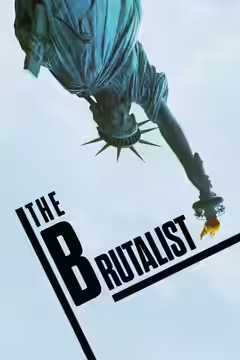
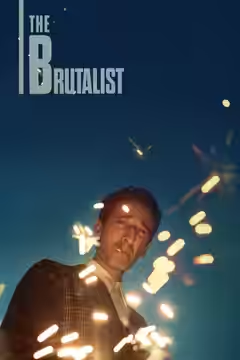
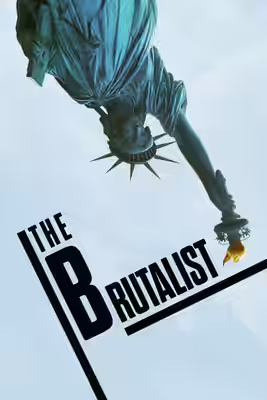
The Brutalist poster

The Brutalist

2024 · Directed by Brady Corbet
3h 35mDrama18
76
Fi1m score
84
Critics · 19
Audience · not yet

Where to watch in the UK

Checked 10 September at 22:29. Prices and availability change; the service’s page is the last word.

Plays from YouTube when you press play; nothing loads from them until then.

Synopsis

László Tóth (Adrien Brody), a Hungarian-Jewish architect who survived the camps, arrives in America in 1947 with nothing but a reputation nobody here has heard of. His wife Erzsébet (Felicity Jones) and niece Zsófia (Raffey Cassidy) are still stuck in Europe. He lodges with his cousin Attila (Alessandro Nivola), who sells furniture in Pennsylvania, and takes a job redesigning a private library for a rich man’s son, Harry Lee (Joe Alwyn). The rich man himself, Harrison Lee Van Buren Sr (Guy Pearce), is not pleased, and then is very pleased, and offers László the commission of a lifetime: a vast community building on a hill. Brady Corbet’s film runs 215 minutes, with an intermission, and covers three decades.

Fi1m review

In a sentenceFifteen minutes’ intermission, and the film that comes back is not quite the one that left

Brady Corbet’s story of an émigré architect and his American patron has a first half as sure of itself as anything we have seen in years, an Adrien Brody performance that carries it, and a second half that loses its way. Worth the evening.

Brady Corbet and Mona Fastvold have written a film about a man who builds in concrete for a man who pays in cash, and the first hundred minutes of it are as good as most critics say. László Tóth (Adrien Brody) comes up out of the hold of a ship into daylight and the camera swings so the Statue of Liberty hangs upside down over him. We knew what the shot meant before we had time to think about it, and it still got us. That is the whole film in one image, and Corbet then spends three and a half hours making sure we have understood.

Brody plays László as a man who has been humiliated so often that he has stopped registering it, and then one day registers it. He is gaunt, he limps, he has a habit of looking slightly past the person talking to him. When Harrison Lee Van Buren Sr (Guy Pearce) finds out who the tradesman in his library actually is and starts calling him a genius at dinner parties, Brody lets a small dreadful hope into the face, and we did not enjoy watching it, because we could see where it was going and he could not. Pearce is the other half of the film: loud, generous, quick to cry, and the more he gives the more frightened we were for everyone at his table.

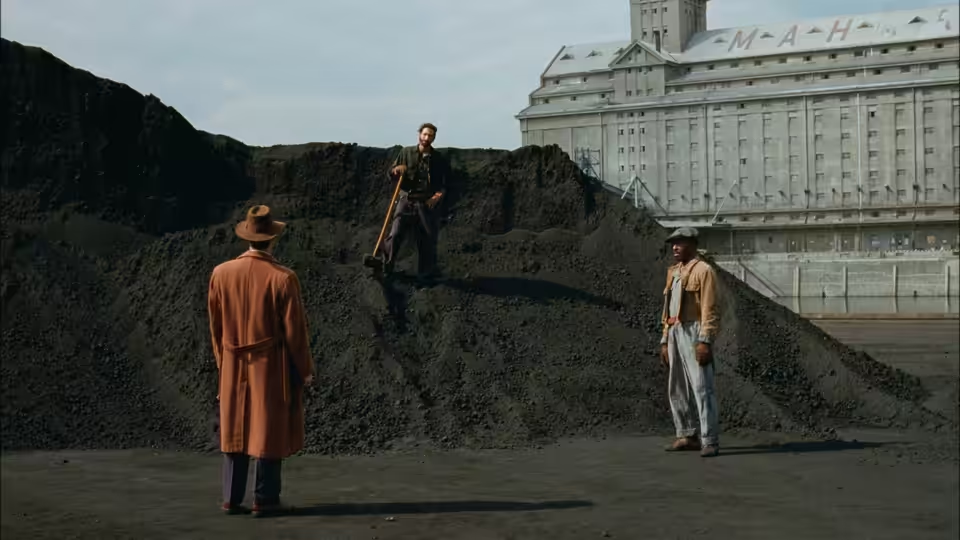
Lol Crawley shoots it grainy and wide and heavy with shadow, so it looks like a film from the era it is set in. He shoots the Pennsylvania estate in flat winter light so the Van Buren house looks like a bank. Judy Becker’s production design does the rest: the library László remakes is the moment we understood, without a line of dialogue, why anyone would hire this man. Kate Forbes’s costumes make the money visible from the back row.

Daniel Blumberg’s score is the best thing about the film that nobody at home will notice they are noticing. Brass comes in low and unresolved under the arrival, then a piano figure that sounds like somebody working something out, then a long stretch where the music gives way to the sound of drills and poured concrete. Dávid Jancsó cuts the first half briskly, with title cards for the years and a newsreel about Pennsylvania steel that we would happily have watched more of. Nothing in the first half is longer than it needs to be.

Then there is an intermission, and Erzsébet (Felicity Jones) arrives, and the film changes. Jones is good, sharp-tongued and unfooled, and her scenes with Brody at the kitchen table are the only ones where László seems to have an equal. But the story that follows is one we will not describe, except to say that it takes a turn we found ugly rather than shocking, and that Corbet stages it as if the ugliness were self-evidently an argument. It is not. We sat through the last hour angry, and not in the way the film intended: the turn is shot at a distance in near darkness, so we are asked to feel its weight without being allowed to see it, and Jancsó then cuts on as if the question were settled. The point about money and art and what patrons do to the people they buy had been made, clearly and well, before the interval. The second half makes it again in capital letters.

There is an epilogue, and we will not describe it either, except to say that it is a strange decision from a director who had, up to then, trusted his images to do the work. Ariane Labed is good in it. We still wished it had not been written.

Most critics have rated the film higher than we do, and we understand why: the first half is a real achievement, the two leads are working at full stretch, and nobody else is shooting on this scale with this much patience. Corbet made Vox Lux before this and it was a mess with a good idea in it. The Brutalist is the reverse, a beautifully made thing with an idea that runs out.

It is a film built for a big screen and an intermission, and the interval is there so you can argue. If you watch at home, do not pause. It is already long enough.

Critical consensus AI synthesised

84
Positive
16
Mixed
2
Negative
1

Most critics agree on the scale of the thing and, broadly, on its success. The praise clusters around Adrien Brody, whose performance as the Hungarian-Jewish architect is called astonishing, nuanced and devastating in review after review, with Guy Pearce singled out almost as often. The VistaVision cinematography and the score draw near-uniform admiration, and several reviews treat Brady Corbet’s ambition as a virtue in itself. The reservations, where they appear, land in the same place: the final stretch. A number of otherwise warm notices find the second half heavy and the epilogue rushed or incomplete, and a few think the film too conscious of its own importance, the Financial Times among them. The spread is narrow at the top and thin at the bottom. The single outright dissent comes from The Telegraph, whose reviewer finds it bloated and dull while still conceding the strength of Brody, Jones and Pearce.

Little White Lies
20 January 2025 · 4/5/5 · Hannah Strong
100

The critic calls it gorgeous capital-C Cinema and a staggering achievement, praising its breathtaking VistaVision visuals, score, and Brody’s phenomenal lead performance as a Jewish architect navigating post-war America.

Read the full review →
Radio Times
13 January 2025 · ★★★★★ · Emma Simmonds
100

The critic deems it an Oscar-worthy epic in length, weight and ambition that speaks volumes about America’s uneasy relationship with immigrants, praising its rich history, VistaVision aesthetic, intermission, and Brody and Pearce’s performances.

Read the full review →
The Times
23 January 2025 · ★★★★★ · Kevin Maher
100

The critic calls it a majestic historical epic and the film to beat for the Oscars. It praises the savage performances, especially Brody and Pearce, and the extraordinary VistaVision cinematography.

Read the full review →
Time Out
3 September 2024 · ★★★★★ · Phil de Semlyen
100

The critic hails it as a major work of art and mighty, discordant anthem to modern America, commending its monumental parable on the American dream, creation, money, and love story, plus its technical craft and Brody’s Oscar-worthy turn.

Read the full review →
Empire
20 January 2025 · Jamie Graham
90*

The critic hails the film's epic, self-consciously important scope as a myth-making saga that propels forward despite its length and weighty themes. They single out the awe-inspiring visuals, Brody and Pearce's performances, and the director's ambition for particular praise.

Read the full review →
The Guardian
26 January 2025 · Wendy Ide
90*

The critic hails the film as a remarkable, audacious achievement that moves Corbet into the ranks of cinema's heavy hitters. It singles out the rich, involving storytelling and exemplary craft, especially the cinematography and score.

Read the full review →

Cast

Adrien Brody
László Tóth
Felicity Jones
Erzsébet Tóth
Guy Pearce
Harrison Lee Van Buren Sr
Joe Alwyn
Harry Lee
Stacy Martin
Maggie Lee

Stills

Awards

Academy Awards, 2025

Nominated
Best Picture

Amanda Award for Best Foreign Feature Film, 2025

Won
Amanda Award for Best Foreign Feature Film

FIPRESCI Grand Prix, 2025

Nominated
FIPRESCI Grand Prix

Golden Globes, 2025

Won
Best Motion Picture – Drama

If you liked this, try…

There Will Be Blood poster

There Will Be Blood

2007 · Another American money-and-monomania story, with an oil derrick where the concrete would be.

The Fountainhead poster

The Fountainhead

1949 · Vidor’s architect film, absurd and sincere, and the ancestor Corbet is plainly answering.

Sunshine poster

Sunshine

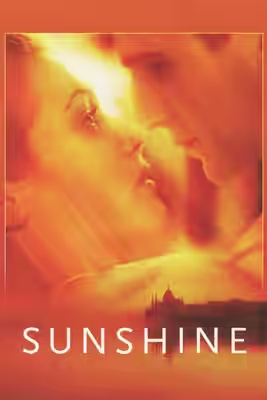
1999 · Three generations of a Hungarian-Jewish family, with Ralph Fiennes playing all of them.

Columbus poster

Columbus

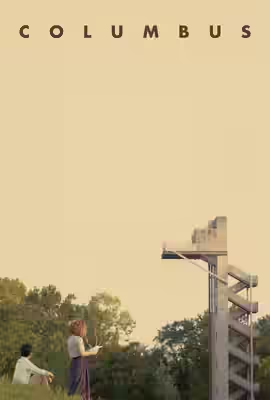
2017 · A quiet film about modernist buildings and the people who stand in front of them.

The Immigrant poster

The Immigrant

2013 · Marion Cotillard arrives at Ellis Island and is promptly bought; two hours, no intermission.