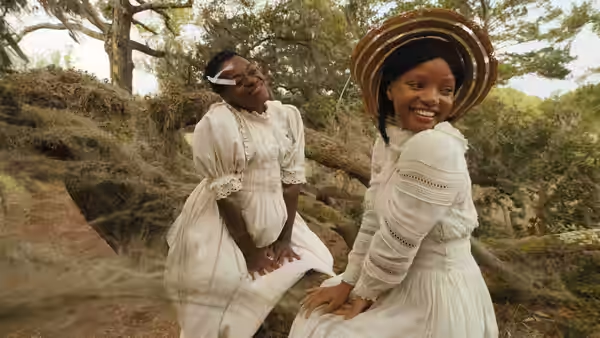
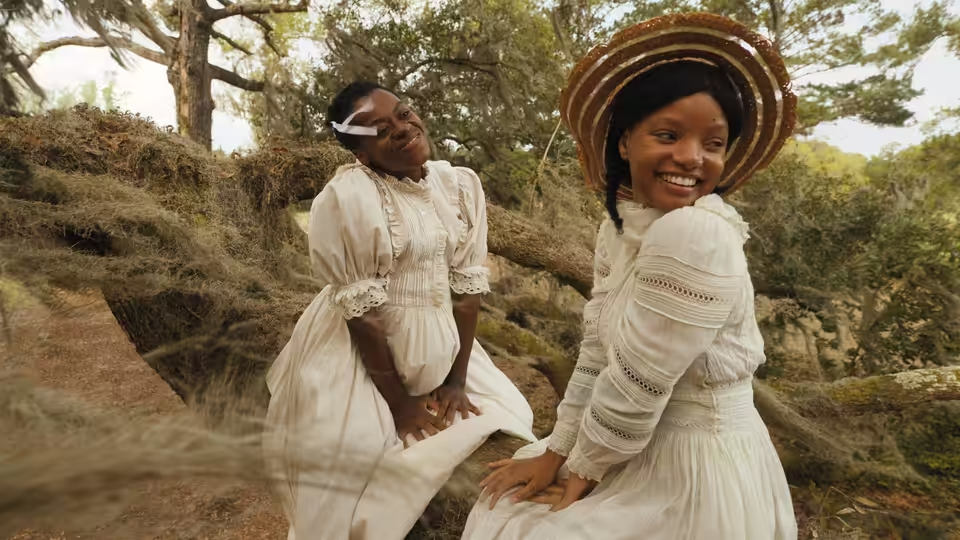
Two young women in white dresses smile together among trees and rocks
Film review

The Color Purple

2023 · Directed by Blitz the Ambassador · 2h 21m

In a sentenceWonderful singers, though we occasionally wanted the music to stop so the women could finish talking

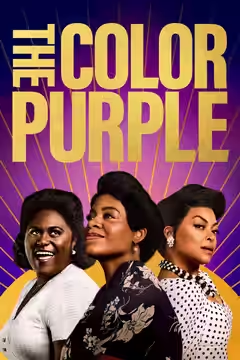
Celie (Fantasia Barrino) struggles to claim a life of her own after years of abuse. Her story begins with Young Celie (Phylicia Pearl Mpasi) and Young Nettie (Halle Bailey), before following her into adulthood. Mister (Colman Domingo), Sofia (Danielle Brooks) and Shug Avery (Taraji P. Henson) are part of the world she must navigate. Celie’s search for a voice unfolds through songs that make her private feelings audible, while the women around her suggest possibilities beyond suffering. The drama moves between everyday life and imagined escapes, drawing on Alice Walker’s novel.

Plays from YouTube when you press play; nothing loads from them until then.

Fi1m review

Fantasia Barrino and Danielle Brooks give this uneven musical its feeling and force. Their performances are worth the evening, though the hurried storytelling and determination to cheer us up sometimes leave Celie’s suffering too neatly tidied away.

The Color Purple is worth seeing for the women who sing it, with a substantial caveat about the way their story is told. Director Blitz the Ambassador sets pleasure alongside an account of abuse, trusting music to give Celie more freedom than her circumstances allow. The songs let her express feelings that the dialogue leaves unspoken, and the cast makes that freedom count. The difficulty comes when celebration arrives before we have had time to take in the hurt.

Fantasia Barrino gives Celie’s songs the urgency that Marcus Gardley’s screenplay sometimes lacks. Her singing has force, but she does not make Celie’s ability to express herself seem easy or automatic. We were moved by that effort: the songs sound like things she needs to say and has struggled to say aloud. The musical form earns its place whenever she is allowed to carry a number without the surrounding spectacle insisting on equal attention.

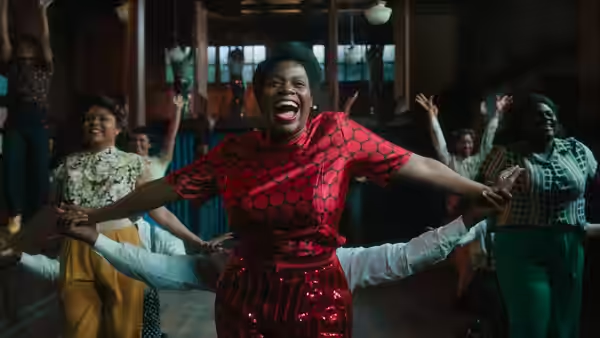
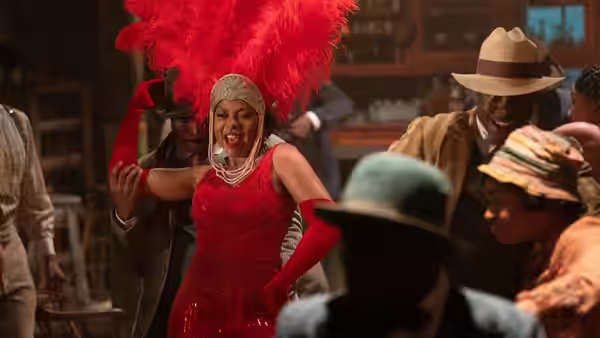
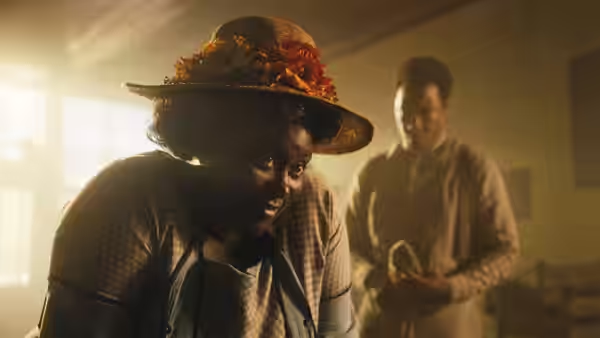
Danielle Brooks is just as important as Sofia, bringing an energy that makes the surrounding drama feel less dutiful. There is humour in her forcefulness, and a sense that maintaining it takes work. She never settles for being the lively supporting character who arrives to improve everyone else’s afternoon. Taraji P. Henson gives Shug Avery a different assurance, and the scenes between Shug and Celie have an intimacy the larger numbers sometimes struggle to find.

Dan Laustsen’s cinematography is most persuasive when Celie’s imagination is allowed to change how the film looks. A fantasy styled as silent cinema gives that polish a reason, letting private desire occupy the whole screen. Paul Denham Austerberry’s production design helps the musical passages feel removed from everyday life, but its attractive finish also makes the crueller drama seem too comfortably staged. The larger numbers can leave us attending to the arrangements around Celie when we ought to be attending to her.

Marcus Gardley’s screenplay has a great deal to carry, and its compression is felt most sharply between the musical numbers. Celie’s suffering receives attention that her relationship with Shug does not, leaving an important connection less fully developed than the performances suggest it could be. Jon Poll’s editing keeps the years moving briskly, but the quick changes of mood can make emotional progress seem too easy. We needed a few more unhurried scenes with these women, and fewer occasions on which the film seemed anxious to reassure us.

Kris Bowers’s music contributes to the emotional swell, though the film can be too eager to tell us when to feel uplifted. The voices are often sufficient; the extra insistence makes us conscious of being encouraged. Musical drama can accommodate terrible things without abandoning pleasure, and Blitz the Ambassador is right to attempt both. The problem is the speed at which one mood replaces the other, especially when the singing has persuaded us to take Celie’s feelings seriously.

At 141 minutes, this hardly needs to be longer; it needs to spend more of its time on the relationships its cast makes compelling. The performances kept drawing us back whenever the storytelling hurried ahead. For those who enjoy a musical carried by strong voices and forceful personalities, there is plenty here to reward the evening. Go for the women, with some patience for the film’s determination to cheer us up.

Critical consensus AI synthesised

68
Positive
12
Mixed
11
Negative
2

The reviews lean positive, though enthusiasm is far from uniform. Praise centres on the cast, particularly Danielle Brooks’s spirited Sofia and Fantasia Barrino’s emotionally direct Celie; even several sceptical critics admire the performances. Supporters find the musical adaptation moving and hopeful, with songs that give Celie a stronger voice. Deadline particularly praises the use of magical realism to reveal her inner world, while other favourable reviews respond to the ensemble’s energy and the musical staging.

The main divide concerns how well that exuberance serves the story’s harsher material. Several critics find that the polish and uplift soften its brutality, while others point to abrupt tonal shifts, an overstuffed narrative and an underdeveloped Celie–Shug romance. The spread runs from strong enthusiasm to outright disappointment: /Film argues that the musical and dramatic elements fail to gel, although Brooks earns praise there too.

The New Yorker
27 December 2023 · Richard Brody
90*

Brody praises the film’s tone and its lyrical, imaginative direction. He especially singles out Danielle Brooks and Fantasia Barrino, whose performances give the story its emotional force.

Read the full review →
Los Angeles Times
22 December 2023 · Katie Walsh
85*

Walsh finds this adaptation emotionally powerful and an essential American story brought to its best onscreen expression. She especially praises Danielle Brooks, whose spirited Sofia electrifies the film.

Read the full review →
Variety
19 December 2023 · Critics Pick · Peter Debruge
85*

Debruge finds this adaptation a rousing, spiritually uplifting expansion of the earlier film and musical. He especially praises Fantasia Barrino’s soul-felt performance and the way the songs give Celie a stronger voice.

Read the full review →
The Hollywood Reporter
19 December 2023 · David Rooney
80*

Rooney finds the musical remake joyful and emotionally satisfying, despite some oversized musical numbers and stylistic detours. He particularly praises Fantasia Barrino’s affecting performance and the strength of the ensemble.

Read the full review →
IndieWire
19 December 2023 · B · Kate Erbland
77

The review finds the musical moving and often miraculous, despite tonal shifts and an overstuffed story. It especially praises Danielle Brooks’ standout performance as Sofia and the cast’s commitment.

Read the full review →
Empire
22 January 2024 · Ian Freer
75*

Freer finds the adaptation exuberant, beautifully crafted, and ultimately moving, despite its sanitised treatment of the story. He singles out Barrino’s performance and the bravura musical sequences for praise.

Read the full review →

Straight answers AI written, from our review

Is The Color Purple worth watching?
The Color Purple is worth watching for its singers, especially Fantasia Barrino and Danielle Brooks, and we score it 73 out of 100. We recommend it to those who enjoy musicals carried by forceful performances, with a substantial caveat: the hurried storytelling sometimes pushes towards celebration before Celie’s suffering has had time to register.
How long is The Color Purple, and what is it rated?
The Color Purple runs 2h 21m. It is a drama film.
Where can I watch The Color Purple in Romania?
The Color Purple is available to rent from Amazon Prime Video from lei 9.99. Availability is checked daily; the links above go straight to each service.
How violent or frightening is The Color Purple, and is it suitable for children?
The Color Purple has a UK 12A certificate and deals with years of abuse, so we would not treat its musical form as a promise of light family viewing. Celie’s suffering makes this potentially upsetting material for younger children; the certificate permits under-12s with an accompanying adult, but the subject calls for careful judgement.
How does The Color Purple compare to Carmen Jones?
The Color Purple is our preference for expressive singing, while Carmen Jones offers a compelling central performance from Dorothy Dandridge despite dubbed vocals that weaken the romance. Both connect songs with women’s desire and difficult circumstances; we recommend the former for Barrino and Brooks, though its hurried storytelling requires patience, just as the latter’s awkwardness does.
Is The Color Purple based on a true story or a book?
The Color Purple draws on Alice Walker’s novel rather than being presented as a true-story account. No knowledge of the book is needed to follow Celie’s search for a life and voice of her own, though we find the film’s compressed storytelling leaves important relationships, particularly her connection with Shug, less developed than they need to be.
What should I watch after The Color Purple?
After The Color Purple, try Carmen Jones (1954, Fi1m 65): A forceful female lead and songs that refuse to separate desire from danger. Then The Umbrellas of Cherbourg (1964, Fi1m 88): Bright colours and continuous song give romantic disappointment room to hurt; and The Piano (1993, Fi1m 88): Music carries a woman’s desires through a period drama less inclined to reassure.

Cast

If you liked this, try…

  1. Carmen Jones (1954, Fi1m 65)A forceful female lead and songs that refuse to separate desire from danger.

  2. Daughters of the Dust (1991) · not reviewed yetBlack women’s lives and family history told with patience and visual imagination.

  3. The Umbrellas of Cherbourg (1964, Fi1m 88)Bright colours and continuous song give romantic disappointment room to hurt.

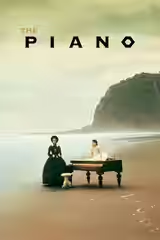
  4. The Piano (1993, Fi1m 88)Music carries a woman’s desires through a period drama less inclined to reassure.

  5. Dreamgirls (2006, Fi1m 68)Another musical carried by commanding voices, with female ambition under constant pressure.