Film review

The Color Purple

1985 · Directed by Steven Spielberg · 2h 34m · MPA PG-13

In a sentenceA film about a woman who cannot see the flowers, shot by a man who cannot see anything else

DramaHistory

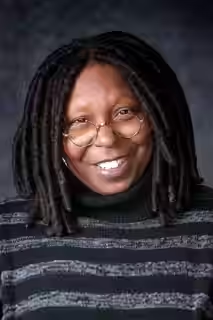
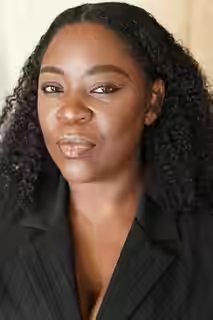
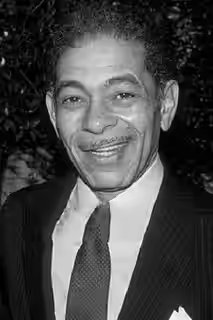
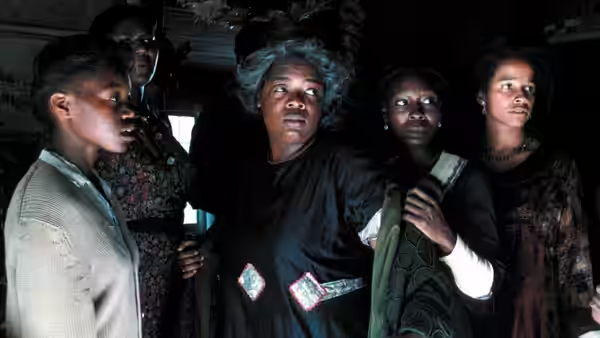
Rural Georgia, 1909. Celie (Desreta Jackson) is fourteen, pregnant for the second time by the man she calls Pa (Leonard Jackson), and both babies are taken from her the day they are born. Pa marries her off to Albert (Danny Glover), a widower with a farm, a houseful of children and a temper, who had wanted her prettier sister Nettie (Akosua Busia) instead. Celie cooks, cleans and is beaten. When Nettie comes to stay and fights Albert off, he drives her from the property, and the sisters promise to write to each other every day. The grown Celie (Whoopi Goldberg) waits by the letterbox for years. Above the mantel hangs a photograph of Shug Avery (Margaret Avery), the singer Albert loves, and Celie cannot stop looking at it.

Plays from YouTube when you press play; nothing loads from them until then.

Fi1m review

Spielberg’s first film without spaceships or whips is handsomely built and, in Whoopi Goldberg and Oprah Winfrey, superbly acted. It is also soft where the book is hard, and it keeps cutting to slapstick whenever the pain gets close. Worth an evening, with reservations.

Alice Walker’s novel is told in letters, most of them addressed to God by a girl nobody else will listen to, and it is blunt about incest, rape, beatings and the love between two women that finally lets one of them stand up. Steven Spielberg, in 1985 the most successful maker of adventure films alive, took it on as his first grown-up drama. What he made is 154 minutes of care, golden light and real feeling, and we came out of it convinced he had understood about two thirds of the book he was adapting.

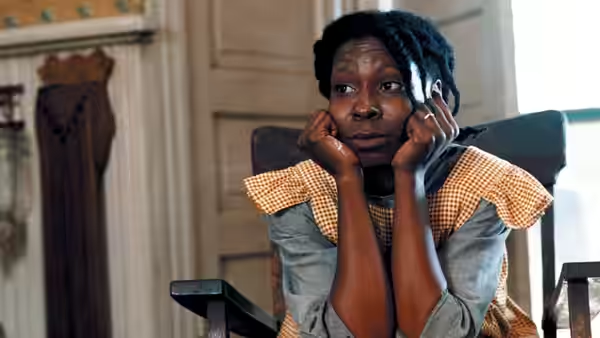
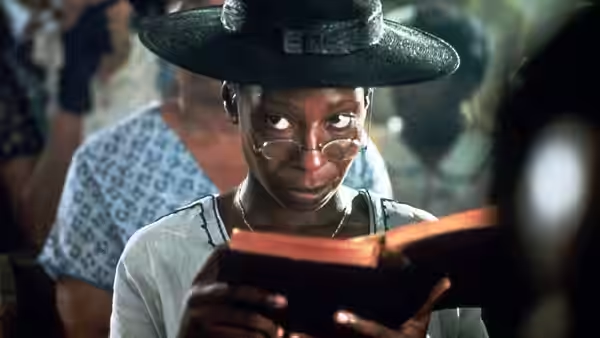
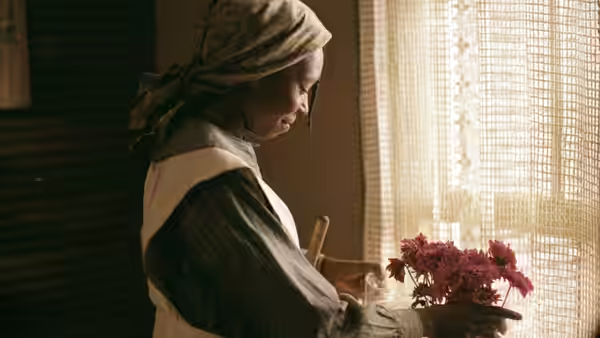
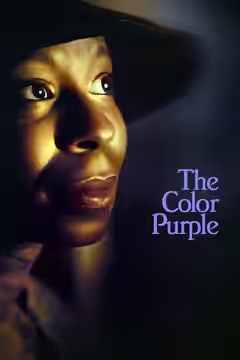
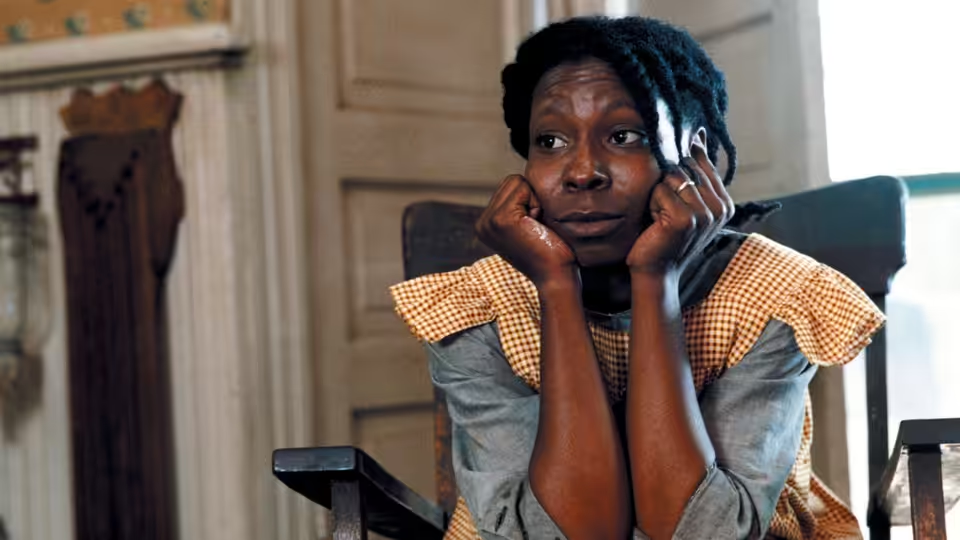
The third he understood is Celie. Whoopi Goldberg, in her first film role, plays her for most of the running time with her shoulders folded in and her hand across her mouth, a woman who has been told she is ugly so often that she hides her own smile. She barely speaks in the first hour. Her face does the talking, and Spielberg, to his credit, lets it. When Celie starts to answer back, late on and in ways we will not describe, the effect is of a house that has had its windows painted shut for thirty years being opened all at once.

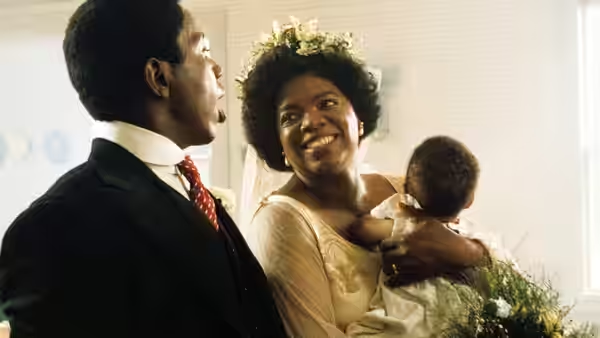
Oprah Winfrey is the other reason to watch. Her Sofia arrives to marry Harpo (Willard E. Pugh), Albert’s son, and she walks into that yard like she owns it and everyone in it. Winfrey plays her big, loud and completely without fear, and the film is at its sharpest when it lets us see what the world does to a Black woman who refuses to lower her eyes. Danny Glover’s Albert is a brute, but Glover gives him a lazy vanity and a fear of his own father (Adolph Caesar, wonderfully mean) that make him a man rather than a monster. Margaret Avery’s Shug is warm and sly and a little tired, and when she sings a song to Celie in Harpo’s juke joint, everyone present and the film itself go still.

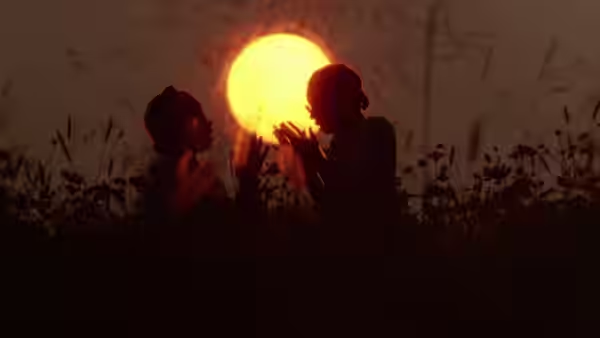
That moment got to us. So did an early one: Nettie hauled to the gate by Albert while Celie runs after her, the two girls’ hands pressed together through the slats before they are pulled apart. Allen Daviau shoots the farm in late-afternoon light so thick you could spread it on bread, and here it earns its keep, because the beauty makes the cruelty worse. J. Michael Riva’s house is a real place, unpainted wood, a porch that sags, a kitchen full of the labour of one exhausted woman. Aggie Guerard Rodgers dresses Celie in shapeless grey and Shug in red satin and feathers, and the film’s whole argument about who is allowed to be looked at is in those two wardrobes.

The trouble is what Spielberg does when the material frightens him. Every time the story goes somewhere dark he reaches for a gag: Harpo falls through a roof, and then falls through it again. Michael Kahn cuts these bits fast and bright, as if for a different film, and each one lets the air out of the scene before it. Quincy Jones’s score is worse. It swells under everything, strings and choir and harmonica, telling us to weep at moments when Goldberg’s face had already made the case. There is a stretch set in Africa, following Nettie, that is shot like a travelogue and lands like one. And Menno Meyjes’s screenplay reduces what happens between Celie and Shug to a single kiss and a lot of meaningful glances, which is not what Walker wrote and not enough to explain the change in Celie that the last act depends on.

We were moved, often, and we were also aware of being worked on, and by the second hour the two feelings were fighting. Most critics have come down on one side or the other; the reviews split almost evenly between people who find it dignified and people who find it saccharine. It is both. The acting is honest and the direction keeps apologising for the story.

It was released in British cinemas on 11 July 1986 with a 15 certificate. See it for Goldberg, for Winfrey, and for the light on the fields. Then read the book, which is shorter, harder and does not have a harmonica in it.
Critical consensus AI synthesised

58
Positive
5
Mixed
2
Negative
4

The reviews split almost down the middle. What nearly everyone agrees on is the cast. Whoopi Goldberg’s Celie is singled out repeatedly, with Oprah Winfrey, Margaret Avery and Danny Glover close behind, and even the harshest notices allow that the performances carry the film. The warmer critics see a dignified, emotionally generous attempt to bring a radical book to a mainstream audience, and The Hollywood Reporter goes further, ranking it among the loveliest parables it has seen on screen.

The reservations cluster around what Spielberg does to Alice Walker’s novel. Most critics note that the lesbian relationship and the feminism are toned down, and that hard material about abuse and racism is offset with broad comedy and a swelling score. The Independent and Slant find this fatal; Variety and The New York Times find it a flaw in an otherwise stirring film. The spread is wide, from warm praise to real anger.

The Hollywood Reporter
17 December 1985 · Arthur Knight
90*

The critic praises the film's tenderness and love, Spielberg's convincing direction, and the cast's performances, calling it a lyric ode to the goodness in mankind and one of the loveliest parables ever created for the screen.

Read the full review →
Radio Times
★★★★ · Sue Heal
80

It was once fashionable to criticise Spielberg for a glossy, sugar-coated take on Walker's hard-hitting novel, but this is an impressive, dignified attempt to adapt a radical book into mainstream entertainment with a message. Whoopi Goldberg is wonderful in the lead, with strong support from Danny Glover, Margaret Avery and a pre-fame Oprah Winfrey.

Read the full review →
The Telegraph
3 September 2013 · Tim Robey
80*

The 1985 film is a sober and impassioned prestige literary adaptation with emotional generosity to spare. It stands out for its strongest gallery of female characters in any Spielberg work.

Read the full review →
Time Out
10 January 2012 · SJo
75*

Spielberg's adaptation of Alice Walker's novel could be seen as a glossy, Oscar-baiting effort that softens the book's radical elements and employs flashy, emotional style, but it succeeds as a powerful, honourable attempt to bring an unusual story to mainstream audiences, thanks especially to a superb cast led by Whoopi Goldberg.

Read the full review →
The New York Times
18 December 1985 · Janet Maslin
70*

Spielberg has fashioned a grand, multi-hanky entertainment that is as pretty and lavish as the book is plain, combining rapturous and stirring parts with hugely improbable ones. The film lacks the realism and grit of the novel but manages momentum, warmth and staying power through its upbeat, affirmative fable style.

Read the full review →
Variety
18 December 1985 · James Greenberg
50*

There are some great scenes and great performances but it is not a great film, marred by overblown production that threatens to drown in its own emotions. The characters from the novel remain vivid enough to carry the film despite the script's clutter and the director's smoothing out of rough edges into a fairy-tale fantasy.

Read the full review →

Cast

Awards

Academy Awards, 1986

Nominated
Best Actress
Nominated
Best Cinematography
Nominated
Best Costume Design
Nominated
Best Makeup and Hairstyling
Nominated
Best Original Score
Nominated
Best Original Song
Nominated
Best Picture
Nominated
Best Production Design
Nominated
Best Supporting Actress
Nominated
Best Writing, Adapted Screenplay

If you liked this, try…

Beloved poster

Beloved

1998 · Winfrey again, in a Toni Morrison adaptation that refuses to soften anything

Daughters of the Dust poster

Daughters of the Dust

1991 · Gullah women on a Georgia island, told in images rather than letters

Sounder poster83

Sounder

1972 · A Black sharecropping family in the Depression, plain and patient and quietly devastating

Eve's Bayou poster

Eve's Bayou

1997 · Louisiana, the 1960s, a family’s secrets seen through a ten-year-old’s eyes

Empire of the Sun poster81

Empire of the Sun

1987 · Spielberg’s next serious film, and the one where the sentiment is earned