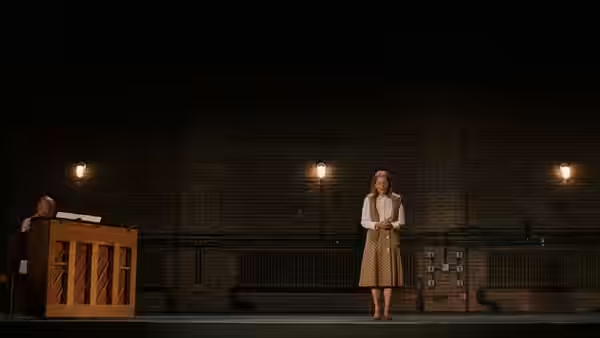
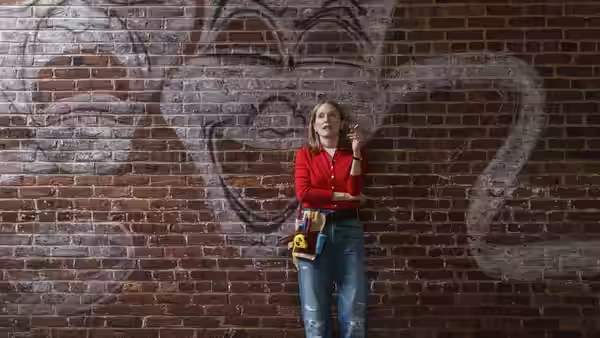
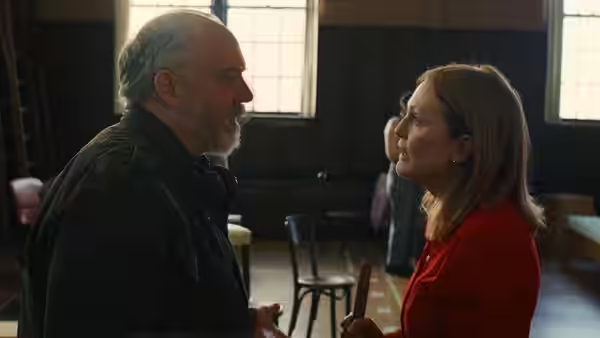
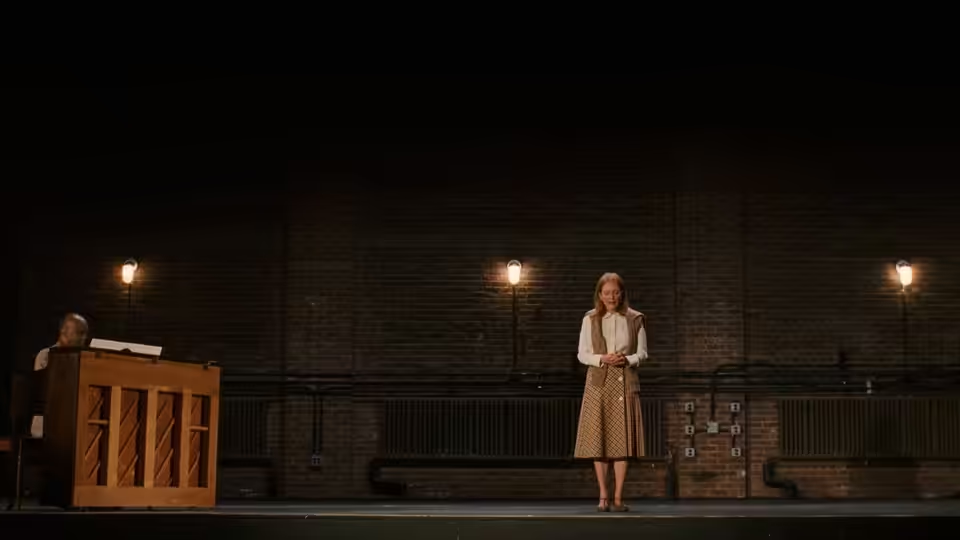
Mona (Julianne Moore) stands onstage near man at wooden podium
Film review

The Debut

2026 · Directed by Jesse Eisenberg · 1h 45m

In a sentenceJulianne Moore joins the am-dram, and the am-dram, quite reasonably, starts to look frightened

Mona (Julianne Moore) is a housewife whose children have grown and left, and whose days have gone quiet with them. On an impulse she does not fully explain to herself, she auditions for a musical being staged by her local community theatre. The production is run by Jerry (Paul Giamatti), a director who takes amateur theatre as seriously as anyone has ever taken anything, and who expects the same of his cast. Mona gets into the company and begins to rehearse, and the part starts to matter to her more than she expected. The players and people around her include Stef (Halle Bailey), Todd (Jesse Eisenberg), Marty (K. Todd Freeman) and Serena Cherry (Bernadette Peters). What begins as a nervous woman learning her lines becomes something odder as rehearsals go on.

Plays from YouTube when you press play; nothing loads from them until then.

Fi1m review

Jesse Eisenberg’s comedy about a housewife who disappears into a community theatre musical is often funny and never quite sure what it is arguing. Julianne Moore is the reason to go, and she is reason enough.

Mona has an empty house and nothing pressing to do in it, so she auditions for a musical at her local community theatre. The director, Jerry, treats the production as if the fate of the art form depended on it. That is the whole set-up of The Debut, which Jesse Eisenberg wrote and directed, and it is by some distance his strangest film. It starts as a comedy about amateur theatre and becomes a film about what happens when a person gets lost inside a part. We liked it a good deal. We are less sure it knows what it thinks.

Julianne Moore plays Mona, and the film lives or dies on her, so it is fortunate that she is as good here as we have seen her. She plays the timidity first, and plays it without asking for our sympathy: Mona is a woman who has spent years being easy to overlook and has come to expect it. Then the part takes hold and Moore lets it take hold completely, and the transformation is both ridiculous and, somewhere underneath, upsetting. We laughed at her more than we expected to. Then, in a scene we will not describe, we found we had stopped laughing and were simply watching her face, and were not entirely comfortable with how we had got there.

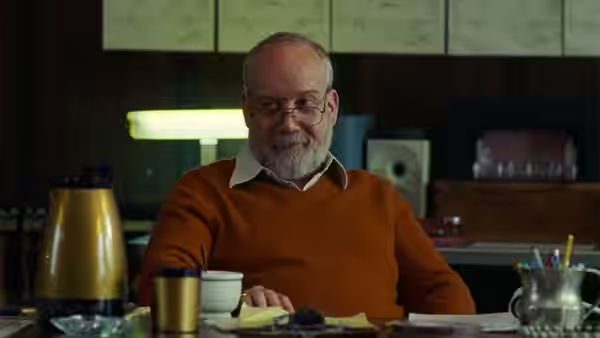
Paul Giamatti’s Jerry is the other engine. He is the sort of director who exists in every amateur society in the world, the man who has read about the Method and believes it is his to dispense, and Giamatti plays him without a wink. The confrontations between Jerry and Mona are the funniest stretches of the film, partly because neither of them is joking. Around them Eisenberg has assembled a company that includes Halle Bailey, K. Todd Freeman, Colton Ryan, Bonnie Milligan and Bernadette Peters, and he gives himself a part as Todd. Eisenberg and Emile Mosseri are credited with the music, and the musical the company is rehearsing is the film’s own invention, which spares it from being a joke at any real show’s expense.

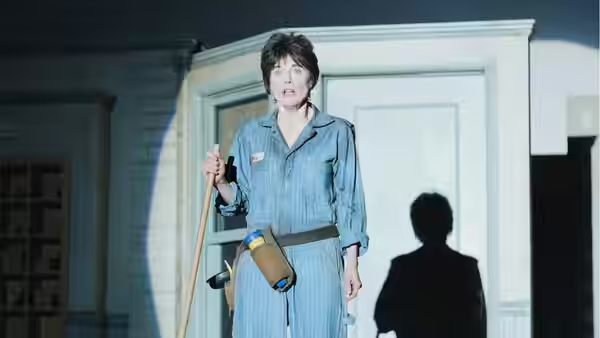
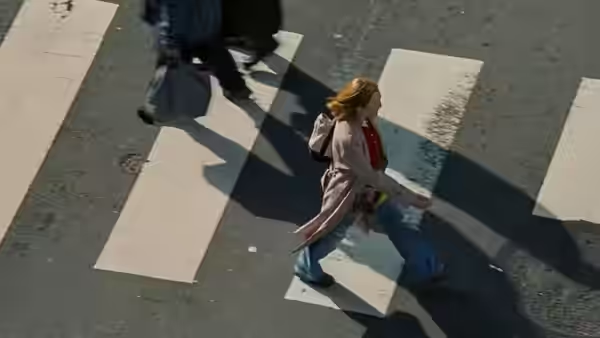
The film’s most interesting decision is that it changes shape as Mona does. Drew Daniels’s camera and Robert Nassau’s cutting stay plain and unfussy while she is a nervous newcomer, and then, as the part swallows her, the film gets odder, less tethered, more willing to go somewhere surreal and stay there. It is a bold move for a comedy that could have coasted on its cast, and it is the thing that separates The Debut from the dozen other films about a small production going wrong.

It is also where the film loses its footing. Eisenberg has two ideas about Mona. One is that acting has set her free. The other is that it has eaten her. Both are good ideas, and the film wants credit for both without choosing between them, so when it reaches for a statement about what art does to the people who take it seriously, the statement comes out muffled. The stranger passages are executed with confidence and we admired them, but by the last stretch we were not sure whether we were meant to be worried for Mona or cheering her on, and we do not think Eisenberg was sure either.

The obvious comparison is Waiting for Guffman, and Eisenberg has plainly seen it. He is kinder than that film was. Nobody here is a fool for wanting to be in a show; the joke is never that these people are amateurs, only that they are human, and the film’s warmth towards the whole scrappy enterprise is real. Anyone who has ever stood in a draughty hall waiting for their cue will recognise every person in it.

It is 105 minutes and a 15 certificate, mostly for language. Most critics have been warmer than we are, and we understand why, because Moore is doing something you do not see often. We would send you for her, and for Giamatti, and for the pleasure of a comedy that takes a risk in its second half even if it does not quite land it. If you have ever directed an amateur production yourself, you may want a seat near the exit.

Critical consensus AI synthesised

85
Positive
13
Mixed
1
Negative
0

The reviews are close to unanimous. Almost every critic calls The Debut funny, several of them exceptionally so, and nearly all of them give the same reason: Julianne Moore. Her performance as Mona, the timid housewife who auditions for a community musical, is described across the board as transformative, and more than one review credits her with holding the whole film together. Paul Giamatti’s overbearing director draws consistent praise too, particularly in his confrontations with Moore. Jesse Eisenberg, directing his third film, is credited with wit and with a stranger, more surreal streak than most critics expected.

The reservations are few and mild. The Guardian finds the comedy inconsistent as it drifts into the absurd, and The Hollywood Reporter thinks the film never settles what it wants to say about artistic perfection. Nobody dislikes it. The spread runs from good to exceptional, and even the one mixed notice singles out Moore as the reason to watch.

Time Out
18 September 2026 · ★★★★★ · Barry Levitt
100

The critic praises the film as wildly entertaining and exceptionally funny, with Eisenberg at his most accomplished as director. Julianne Moore's performance as the overlooked housewife Mona is singled out as utterly dazzling and the emotional core.

Read the full review →
RogerEbert.com
17 September 2026 · festival review
91*

The critic calls it one of the best films of 2026 so far and one of the funniest, noting it asks unexpected questions about getting lost in a character. They single out Julianne Moore’s best work of her career in the role.

Read the full review →
The New York Times
18 September 2026 · festival review · Manohla Dargis
90*

The critic describes it as one of the most pleasurable films seen at Toronto, praising how Eisenberg and the performers coax laughs from the characters and community theater without cruelty or condescension. They single out Julianne Moore’s glorious, wide-ranging expressivity in the role.

Read the full review →
Vulture
5 September 2026 · festival review
90*

The critic hails Julianne Moore’s performance as an all-timer and explosive, turning the film into a fire-breathing encomium to the reality-altering power of acting. They single out Moore’s transcendent, hilarious transformations and the film’s playful, deceptively strange style as it breaks down and rebuilds alongside the character.

Read the full review →
Variety
6 September 2026 · festival review · Owen Gleiberman
84*

The critic calls it a funny and dizzying mind-bender like 'Waiting for Guffman' made by the Coen brothers at their most unhinged, a twisted love letter to community theater. They single out Julianne Moore’s astonishing, transformative performance as the standout element that holds the film together.

Read the full review →
IndieWire
6 September 2026 · festival review · Cortlyn Kelly
81*

The review highlights Julianne Moore’s shining performance in Jesse Eisenberg’s story of midlife reinvention through community theater, celebrating the small spaces that birth future stars and Paul Giamatti as the overbearing director. It praises Moore’s turn in a film that feels like a love letter to the scrappy ethos of local productions.

Read the full review →

Straight answers AI written, from our review

Is The Debut worth watching?
The Debut is worth watching for Julianne Moore, who is as good here as we have seen her, and we scored it 78. Jesse Eisenberg's comedy about a housewife swallowed by a community theatre musical is often funny and takes a real risk in its second half, though it never quite decides what it is arguing. Anyone who has stood in a draughty hall waiting for a cue will recognise every person in it.
How long is The Debut, and what is it rated?
The Debut runs 1h 45m. It is a music and comedy film.
Where can I watch The Debut in Bulgaria?
The Debut is not on any streaming or rental service in Bulgaria at the moment. Availability is checked daily.
How violent or frightening is The Debut, and is it suitable for children?
The Debut is a 15 certificate in the UK and rated R in the US, mostly for language, and it is not a film for children. There is no violence to speak of; what unsettles is Mona's transformation, which starts as comedy and turns odd and uncomfortable as the part takes hold of her. Older teenagers who can take strong language and a strange second half should be fine.
How does The Debut compare to Topsy-Turvy?
The Debut and Topsy-Turvy are both films about rehearsal, but Mike Leigh's is the more patient and the more finished of the two. Topsy-Turvy treats the preparation of The Mikado as the whole of life and is absorbing and unexpectedly moving; The Debut is funnier, stranger and less sure of its point. Choose Leigh for depth and Eisenberg for Julianne Moore and a shorter, riskier evening.
What should I watch after The Debut?
After The Debut, try Topsy-Turvy (1999, Fi1m 88): Mike Leigh on Gilbert and Sullivan: rehearsals as the whole of life, patiently. Then Drive My Car (2021, Fi1m 88): A Chekhov production in Hiroshima; the quiet Japanese cousin of losing yourself in a part; and A Real Pain (2024, Fi1m 76): Eisenberg’s previous film, smaller and sadder, with Kieran Culkin doing the damage.

Cast

If you liked this, try…

  1. Waiting for Guffman (1996) · not on Fi1m yetThe amateur-theatre comedy Eisenberg is answering; sharper edges, less mercy.

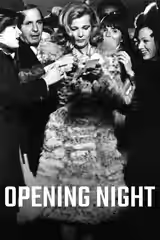
  2. Opening Night (1977) · not on Fi1m yetGena Rowlands comes apart inside a role; Cassavetes watches and does not flinch.

  3. Topsy-Turvy (1999, Fi1m 88)Mike Leigh on Gilbert and Sullivan: rehearsals as the whole of life, patiently.

  4. Drive My Car (2021, Fi1m 88)A Chekhov production in Hiroshima; the quiet Japanese cousin of losing yourself in a part.

  5. A Real Pain (2024, Fi1m 76)Eisenberg’s previous film, smaller and sadder, with Kieran Culkin doing the damage.

The Debut (2026) review: Moore carries a strange, funny film (Bulgaria) | Fi1m