Anne Hathaway and Nicholas Galitzine make this uneven romance worth the evening. Their attraction is convincing, though a thinly written pop star and some laboured obstacles leave the actors doing more than their share.
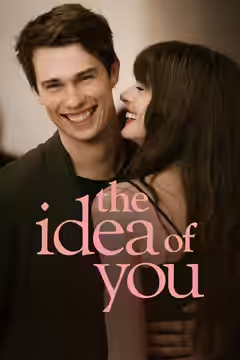
Michael Showalter’s The Idea of You is an enjoyable romance whose leads keep rescuing it from some thin writing. It wants to take a woman’s desire seriously while giving us the pleasures of an improbable courtship, and those aims sit comfortably together. Anne Hathaway and Nicholas Galitzine make the attraction convincing enough that we stop questioning the premise. The difficulties introduced to keep them apart need more work, particularly when celebrity becomes the explanation for everything.
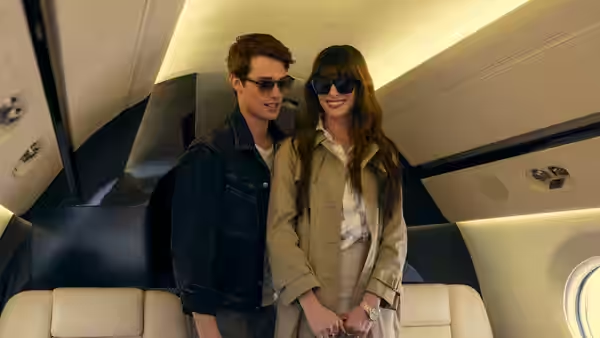
Anne Hathaway gives Solène the emotional life that the film needs. We were moved by the embarrassment she allows into Solène’s pleasure: being wanted is welcome, but accepting it does not come easily. There is humour in that uncertainty, too, and the performance makes her hesitation understandable without letting it become her only characteristic. The script gives her a familiar romantic dilemma; she makes us care about the person having it.
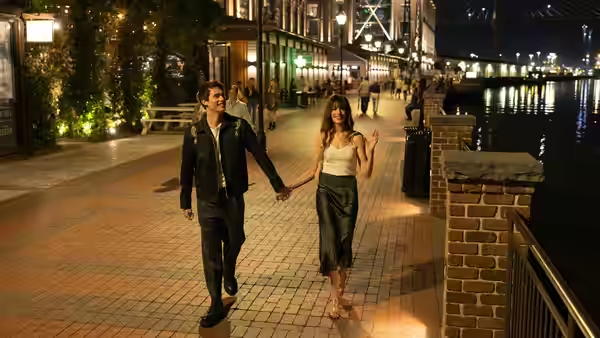
Nicholas Galitzine is an appealing partner, and the intimacy between Hayes and Solène supplies the film’s strongest reason to exist. He makes the attention Hayes pays her feel welcome rather than calculated. But Hayes has been written with too little to occupy him beyond the relationship, so charm has to account for most of his personality. That is enough to make the courtship pleasurable, though it limits how much we can care about his side of it.
Jim Frohna’s cinematography gives the romance an inviting polish, and that finish suits a film asking us to enjoy its central attraction. Amy Williams’s production design works on similar terms, contributing to the pleasure without making the surroundings especially revealing about the people occupying them. Both serve the fantasy more effectively than they establish a convincing celebrity life. The actors remain the most interesting things to look at, which is a reasonable priority for this kind of film.
Siddhartha Khosla’s music supports the tenderness without making the quieter feelings seem small. That suits Anne Hathaway’s performance, which does not need much assistance to hold our attention. The boy-band songs are a weaker proposition, and do little to explain the scale of the devotion the group is supposed to inspire. It is a small but persistent problem when so much of the relationship’s difficulty depends upon Hayes being famous.
Jennifer Westfeldt and Michael Showalter’s screenplay struggles to sustain interesting conversations once the attraction has been established. The talk becomes blander, and the writing leans on public judgement when the couple themselves might have offered more interesting difficulties. The double standard facing Solène is worth examining, but the film does not pursue it with much depth. Peter Teschner’s editing cannot quite disguise the repetition in this middle stretch. At 116 minutes, there is time to give both lovers more to say for themselves.
Romantic comedies do not need surprising plots to work, but they do need people whose happiness matters. This one has that, even if Anne Hathaway is doing a disproportionate amount of the work. It also allows desire to be pleasurable without constantly apologising for the fantasy, which is welcome. Choose it for the courtship, and be prepared to forgive the rather less persuasive obstacles.