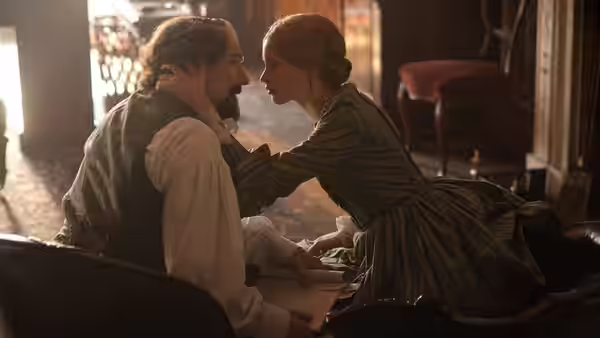
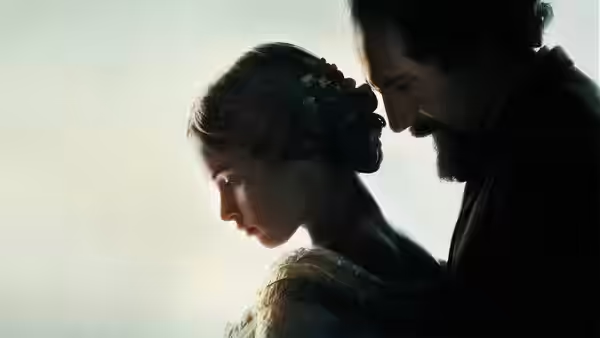
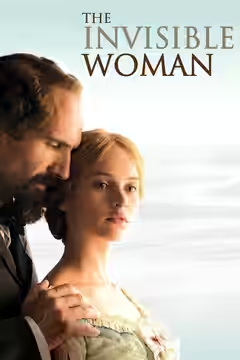
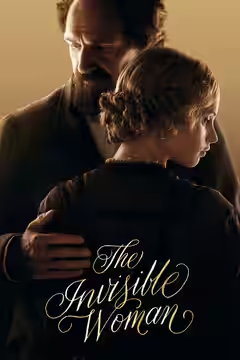
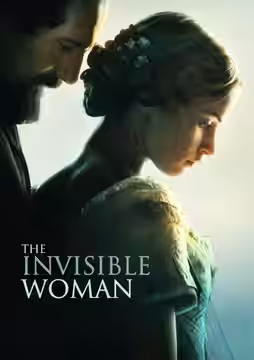
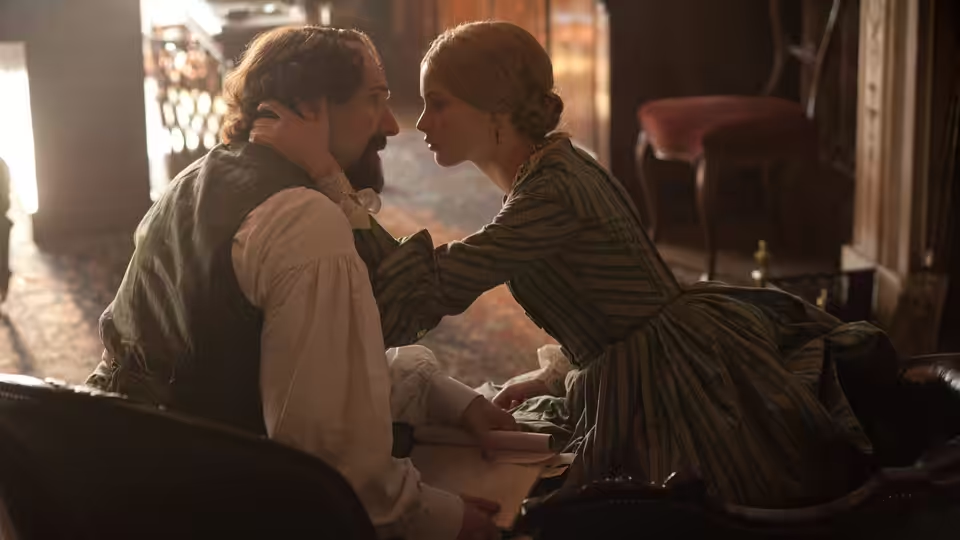
Charles Dickens (Ralph Fiennes) leans close as Nelly Ternan (Felicity Jones) reaches toward him indoors
Film review

The Invisible Woman

2013 · Directed by Ralph Fiennes · 1h 51m

In a sentenceJoanna Scanlan quietly makes Charles Dickens look like rather a lot of work

Young actress Nelly Ternan (Felicity Jones) attracts the attention of Charles Dickens (Ralph Fiennes), the married Victorian writer. She is drawn to him, but the prospect of a romance conflicts with her sense of propriety. Catherine Dickens (Joanna Scanlan), his wife, stands to be hurt by a relationship that already gives her husband more freedom than Nelly. Nelly must work out what she wants from Dickens, and what a place in his life would require her to accept. His marriage remains an obstacle to their attachment.

Plays from YouTube when you press play; nothing loads from them until then.

Fi1m review

Ralph Fiennes’s Dickens romance is worth considering for its performances, though the central relationship stays frustratingly distant. Felicity Jones does careful work; Joanna Scanlan, as the wife, makes the stronger impression.

Ralph Fiennes wants to give Nelly Ternan a life of her own in a romance dominated by Charles Dickens. The Invisible Woman is a decent, frustratingly distant drama, with performances that deserve a less cautious screenplay. Its sympathy for Nelly is never in question. The problem is that Felicity Jones has to supply so much of what we need to understand about her.

As Dickens, Ralph Fiennes supplies the energy that such a cautious film needs. His liveliness makes Nelly’s attraction credible, and he avoids smoothing away the difficulties of the man she wants. Felicity Jones gives Nelly’s reserve a recognisable tension, making us sense both romantic expectation and the effort of keeping it in check. The performance asks for close attention, though there are passages when the film relies on her presence to hold our interest without giving her enough to play.

Joanna Scanlan, playing Catherine Dickens, makes a sharper impression in much less time. We were moved by her resignation, because she makes the wife seem to understand the painful situation without having the freedom to change it. She gives Catherine an emotional life beyond being an impediment to somebody else’s romance. The performance brings the marriage into focus and makes us wish the central attachment were drawn with the same clarity.

Abi Morgan’s screenplay gives proper weight to the unequal terms of the affair. Nelly’s wish to preserve her respectability is not treated as mere fussiness, which matters in a story so dependent on what she feels able to ask for. Yet understanding her hesitation only takes us so far. The romance needs to make her desire equally clear, and too often we are left with the broad predicament of a young woman attached to a married man.

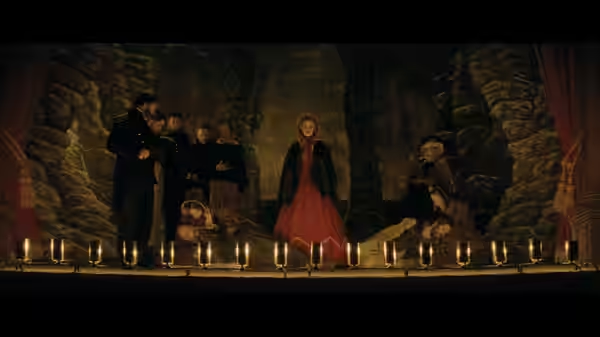
Rob Hardy’s composed images make Felicity Jones’s guarded expression worth studying, and the visual care helps sustain the quieter passages. Their polish can also make the unhappiness seem too neatly presented. Maria Djurkovic’s production design is equally assured about the Victorian setting. That confidence in the period detail is useful when the scenes themselves are slow to develop.

Nicolas Gaster gives the performances space in the editing, though the movement between timelines is less persuasive. Instead of deepening our involvement, the structure can make a slow film feel further interrupted. Ilan Eshkeri’s score does little to overcome that reserve; the actors’ quieter moments supply the strongest feeling. At times the measured pace becomes tedious, and the film’s consideration starts to feel like an unwillingness to move on.

Period romance can accommodate this much restraint, but it needs to make the things people cannot say unmistakable. The actors sometimes achieve that, especially Joanna Scanlan, who makes Catherine’s disappointment easy to understand. For viewers interested in Dickens, or in the women expected to fit around him, there is enough here to warrant the patience. Choose it for the performances, with no expectation of being swept into the affair.

Critical consensus AI synthesised

66
Positive
11
Mixed
4
Negative
4

Most critics respond positively to The Invisible Woman, with praise clustering around the performances rather than the affair itself. Felicity Jones’s controlled, expressive portrayal of Nelly draws the broadest approval, while Ralph Fiennes’s Dickens is frequently admired for his energy and humanity. Joanna Scanlan’s brief appearance as Dickens’s wife also makes a strong impression. Supporters find the relationship sensitively handled and emotionally affecting, and the film’s visual compositions earn approval even from some less persuaded by its storytelling.

The spread is wide, however: what some find moving, others find too restrained to engage with. Reservations centre on stately pacing, excessive polish and an affair that does not always become a compelling drama. The New Yorker admires Fiennes but finds the relationship insufficiently clear; Digital Spy faults the way the timelines fit together. Even favourable reviews acknowledge stretches of tedium or heavy-handedness, making this a qualified rather than settled consensus.

Los Angeles Times
24 December 2013 · Kenneth Turan
90*

Turan calls the film exceptional and praises its sensitive, evenhanded treatment of a complicated relationship. He singles out Ralph Fiennes’s performance and Felicity Jones’s expressive portrayal of Nelly Ternan.

Read the full review →
Variety
6 September 2013 · festival review · Scott Foundas
90*

Foundas finds the film exceptionally classy, vibrant, and brilliantly acted. He especially praises Felicity Jones’s emotionally controlled performance as Nelly.

Read the full review →
Radio Times
★★★★ · Trevor Johnston
80

Johnston gives the film a positive four-star review. He singles out Ralph Fiennes’s portrayal of Dickens as particularly effective.

Read the full review →
Time Out
4 February 2014 · ★★★★ · Dave Calhoun
80

The review describes the film as a touching insight into its subject. It notes that, despite the title’s superhero-like suggestion, the film’s special powers are not superheroic.

Read the full review →
The Guardian
6 September 2013 · festival review · Catherine Shoard
75*

Shoard finds the film a mature, affecting romance, though its approach can be heavy-handed. She singles out Nelly’s reticence and the unusual power dynamic as the story’s source of force.

Read the full review →
Film Comment
· Graham Fuller
70*

Fuller’s assessment appears positive, describing the film as a sensitive account of Dickens’s relationship with a young actress. The page provides no further detail about what the review singles out for praise.

Read the full review →

Straight answers AI written, from our review

Is The Invisible Woman worth watching?
The Invisible Woman is worth considering for its performances and its interest in the women around Dickens; we scored it 67. We recommend it chiefly to patient viewers drawn to period drama: Joanna Scanlan makes Catherine Dickens affecting, but the central romance remains distant and the measured pace sometimes becomes tedious.
How long is The Invisible Woman, and what is it rated?
The Invisible Woman runs 1h 51m. It is a drama and history film.
Where can I watch The Invisible Woman in Thailand?
The Invisible Woman is not on any streaming or rental service in Thailand at the moment. It is available in 30 other countries; change your country at the top of the page to see where. Availability is checked daily.
How violent or frightening is The Invisible Woman, and is it suitable for children?
The Invisible Woman carries a UK 12 certificate, so it is not a choice for younger children. The certificate alone does not establish how violent or frightening it is; our review chiefly identifies adult relationship tensions, marital unhappiness and a slow, restrained approach that is more likely to engage adults than children.
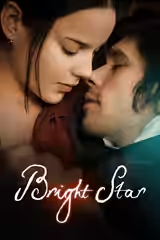
How does The Invisible Woman compare to Bright Star?
The Invisible Woman is our weaker recommendation beside Bright Star, which gives more room to the woman’s daily life within a literary attachment. We find Bright Star more affecting, despite a disruptive supporting performance; The Invisible Woman suits an interest in Dickens, but its strong actors cannot quite overcome the central romance’s distance.
Is The Invisible Woman based on a true story or a book?
The Invisible Woman is adapted from a book by Claire Tomalin and concerns the relationship between Charles Dickens and Nelly Ternan. Prior reading is not necessary to follow the romantic predicament, though we cannot establish the adaptation’s fidelity from our review; our reservation is that the film leaves Nelly’s desire insufficiently clear.
What should I watch after The Invisible Woman?
After The Invisible Woman, try Bright Star (2009, Fi1m 82): Another literary attachment, with more room for the woman’s daily life. Then The Heiress (1949, Fi1m 90): Family pressure and romantic hope, with a far sharper dramatic edge; and In the Mood for Love (2000, Fi1m 91): Restrained desire made painfully clear through rooms, clothes and missed chances.

Cast

Awards

Academy Awards, 2014

Nominated
Best Costume Design

If you liked this, try…

  1. Bright Star (2009, Fi1m 82)Another literary attachment, with more room for the woman’s daily life.

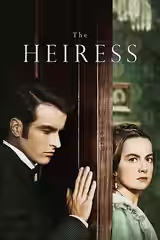
  2. The Heiress (1949, Fi1m 90)Family pressure and romantic hope, with a far sharper dramatic edge.

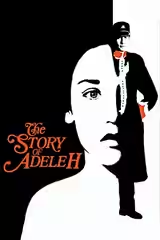
  3. The Story of Adèle H. (1975) · not on Fi1m yetFor a more unsettling account of a woman consumed by attachment.

  4. In the Mood for Love (2000, Fi1m 91)Restrained desire made painfully clear through rooms, clothes and missed chances.

  5. The Wife (2017) · not on Fi1m yetA famous writer’s marriage examined with particular attention to the neglected partner.