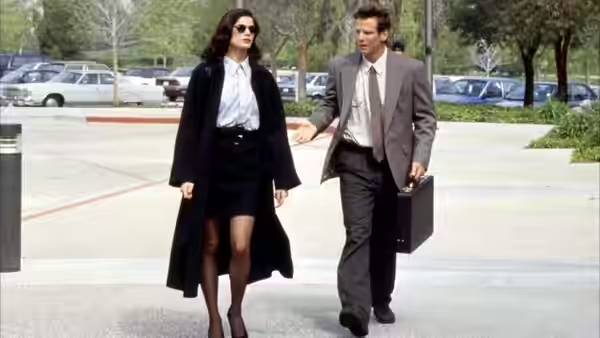
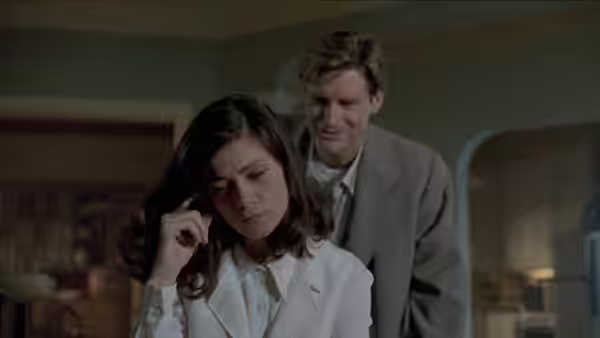
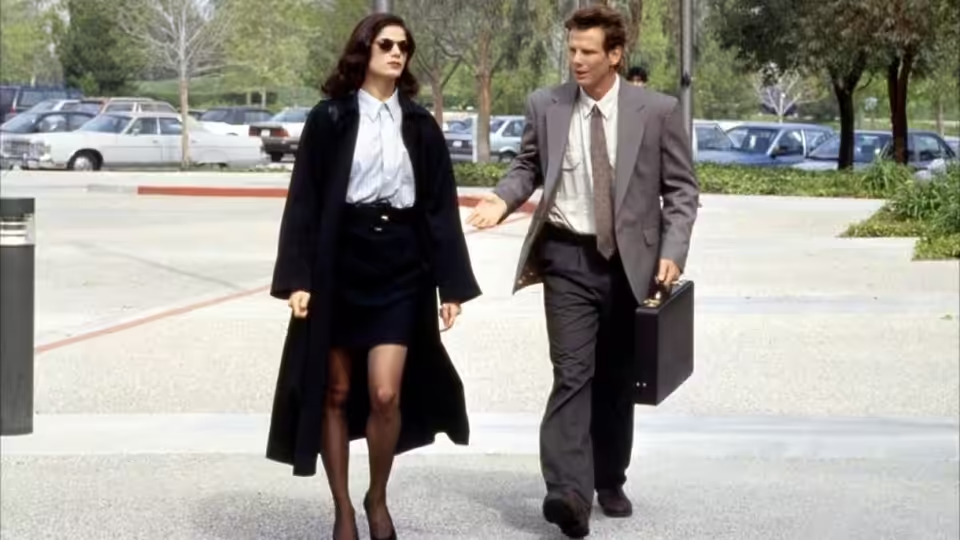
Bridget Gregory (Linda Fiorentino) walks through a parking lot beside a suited man carrying a briefcase
Film review

The Last Seduction

1994 · Directed by John Dahl · 1h 50m

In a sentenceLinda Fiorentino makes having a conscience look like a disadvantage in a job interview

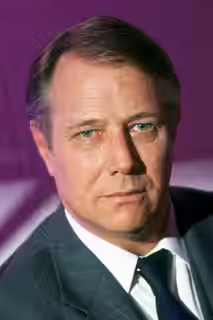
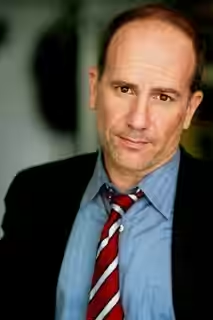
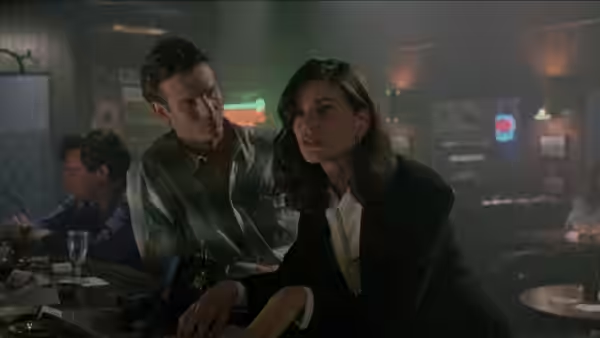
Bridget Gregory (Linda Fiorentino) pursues her own interests without much concern for anyone caught in the way. Around her are Mike Swale (Peter Berg), Clay Gregory (Bill Pullman), Harlan (Bill Nunn) and Frank Griffith (J. T. Walsh). Sex, calculation and the prospect of getting the upper hand govern this crime thriller, whose central woman gives little reason to expect fair dealing. Bridget’s willingness to exploit other people makes trust a hazardous business, particularly for anyone who mistakes attraction for a promise of affection.

Fi1m review

Linda Fiorentino gives this dry, nasty thriller its considerable pleasure. John Dahl handles the noir machinery with assurance, though the plotting asks for more indulgence than Bridget Gregory would ever grant anyone else.

The Last Seduction is a sharp, funny thriller with a central performance strong enough to carry its less convincing calculations. John Dahl understands the pleasure of watching somebody behave appallingly without asking us to diagnose or forgive them. As Bridget Gregory, Linda Fiorentino makes that pleasure slightly uncomfortable, which improves it considerably. We recommend it, with a reservation about a screenplay that sometimes needs its cleverness to go unexamined.

Fiorentino’s chief achievement is to make Bridget’s ruthlessness funny without making it harmless. There is no appeal for affection built into the performance, and no suggestion that approval would interest her much. We laughed at her callousness, then felt slightly ashamed of ourselves: Fiorentino makes the disregard for other people so entertaining that it takes a moment to register its ugliness. That delayed discomfort gives the humour a bite that simple wisecracking would not have.

Steve Barancik’s screenplay gives her the right material, particularly in its hard-edged dialogue. The writing allows an unpleasant thought to remain unpleasant rather than tidying it into something reassuring. Its weakness is plausibility: the intricate plotting occasionally asks us to accept a calculation because the resulting surprise is satisfying. That is a familiar thriller bargain, but the confidence of the writing makes its demands more noticeable when we stop to consider them.

Dahl’s direction is persuasive enough to keep those doubts from becoming the whole evening. His affinity for noir lies in the willingness to let an amoral character command our attention without providing a more respectable companion to explain how we ought to feel. Peter Berg plays Mike Swale and Bill Pullman plays Clay Gregory, but Fiorentino sets the standard by which the surrounding performances register. The film’s balance depends heavily on our appetite for Bridget, and that is both its strength and a genuine limitation.

The craft supports that emphasis without making the film feel like an illustrated lesson in noir. Jeffrey Jur’s cinematography contributes to its hard-boiled appeal, while Linda Pearl’s production design belongs to the same controlled approach. Neither is the principal reason to watch, but the polished presentation helps Dahl sustain the confidence on which this kind of thriller depends. The danger would be a handsome exercise with nobody worth following; Fiorentino prevents that.

Eric L. Beason’s editing has the difficult task of making Barancik’s complicated plotting feel persuasive as it unfolds. The film remains entertaining even when the mechanics become questionable, although pace cannot settle every objection to probability. Joseph Vitarelli’s music likewise forms part of the film’s assurance rather than its chief attraction. The strongest impression remains the performance and the writing, with the supporting craft serving them rather than demanding equal attention.

Within the noir tradition, the distinctive pleasure here is the freedom given to a woman’s unsoftened selfishness. Dahl and Fiorentino trust us to stay interested without being offered much comfort, and that trust largely pays off. Anyone requiring a thriller to withstand patient cross-examination should keep the qualification in mind. Watch it for Fiorentino, and save the objections until she has finished speaking.

Critical consensus AI synthesised

77
Positive
7
Mixed
1
Negative
0

Most critics respond warmly to The Last Seduction, with praise concentrated on Linda Fiorentino’s performance as Bridget. The reviews repeatedly single out her ruthlessness, humour and command of an amoral character. John Dahl’s feel for film noir also earns approval, while the screenplay attracts praise for its wit, sharp dialogue and cleverly arranged surprises. The broad agreement is that the film makes its hard-boiled material entertaining through both performance and plotting.

The main reservation concerns how far that plotting stretches credibility: the Los Angeles Times finds the film audacious and entertaining but questions its plausibility. The spread is broadly favourable rather than sharply divided, with seven positive assessments, one mixed and none negative. There is little evidence of a substantial dissenting camp, although incomplete access to some reviews limits what can be said about their reservations.

Empire
12 June 1998 · Kim Newman
90*

Newman calls it John Dahl’s best film to date, praising its surprising plot twists and strong performances. He especially singles out Linda Fiorentino’s funny, cynically rendered performance as Bridget.

Read the full review →
The Independent
7 August 1994 · Lesley Thornton
85*

The critic finds the film a compelling, witty update of film noir. She particularly praises Linda Fiorentino’s riveting performance and the strength of the screenplay.

Read the full review →
Variety
23 February 1994 · festival review · David Stratton
85*

Stratton praises the film as a polished, cleverly plotted thriller with a compellingly amoral lead. He singles out Linda Fiorentino’s performance as the ruthless Bridget for particular praise.

Read the full review →
The New Yorker
30 October 1994 · Anthony Lane
75*

Lane gives the film a positive verdict, calling Linda Fiorentino’s performance a star turn. He also praises its hard-boiled film-noir style and John Dahl’s affinity for the genre.

Read the full review →
Los Angeles Times
26 October 1994 · Kenneth Turan
70*

Turan finds the film entertaining and audacious despite a plot that strains plausibility. He especially praises Linda Fiorentino’s venomous performance and John Dahl’s feel for film noir.

Read the full review →
The New York Times
26 October 1994 · Janet Maslin
70*

The headline suggests a positive verdict, presenting the film’s femme fatale as convincing. The accessible page provides no further detail about what the critic praised.

Read the full review →

Straight answers AI written, from our review

Is The Last Seduction worth watching?
The Last Seduction is worth watching for Linda Fiorentino’s ruthlessly funny performance and its hard-edged noir dialogue; we score it 81 out of 100. We recommend it to anyone who enjoys an amoral thriller, provided the pleasure of watching Bridget manipulate people outweighs the need for every calculation in the plot to withstand scrutiny.
How long is The Last Seduction, and what is it rated?
The Last Seduction runs 1h 50m. It is a thriller and crime film.
Where can I watch The Last Seduction in South Africa?
The Last Seduction is not on any streaming or rental service in South Africa at the moment. It is available in 5 other countries; change your country at the top of the page to see where. Availability is checked daily.
How violent or frightening is The Last Seduction, and is it suitable for children?
The Last Seduction has a UK 18 certificate and is not suitable for children; its sex, exploitation and callous treatment of others make it adult viewing. We would describe its appeal as darkly comic rather than reassuring, but cannot give a precise account of violence or frightening material from the certificate alone.
How does The Last Seduction compare to Double Indemnity?
The Last Seduction is the more performance-dependent recommendation beside Double Indemnity, which we recommend more broadly for its viciously funny dialogue and three finely judged leads. Both make desire and calculation reasons to distrust people, but Fiorentino’s unsoftened ruthlessness is the particular attraction here. We give Double Indemnity the edge, while recommending The Last Seduction to viewers happy to indulge some questionable plotting.
What should I watch after The Last Seduction?
After The Last Seduction, try Double Indemnity (1944, Fi1m 92): Desire and calculation make a persuasive case against trusting either. Then Body Heat (1981, Fi1m 83): Another noir where sexual confidence makes clear thinking increasingly unlikely; and Bound (1996, Fi1m 80): A tightly controlled crime thriller with desire driving the practical decisions.

Cast

If you liked this, try…

  1. Double Indemnity (1944, Fi1m 92)Desire and calculation make a persuasive case against trusting either.

  2. Body Heat (1981, Fi1m 83)Another noir where sexual confidence makes clear thinking increasingly unlikely.

  3. Bound (1996, Fi1m 80)A tightly controlled crime thriller with desire driving the practical decisions.

  4. The Grifters (1990, Fi1m 84)Three accomplished manipulators discover the inconvenience of having personal connections.

  5. La Cérémonie (1995) · not on Fi1m yetFor another chilly examination of women whom respectable explanations cannot contain.