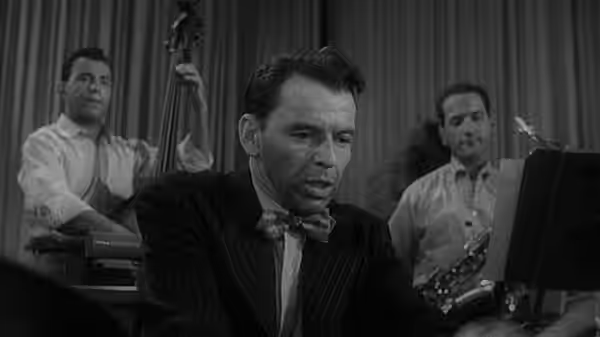
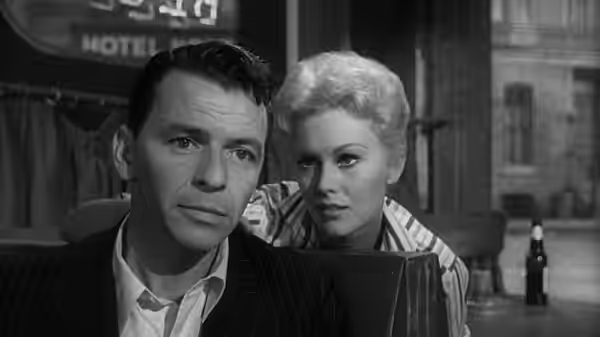
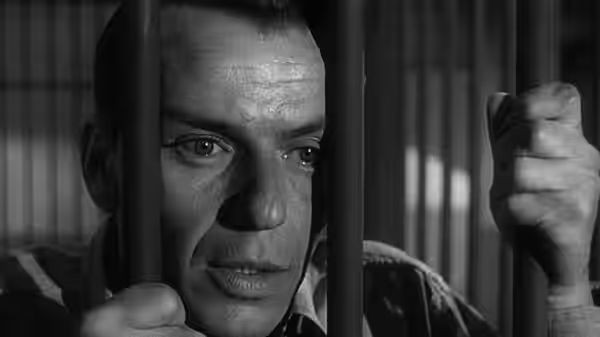
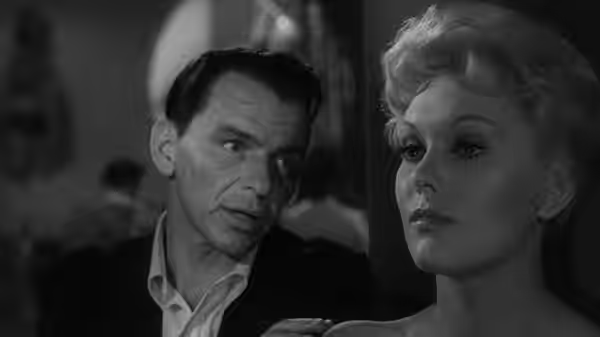
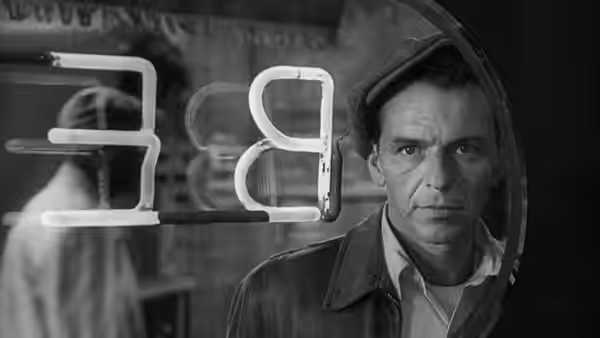
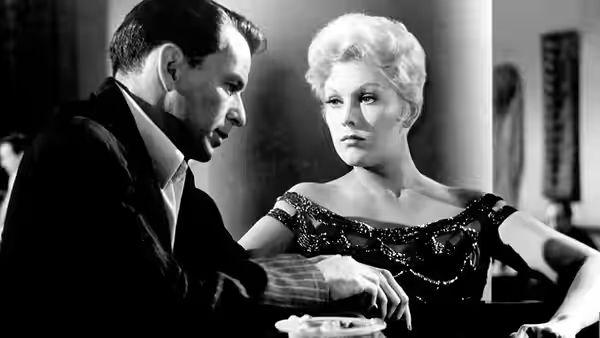
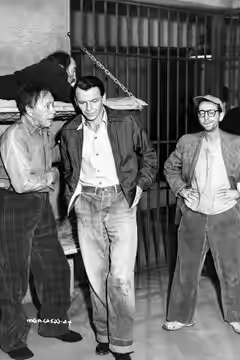
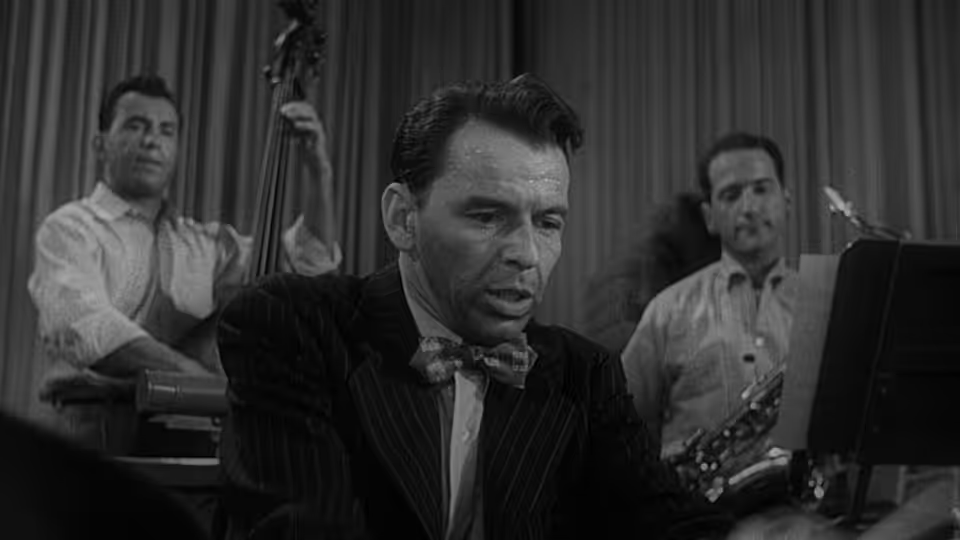
Frankie Machine (Frank Sinatra) plays drums with musicians behind him
Film review

The Man with the Golden Arm

1955 · Directed by Otto Preminger · 1h 59m

In a sentenceFrank Sinatra makes a poker game exhausting, and we mean that as praise

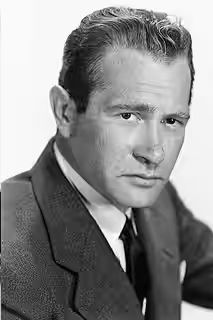
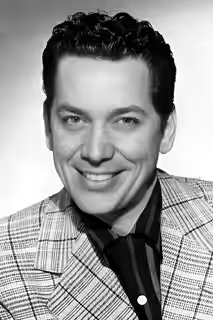
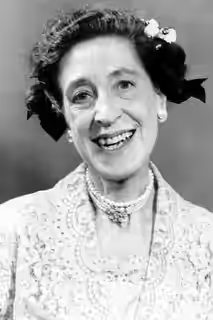
Frankie Machine (Frank Sinatra) is trying to regain control of a life threatened by drug addiction. Around him are Zosh Machine (Eleanor Parker), Molly (Kim Novak), Sparrow (Arnold Stang) and Louie (Darren McGavin). Frankie’s wish to recover comes up against the difficulty of carrying on among the people who know him, with their demands and his dependence pulling at him. He needs to find a way through ordinary life while the strain of keeping himself together grows harder to hide.

Plays from YouTube when you press play; nothing loads from them until then.

Fi1m review

Frank Sinatra gives this addiction drama a vulnerability that survives its more emphatic melodrama. Otto Preminger’s film can feel stage-bound, but its concern for a suffering man remains persuasive.

The Man with the Golden Arm is worth seeing for Frank Sinatra, whose vulnerability keeps a sometimes stiff drama painfully human. Otto Preminger takes drug addiction seriously enough to let it be uncomfortable, and there is no need to admire the film merely for tackling the subject. We care because Frankie Machine seems so poorly equipped to withstand another disappointment. The weakness is that the surrounding drama sometimes works too hard to make certain we understand how much he suffers.

The central performance avoids making weakness contemptible. There is nothing comfortably picturesque about Frankie’s deterioration, and little invitation to enjoy watching a star demonstrate how far he can descend. Frank Sinatra makes the character’s difficulty in carrying on persuasive enough that we need no special pleading on his behalf. That matters in a film about dependence, where pity can easily become the only feeling available to an audience.

The poker sequence is where that pressure becomes most absorbing. We felt anxious watching the effort of carrying on; the game becomes exhausting because Frankie’s vulnerability remains apparent throughout it. Louis R. Loeffler’s editing is particularly effective here, giving the strain time to register without making the sequence feel merely prolonged. Elsewhere, the dramatic emphasis can become tiring, but here the duration is part of what makes the scene work: we start to feel how much continuing costs him.

Sam Leavitt’s cinematography is most persuasive when our attention rests on the performers. Faces hold our interest more securely than the world around them, which never quite loses its enclosed, theatrical feel. Joseph C. Wright’s production design contributes to that limitation: the settings feel prepared for a drama rather than inhabited before it began. This does not ruin the film, but it sometimes makes the suffering seem arranged for inspection, particularly when the acting becomes emphatic too.

Kim Novak supplies a welcome degree of restraint as Molly, giving the film someone whose sensitivity does not need to be underlined. Eleanor Parker’s Zosh Machine is harder to accept on those terms; the performance can feel over-insistent beside the uncertainty of the lead. The screenplay by Lewis Meltzer and Walter Newman is susceptible to the same problem, pressing an emotional point after it has registered. These are connected weaknesses rather than separate disasters, but they account for much of the film’s stiffness.

Elmer Bernstein’s music is forceful enough to risk adding another layer of insistence. We find its urgency more persuasive than some of the dramatic exchanges, however, because it gives the anxiety a momentum that the dialogue cannot always sustain. The score helps the film feel unsettled even when the staging seems fixed. It is a useful reminder that restraint is not the only way to take a character’s pain seriously.

As an addiction drama, the film succeeds most clearly in keeping our attention on a particular person rather than asking us to approve its seriousness. Its theatrical passages require some tolerance, and the supporting characters do not all feel equally convincing. See it for Frank Sinatra and Kim Novak, and accept that the film occasionally presses harder than either of them needs it to.
Critical consensus AI synthesised

75
Positive
6
Mixed
1
Negative
0

Most critics respond warmly to The Man with the Golden Arm, with praise clustering around Frank Sinatra’s convincing, vulnerable portrayal of addiction. The reviews repeatedly stress the film’s importance in bringing the subject into Hollywood drama, while also finding it gripping, moving and humane. Sinatra’s depiction of Frankie’s disintegration is the clearest point of agreement, though the screenplay’s treatment of addiction and the force of the withdrawal scenes also draw praise.

The available verdicts show a fairly narrow spread, with reservations qualifying the enthusiasm rather than overturning it. Eye for Film finds the presentation somewhat stagy by modern standards, but also singles out Kim Novak’s sensitive, assured performance. The New York Times entry cannot establish a dissenting position because its review text is unavailable; among the accessible assessments, there is no substantial case against the film.

Variety
31 December 1954 · Variety Staff
85*

The review finds the film gripping and fascinating, praising its conviction and expert execution. It singles out Frank Sinatra’s performance and the screenplay’s convincing analysis of addiction.

Read the full review →
Radio Times
★★★★ · Adrian Turner
80

Turner calls the film a trailblazer in its portrayal of drug addiction and says it shocked audiences in its era. He singles out Frank Sinatra’s Oscar-nominated performance as still impressive.

Read the full review →
Empire
1 January 2000 · Kim Newman
75*

Newman finds the film powerful, entertaining and moving. He especially praises the harrowing cold-turkey scenes and the three-day poker-game sequence.

Read the full review →
Time Out
· RM
70*

The review presents the film as a major Hollywood treatment of heroin addiction. It singles out Frank Sinatra’s performance as excellent.

Read the full review →
The New York Times
16 December 1955 · Bosley Crowther
64*

The article appears to be a review, but its text is unavailable here, so the critic’s verdict cannot be established. No specific praise or complaint can be verified from the accessible page.

Read the full review →
The Skinny
29 June 2015 · ★★★★ · Lewis Porteous
80

Porteous calls the film an unflinchingly humane work of enormous importance. He singles out Frank Sinatra’s compelling portrayal of Frankie’s disintegration.

Read the full review →

Straight answers AI written, from our review

Is The Man with the Golden Arm worth watching?
The Man with the Golden Arm is worth watching for Frank Sinatra’s vulnerable performance, especially if you value character-led drama; we score it 78 out of 100. Kim Novak’s restraint also helps, though the stage-bound settings and over-insistent melodrama require some tolerance.
How long is The Man with the Golden Arm, and what is it rated?
The Man with the Golden Arm runs 1h 59m. It is a drama and crime film.
Where can I watch The Man with the Golden Arm in Greece?
The Man with the Golden Arm is not on any streaming or rental service in Greece at the moment. It is available in 12 other countries; change your country at the top of the page to see where. Availability is checked daily.
How violent or frightening is The Man with the Golden Arm, and is it suitable for children?
The Man with the Golden Arm has no UK certificate and is unrated in the US, so its classification offers no useful age guidance. Frankie’s deterioration through drug addiction is uncomfortable, and even a poker game becomes anxiety-inducing. We would not recommend it for young children; the concern is the distress of watching dependence rather than any violence established here.
How does The Man with the Golden Arm compare to The Lost Weekend?
The Man with the Golden Arm is the more theatrically stiff of these two addiction dramas; we find The Lost Weekend more convincing, despite its false-sounding final minutes. Both make ordinary activities feel fraught, but Sinatra’s vulnerability is the chief reason to choose the former, while the latter offers a more consistently frightening account of struggling towards sobriety.
Is The Man with the Golden Arm based on a true story or a book?
The Man with the Golden Arm is adapted from a novel by Nelson Algren, rather than presented as a true story. We cannot establish how closely it follows the book, but no prior reading is needed to appreciate Sinatra’s performance or understand Frankie’s struggle with dependence.
What should I watch after The Man with the Golden Arm?
After The Man with the Golden Arm, try The Lost Weekend (1945, Fi1m 82): Another troubled attempt at sobriety, with everyday errands becoming sources of dread. Then Sound of Metal (2019, Fi1m 81): Another performer faces the frightening business of living without his familiar defences.

Cast

Awards

Academy Awards, 1956

Nominated
Best Actor
Nominated
Best Art Direction, Black and White
Nominated
Best Original Dramatic or Comedy Score

If you liked this, try…

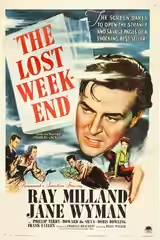
  1. The Lost Weekend (1945, Fi1m 82)Another troubled attempt at sobriety, with everyday errands becoming sources of dread.

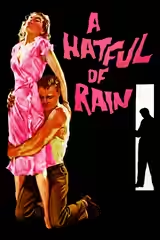
  2. A Hatful of Rain (1957) · not on Fi1m yetAddiction puts a household under pressure, with sympathy extending beyond the sufferer.

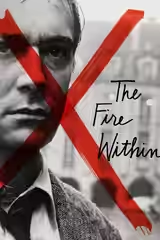
  3. The Fire Within (1963) · not on Fi1m yetA more inward account of despair, attentive to the difficulty of accepting help.

  4. Clean (2004) · not on Fi1m yetRecovery means rebuilding ordinary life, with little room for comforting shortcuts.

  5. Sound of Metal (2019, Fi1m 81)Another performer faces the frightening business of living without his familiar defences.