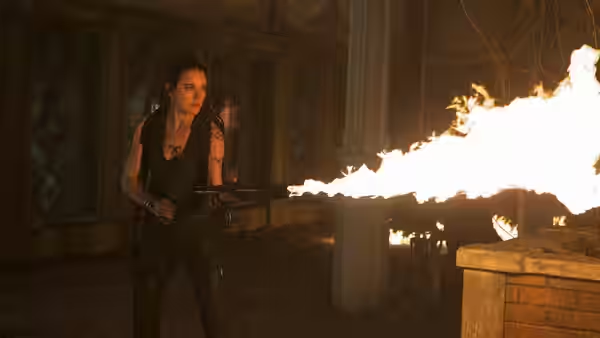
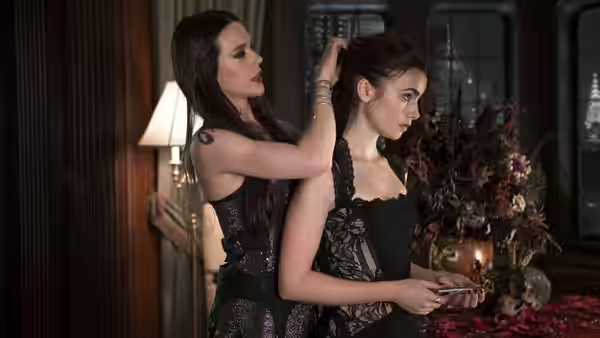
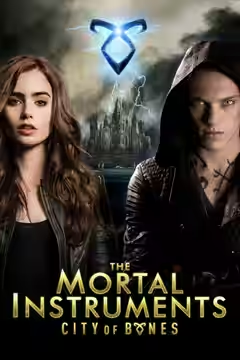
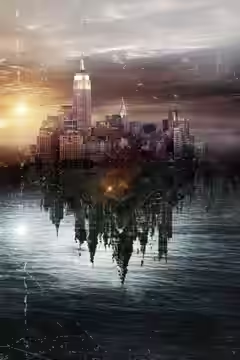
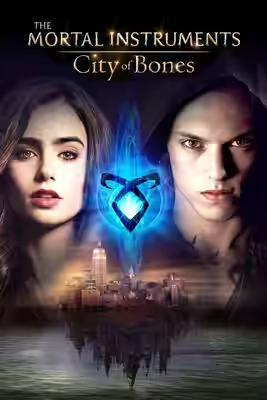
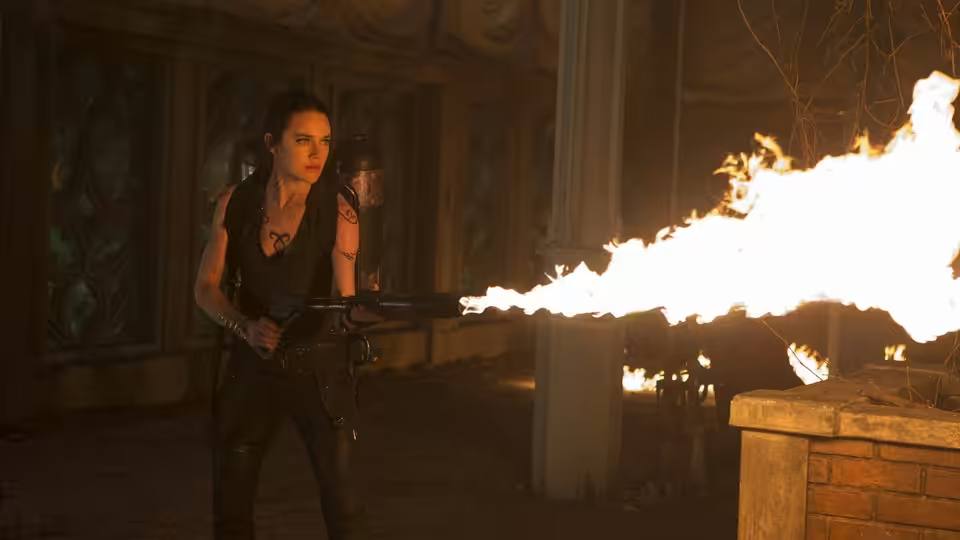
Clary Fray (Lily Collins) holds a weapon as flames burst across a dim room
Film review

The Mortal Instruments: City of Bones

2013 · Directed by Harald Zwart · 2h 10m · ACB M

In a sentenceTwo hours of beautiful people being solemn about tattoos, and the villain is the only one allowed to enjoy himself

Brooklyn, the present day. Clary Fray (Lily Collins) is a teenager who has started drawing a symbol she does not recognise, over and over, without knowing why. At a nightclub with her best friend Simon Lewis (Robert Sheehan) she watches a tattooed boy, Jace Wayland (Jamie Campbell Bower), kill a man nobody else in the club can see. The next day her mother Jocelyn (Lena Headey) vanishes from their flat, taken by men working for Valentine (Jonathan Rhys Meyers), who wants an object called the Mortal Cup and believes Jocelyn knows where it is. Jace takes Clary to the Institute, a cathedral where Shadowhunters, demon-killers invisible to ordinary people, live and train under Hodge Starkweather (Jared Harris). Clary wants her mother back. To find her she has to recover memories somebody has taken from her.

Plays from YouTube when you press play; nothing loads from them until then.

Fi1m review

Harald Zwart’s adaptation of Cassandra Clare’s novel has a handsome cathedral, a willing cast and no idea how to tell its story. The first half explains, the second half fights, and neither half makes us care who ends up holding the cup.

Clary Fray (Lily Collins) is a Brooklyn teenager who starts drawing a symbol she has never seen, then watches a boy kill a man in a nightclub while nobody else notices. Within the first half-hour her mother is gone, her flat has been wrecked by a demon that looks like a dog turned inside out, and she has been carried off to a cathedral full of young people with tattoos. That is a lot of set-up, and the film has a great deal more where it came from. Harald Zwart’s adaptation of Cassandra Clare’s novel runs 130 minutes and spends perhaps ninety of them explaining the rules.

The explaining is the problem. The screenplay, which Jessica Postigo shares the credit for, has to tell us what a Shadowhunter is, what a rune does, why ordinary people cannot see demons, who the Silent Brothers are, what the Mortal Cup is for and why Valentine wants it, and it does this in corridors, with one character asking a question and another answering it. Clary asks most of the questions. Collins is a likeable presence and does what she can, but a heroine whose main job is to say “what is that” for two hours has nowhere to go, and the script never finds her anything to want beyond her mother and a boy.

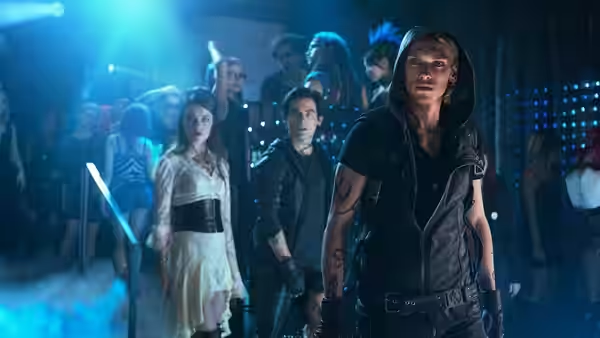
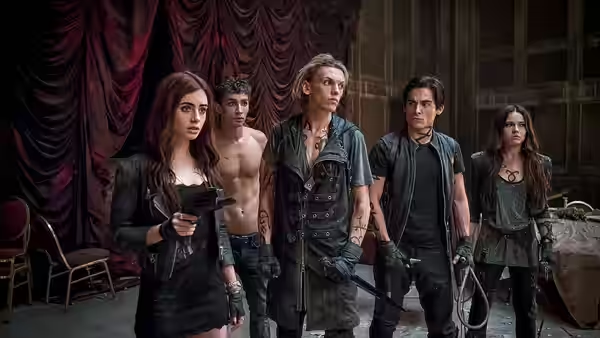
The thing that works is the Institute. François Séguin has built a Gothic church kitted out as a dormitory and armoury, with candles and brass, a library with ladders and weapons racked along the walls, and Geir Hartly Andreassen lights it in warm amber against the cold blue of the streets outside, so we always know which world we are in. Gersha Phillips dresses the Shadowhunters in black leather a shade too clean, as if nobody had fought in it, but the look holds together. When the film sits still in these rooms it is close to pleasant.

It does not sit still often. The action is cut by Jacqueline Carmody into short, dim fragments, a blade, a snarl, a body hitting a wall, so that we were seldom sure who had struck whom or from where. The demon in the flat and a later fight in a hotel full of vampires have the same fault: the film seems embarrassed by its creatures and keeps cutting away from them before we have had a proper look. Atli Örvarsson’s score pushes strings and choir under all of it, insisting this is grand, when what we are looking at is a corridor.

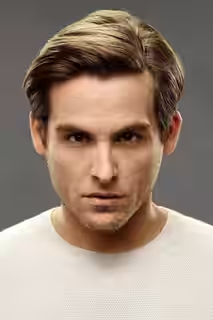
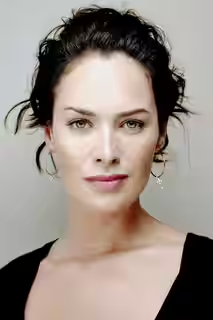
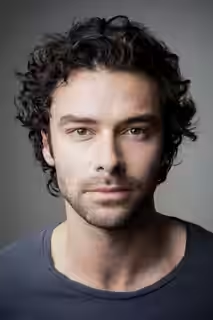
We laughed once, properly, and it was at the moment Jace Wayland (Jamie Campbell Bower) sits down at a piano and explains that Bach was one of them. We are fairly sure the line was meant to be charming. It is the film in miniature: a straight face held over material that needed a wink. Robert Sheehan, as Clary’s best friend Simon, is the one actor who seems to know the register, and the film sidelines him for the romance. Jonathan Rhys Meyers arrives late as Valentine, in a long coat and a sneer, and plays it as a man who has decided to have a good time whatever the rest of the cast are doing; we were briefly glad of him. Lena Headey gets one good scene before the plot removes her. Jared Harris, Aidan Turner and Kevin Zegers are all given a function and no character.

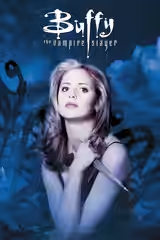
The genre is the hidden-world teen fantasy, and the better examples of it, Buffy the Vampire Slayer chief among them, understood that the rules are the least interesting thing about a secret world and the people are the most. Zwart’s The Karate Kid remake was patient about one boy learning one thing. Here he has a dozen things to teach and a sequel to prepare for, and the people are what get squeezed. Most critics landed near where we have, and the complaints cluster in the same place: a story that cannot be followed and a tone that cannot decide.

Readers of the book may get what they came for, since the film is faithful in the way of a checklist. For anyone else it is a 12A that confuses rather than frightens. At home you can pause it to ask who everyone is, which is a question the film itself never quite answers.

Critical consensus AI synthesised

38
Positive
0
Mixed
6
Negative
10

The reviews lean firmly negative. None of the critics recommends the film, and the kindest settle for mixed. Where praise exists it sits at the edges: the flashes of humour and self-aware silliness, which several critics find a relief from the plot, and the effects and production design, which earn a grudging word even from writers who dislike everything else. The Wrap credits Jonathan Rhys Meyers with a brief and welcome burst of camp.

The complaints are more consistent than the praise. Most critics call the story incoherent, the exposition clunky and the whole thing a borrowed mix of Twilight, Harry Potter and Buffy. Lily Collins divides opinion: The Hollywood Reporter finds she conveys real empathy, while the Los Angeles Times calls her heroine unconvincing. The spread is narrow in direction and wide in degree, running from two-star shrugs to outright dismissal, with The Guardian going as far as to call the film cynical.

RogerEbert.com
64*

The page content is blocked, so the critic’s verdict cannot be confirmed. No praise or complaint from the review is available to report.

Read the full review →
Screen Daily
22 August 2013 · Brent Simon
64*

The page identifies this as a review, but its critical assessment is unavailable in the excerpt. The visible text does not reveal the critic’s verdict or what they praise or complain about.

Read the full review →
The New York Times
21 August 2013
64*

The page is inaccessible, so the critic’s verdict cannot be established. No specific praise or complaint is available from the page text.

Read the full review →
Radio Times
★★★ · Alan Jones
60

Jones finds the fantasy familiar, blending territory associated with Twilight and Harry Potter. He notes its supernatural creatures and humour, which softens the horror.

Read the full review →
Slant Magazine
21 August 2013 · ★★/4 · R. Kurt Osenlund
50

Osenlund finds the film briefly entertaining as absurd, self-aware genre excess, but ultimately undone by shoddy filmmaking. He praises its kooky humor and flamboyant collection of characters, while criticizing the incoherent action and choppy editing.

Read the full review →
Time Out
19 August 2013 · ★★ · Anna Smith
40

Smith gives the film two stars, indicating a negative verdict. She singles out its familiar mix of Twilight, Buffy, Percy Jackson and Harry Potter as an unconvincing bid for tween popularity.

Read the full review →

Straight answers AI written, from our review

Is The Mortal Instruments: City of Bones worth watching?
The Mortal Instruments: City of Bones is not worth an evening for most viewers, and we scored it 38. The cathedral sets are handsome and the cast is willing, but the script spends ninety of its 130 minutes explaining the rules and the fights are cut into dim fragments. Readers of Cassandra Clare's novel may get what they came for; nobody else will.
How long is The Mortal Instruments: City of Bones, and what is it rated?
The Mortal Instruments: City of Bones runs 2h 10m and is rated M by the ACB in Australia. It is a fantasy and action film.
Where can I watch The Mortal Instruments: City of Bones in Australia?
The Mortal Instruments: City of Bones is streaming on Stan and Amazon Prime Video in Australia, and it is also available to rent from Amazon Prime Video and Apple TV from A$4.99. Availability is checked daily; the links above go straight to each service.
How violent or frightening is The Mortal Instruments: City of Bones, and is it suitable for children?
The Mortal Instruments: City of Bones is a 12A with fantasy violence, demons and vampires, and it is more confusing than frightening. The creatures are glimpsed in short, dark cuts rather than dwelt on, so the squeamish have little to fear. Younger children are more likely to be lost than scared, since the film never makes clear who is fighting whom.
How does The Mortal Instruments: City of Bones compare to Buffy the Vampire Slayer?
The Mortal Instruments: City of Bones is the weaker of the two by some distance, and Buffy the Vampire Slayer is the one to choose. Both are hidden-world teen fantasies, but Buffy puts its people and its jokes first, where City of Bones spends its time on rules recited in corridors. Only committed readers of Cassandra Clare's books should pick the film instead.
Is The Mortal Instruments: City of Bones based on a true story or a book?
The Mortal Instruments: City of Bones is based on Cassandra Clare's novel of the same name, not on a true story. The film follows the book faithfully in the way of a checklist, covering the events without finding the characters. Knowing the source helps a great deal, since the film itself never quite explains who everyone is or why we should care.
What should I watch after The Mortal Instruments: City of Bones?
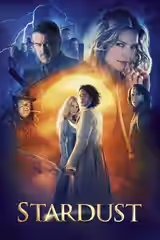
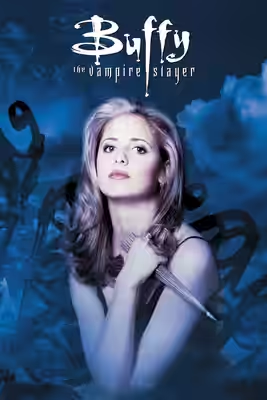
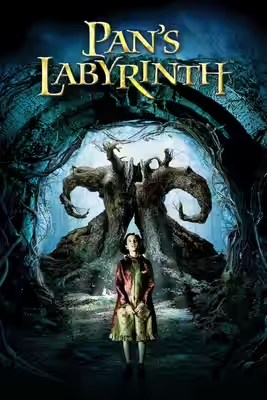
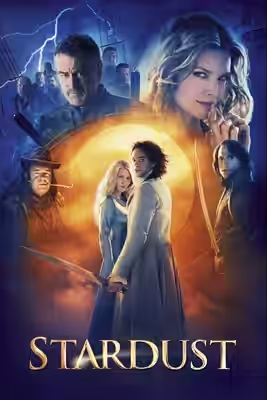
After The Mortal Instruments: City of Bones, try Buffy the Vampire Slayer (1997, Fi1m 80): The hidden-world teen fantasy done with jokes, people and no corridors of exposition. Then Pan's Labyrinth (2006, Fi1m 87): A girl, a monstrous world under the real one, and every rule made to matter; and Stardust (2007, Fi1m 75): Fantasy that knows it is silly and has a lovely time being so.

Cast

If you liked this, try…

  1. Buffy the Vampire Slayer (1997, Fi1m 80)The hidden-world teen fantasy done with jokes, people and no corridors of exposition.

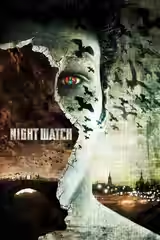
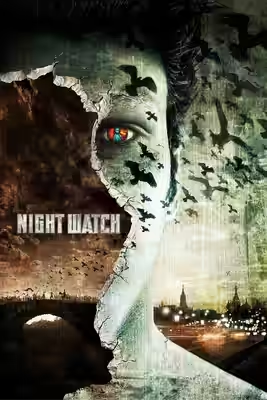
  2. Night Watch (2004) · not reviewed yetMoscow’s secret war between light and dark, scruffy, loud and properly strange.

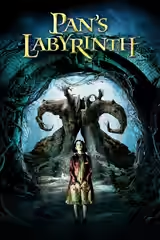
  3. Pan's Labyrinth (2006, Fi1m 87)A girl, a monstrous world under the real one, and every rule made to matter.

  4. Stardust (2007, Fi1m 75)Fantasy that knows it is silly and has a lovely time being so.

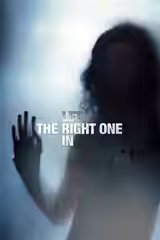
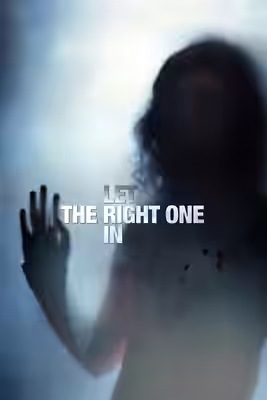
  5. Let the Right One In (2008, Fi1m 88)Teenage vampire love in a Swedish suburb, quiet, cold and unforgettable.

Free account

Know what to watch tonight

Two lists that know where things are streaming, collections you can share, your own score beside ours, and Discover that remembers what you have seen.

  • Want to see, sorted by what is streaming now
  • Seen, with your score out of ten
  • No adverts, ever