Akiva Schaffer’s revival keeps the old rule that nobody on screen may know they are in a comedy, and Liam Neeson obeys it to the letter. The gags come fast and thin out late, but enough of them land.
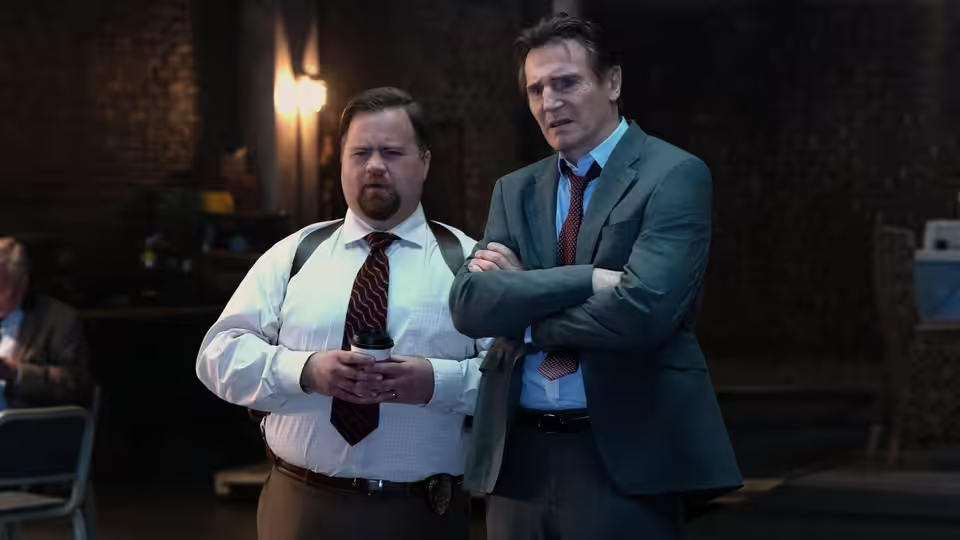
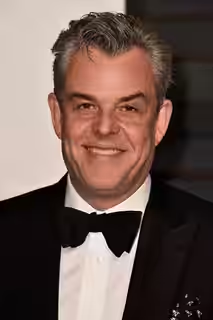
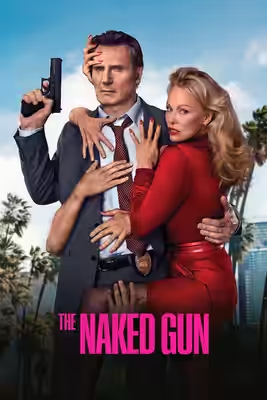
Frank Drebin Jr. is the son of the man Leslie Nielsen played, and he has inherited the raincoat and the inability to cross a room without breaking something in it. Liam Neeson plays him as a detective with Police Squad, under Chief Davis (CCH Pounder) and alongside Ed Hocken Jr. (Paul Walter Hauser). Beth Davenport (Pamela Anderson) walks into his office wanting to know how her brother died, and the trail leads towards Richard Cane (Danny Huston), a billionaire. That is the plot, and the film cares about it roughly as much as its predecessors cared about theirs. It is funny more often than it is not, it is 85 minutes long, and it knows what it is for.
The rule of these films, set down by Zucker, Abrahams and Zucker and kept through the original trilogy, is that nobody on screen may know they are in a comedy. Akiva Schaffer, who directs and writes with Dan Gregor and Doug Mand, holds to it. The jokes come in the three old kinds: a line taken literally, a sign or prop in the background misbehaving, and a large man falling over with conviction. They arrive at a rate that leaves no time to judge the last one. We laughed out loud, in a room full of strangers, at a sign in the squad room reading “Cold Cases”, and at a love montage that carries on long past the point where a sensible editor would have stopped it. Brian Scott Olds is the editor, and the not stopping is his judgment as much as Schaffer’s.
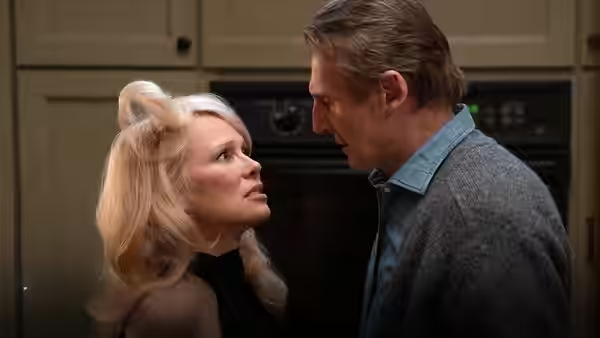
Neeson is why it works. He has spent two decades playing men who threaten people down telephones, and he brings all of it, the growl, the stare, the look of a man counting henchmen, to lines that mean nothing at all. He never winks. Nielsen had a softness, the air of a man surprised to find himself in trouble; Neeson’s Drebin looks as though he caused the trouble and would do it again. It is a different note and it suits him.
Anderson is the other reason. Beth is the woman in the doorway from every 1940s crime picture, all veil and grief, and Anderson plays her straight and gets funnier the longer she holds the face. There is one scene, involving a song, that we will leave you to find. Hauser lets Neeson keep the punchlines, and Huston plays Cane as a man who explains his philosophy to people who did not ask.
Brandon Trost shoots it as you would shoot a real thriller, steel and streetlight and shadow, and that is right; the moment the picture starts looking like a comedy the trick stops working. Bill Brzeski’s Police Squad offices look like every open-plan precinct you have seen, which gives the background jokes plenty of wall to sit on. Betsy Heimann keeps Neeson in a suit and coat that would pass in a serious film and puts Anderson in gowns from another decade entirely. Lorne Balfe and Joel McNeely score it as if lives were at stake, with heavy brass and ticking percussion, and never let on.
The problems are the old ones. The story stops mattering about twenty minutes in, which is fine until the film needs a climax and has to pretend it cared. The last third is thinner than the first; the hit rate drops, a couple of gags come back for a second and third bow, and we found ourselves waiting for the next one rather than being ambushed by it. And the 15 certificate is earned: a fair share of the jokes are about bodies and what comes out of them.
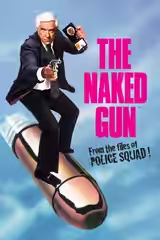
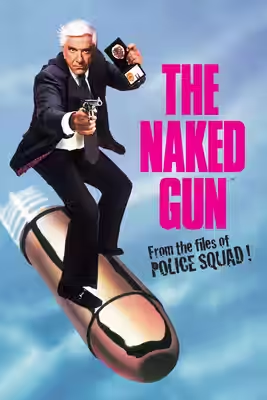
Set against the originals this is a faithful copy rather than a new idea, and it is honest about that. It has the rhythm of the 1988 film and lacks the one thing nobody can copy, which is the luck of being first. Most critics have gone warmer than we have. They are right about the laughs. We think there are stretches here that coast, and a film this short should not have any.
See it with a crowd if you can. Laughter of this kind spreads, and a miss is easier to forgive when someone two rows back has forgiven it first. On a sofa the gaps show, and there are more of them after the hour mark.