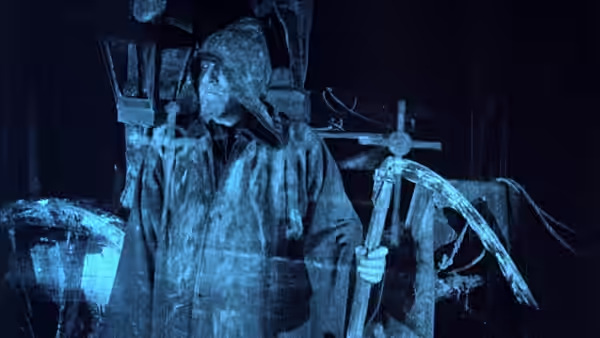
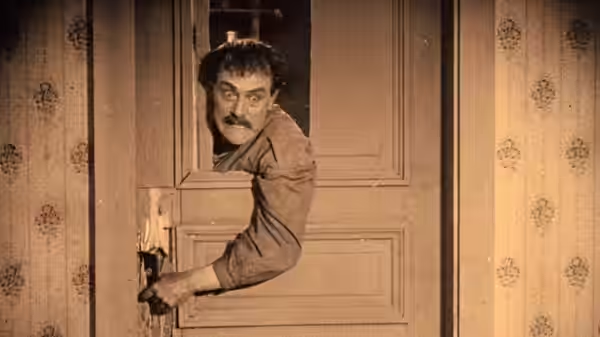
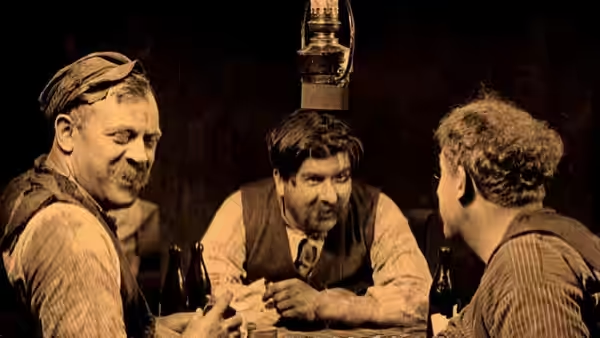
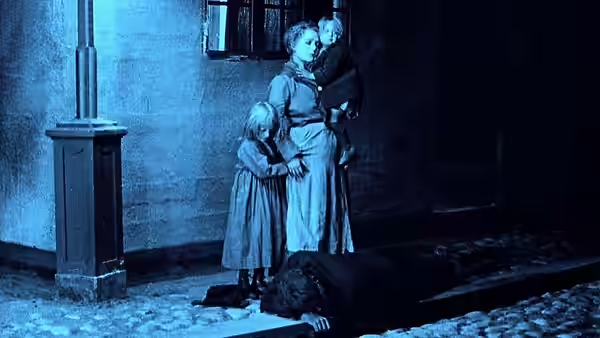
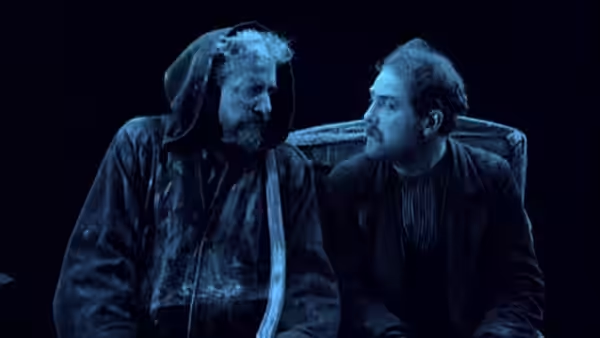
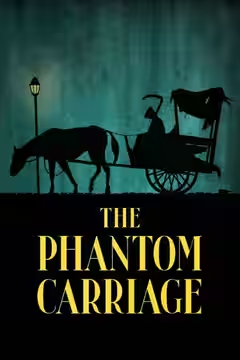
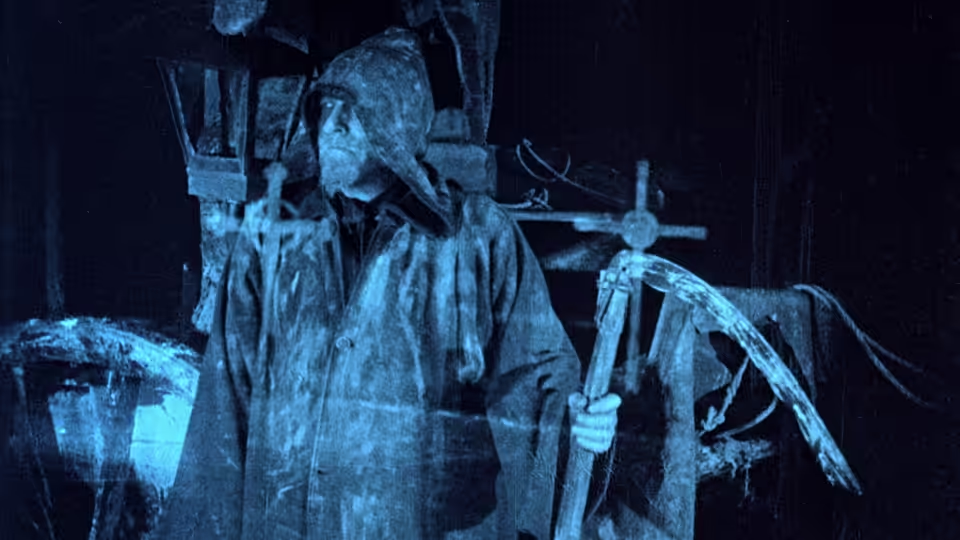
A hooded carriage driver stands holding a scythe beside a horse-drawn carriage
Film review

The Phantom Carriage

1921 · Directed by Victor Sjöström · 1h 48m

In a sentenceA drinking problem serious enough to require supernatural intervention

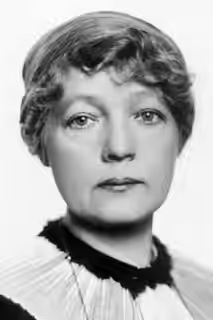
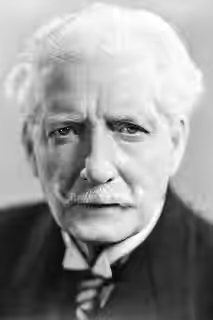
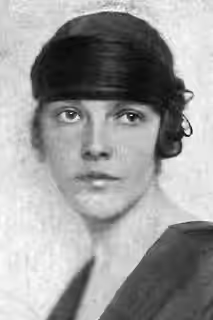
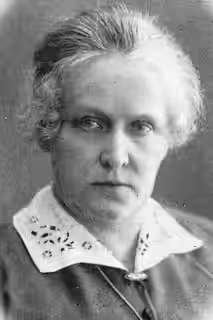
David Holm (Victor Sjöström) is at the centre of a supernatural tale about alcoholism and its consequences for other people. His story involves Mrs. Holm (Hilda Borgström), Georges (Tore Svennberg) and Sister Edit (Astrid Holm). Ghostly appearances bring questions of responsibility and the possibility of change into a drama of human suffering. The narrative moves between layers of the story, returning to the effects of drinking and the hopes placed in personal reform. The question is how far someone can change, and what others must endure along the way.

Fi1m review

Victor Sjöström’s ghost story remains frightening because its effects make human suffering feel close. The double exposures and his patient performance earn a strong recommendation, though the warnings about alcohol can become too insistent.

The Phantom Carriage is a frightening ghost story whose moral instruction sometimes gets too loud, and we recommend it with that reservation. Victor Sjöström writes, directs and plays David Holm, adapting a novel by Selma Lagerlöf into a film about drinking, suffering and the possibility of change. It takes that possibility seriously, including the uncomfortable question of what other people are expected to endure while someone improves. The supernatural gives that question a force that a straightforward cautionary drama might struggle to find.

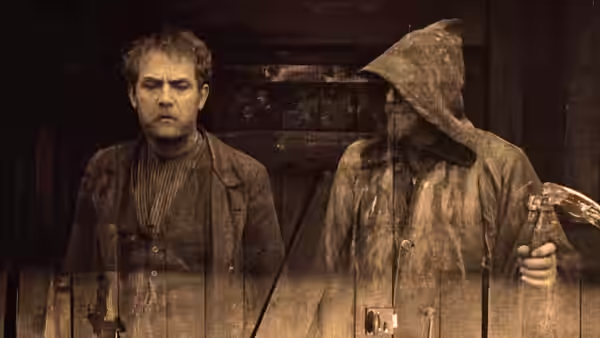
The double exposures are the first reason to watch, and their effectiveness does not depend on allowances for the film’s age. A ghost can be visible without becoming solid, so the eye has to accept a figure and the space seen through it at once. We were frightened by those transparent presences; being able to see through them does nothing to make them feel safely distant. The effect is simple enough to understand, but understanding how it works does little to make it comfortable.

Julius Jaenzon’s cinematography gives these overlapping images the clarity they need. The photography remains crisp enough for the ghostly layer to register without making the whole image dissolve into a vague blur. We keep looking between the transparent figure and what remains visible behind it, trying to separate what the camera has joined. This is painstaking photographic work, and its success lies in how quickly we stop inspecting the technique and start accepting the disturbing thing it shows us.

Victor Sjöström’s performance holds the attention just as firmly. His restraint gives the growing emotion somewhere to go, and the intensity accumulates without every change having to be announced at full strength. There are silent-era stylisations, but his acting is subtle enough to make the character’s distress feel personal. We can follow a human being through the moral lesson because the performance allows him to be difficult, uncomfortable company, even when the writing presses us towards a particular judgement.

The layered storytelling is another reason the film holds our attention across its 108 minutes. It asks us to reconsider what we have understood as the narrative shifts, giving the supernatural material more emotional weight than a simple succession of apparitions would provide. Those changes demand concentration, but following them gives us more to think about than the mechanics of a haunting. The film trusts us to keep up with its storytelling more readily than it trusts us to grasp its warning about drink.

That warning is where the writing becomes less persuasive. The treatment of alcoholism can grow so emphatic that behaviour begins to feel arranged to secure our agreement, and the distress needs little help making its point. Its faith in personal reform also asks for more confidence than we can always give it, considering the suffering involved. These reservations matter, although the photographic invention and the seriousness of the central performance keep the film from becoming merely a lecture.

As supernatural horror, it gives the apparitions a firm purpose by keeping human cruelty and suffering close at hand. There is pleasure in the technical ingenuity, but little comfort in what it serves. The heavy emphasis will trouble some viewers more than the shifts in the narrative, and we would not dismiss that objection as impatience with an old film. Give it a quiet evening and enough attention to follow those shifts; the ghosts can still make themselves felt.
Critical consensus AI synthesised

84
Positive
4
Mixed
0
Negative
0

With only 4 reviews in so far, the response is consistently positive. Critics praise the ghostly effects and inventive storytelling, finding that the technical ingenuity gives the moral tale emotional force. Sjöström’s performance also draws praise for its subtlety and growing intensity. Reservations concern how forcefully the film delivers its message: The AV Club finds the treatment of alcoholism sometimes hysterical, while Slant Magazine sees imperfections in the supernatural story and social optimism. Eye for Film notes silent-era stylisations but finds the moral complexity undiminished. These are qualifications rather than substantial dissent.

The AV Club
12 October 2011 · A- · Scott Tobias
90

Tobias praises the film as a stark, emotionally powerful moral tale, while noting that its treatment of alcoholism can become overly hysterical. He singles out its beautiful in-camera effects and Sjöström’s subtle, intensifying performance for praise.

Read the full review →
Slant Magazine
26 September 2011 · ★★★★ · Joseph Jon Lanthier
80

Lanthier regards the film as an essential work whose supernatural story and social optimism have imperfections. He praises Sjöström’s formal and technical achievements, especially the double exposures and elliptical storytelling that give the film’s supernatural imagery emotional force.

Read the full review →
Eye for Film
12 February 2008 · Anton Bitel
85*

Bitel finds the film a timeless, morally complex work whose message remains powerful despite some silent-era stylisations. He especially praises its layered narrative and crisp cinematography, while also highlighting its inventive ghostly effects.

Read the full review →
The Skinny
6 January 2008 · ★★★★ · Caroline Scott-Thomas
80

Scott-Thomas finds the silent classic gripping and terrifying for modern viewers. She praises Sjöström’s innovative techniques and the unsettling new score.

Read the full review →

Straight answers AI written, from our review

Is The Phantom Carriage worth watching?
The Phantom Carriage is worth watching for its frightening ghostly effects and Victor Sjöström’s restrained performance, and we score it 84 out of 100. We recommend it especially for viewers willing to concentrate on layered storytelling, though its warnings about alcohol become more insistent than the human suffering needs.
How long is The Phantom Carriage, and what is it rated?
The Phantom Carriage runs 1h 48m. It is a drama and fantasy film.
Where can I watch The Phantom Carriage in New Zealand?
The Phantom Carriage is not on any streaming or rental service in New Zealand at the moment. It is available in 4 other countries; change your country at the top of the page to see where. Availability is checked daily.
How violent or frightening is The Phantom Carriage, and is it suitable for children?
The Phantom Carriage has a UK U certificate, but we find its transparent ghosts and human suffering frightening enough to warrant caution with sensitive children. The certificate indicates broad suitability; the alcoholism, cruelty and distress make it a less comfortable family choice than that rating alone might suggest.
How does The Phantom Carriage compare to Ugetsu?
The Phantom Carriage is more emphatic in its moral warnings than Ugetsu, the quieter supernatural drama we recommend alongside it. Both make ghosts and human weakness troubling, and we would choose by temperament rather than declare a clear winner: The Phantom Carriage offers striking double exposures, while Ugetsu rewards patience with quiet human detail.
Is The Phantom Carriage based on a true story or a book?
The Phantom Carriage is adapted from a novel by Selma Lagerlöf, rather than presented as a true story. Victor Sjöström writes and directs this supernatural account of alcoholism, suffering and possible reform; we recommend approaching it on its own, with attention to the layered storytelling rather than prior knowledge of the book.
What should I watch after The Phantom Carriage?
After The Phantom Carriage, try Ugetsu (1953, Fi1m 89): Ghosts and human weakness meet in a quieter, equally troubling supernatural drama. Then Orpheus (1950, Fi1m 82): For another encounter with death made uncanny through simple, carefully controlled photographic tricks.

Cast

If you liked this, try…

  1. The Wind (1928) · not on Fi1m yetAnother silent drama where fear makes an ordinary life almost impossible to bear.

  2. Ugetsu (1953, Fi1m 89)Ghosts and human weakness meet in a quieter, equally troubling supernatural drama.

  3. Scrooge (1951) · not on Fi1m yetSupernatural visitors confront a damaged man, with more bitterness than the seasonal reputation suggests.

  4. Orpheus (1950, Fi1m 82)For another encounter with death made uncanny through simple, carefully controlled photographic tricks.

  5. The Devil's Backbone (2001) · not on Fi1m yetA ghost story that gives human cruelty at least as much attention as apparitions.

The Phantom Carriage (1921) review: A ghost story that still chills (New Zealand) | Fi1m