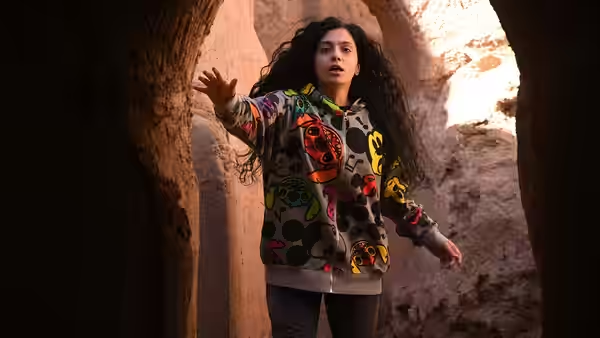
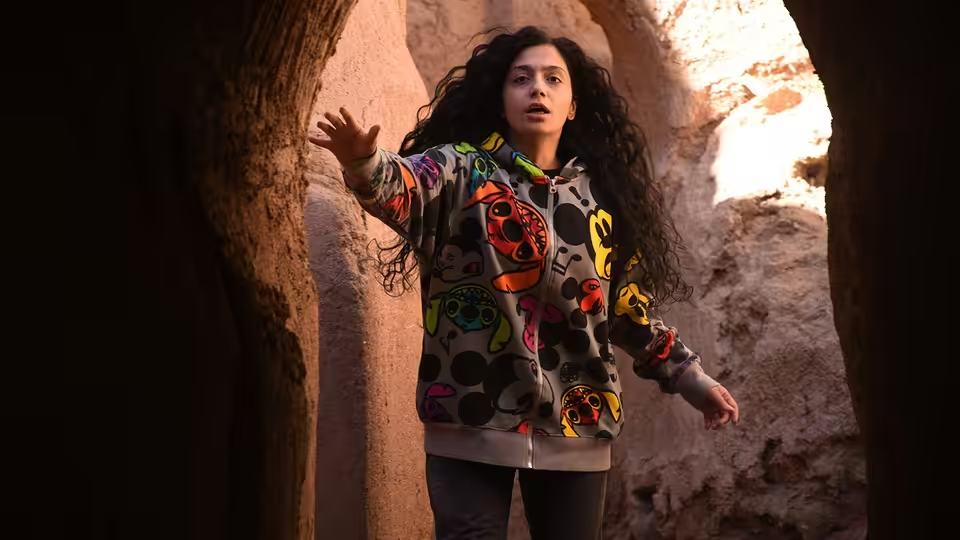
A young woman in a colorful hoodie reaches through a narrow stone passage
Film review

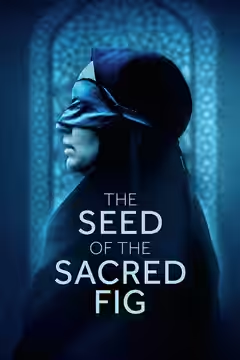
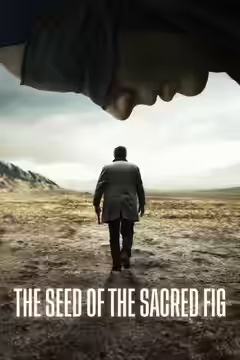
The Seed of the Sacred Fig

2024 · Directed by Mohammad Rasoulof · 2h 47m

In a sentenceOne flat, one missing pistol, and a father who is sure the problem in the house is his daughters

Tehran, autumn 2022. Iman (Missagh Zareh) has just been promoted to investigating judge at the Revolutionary Court, a job that comes with the promise of a bigger flat, a pistol for his protection and a stack of indictments he is told to sign without reading. His wife Najmeh (Soheila Golestani) wants the family to keep its head down so the promotion sticks. Their daughters, Rezvan (Mahsa Rostami), at university, and Sana (Setareh Maleki), still at school, are watching phone footage of the protests that followed the death of Mahsa Amini and asking questions their father will not answer. Then Rezvan’s friend Sadaf (Niousha Akhshi) turns up at the flat with her face full of buckshot, and Najmeh has to decide whose side she is on. Iman keeps the gun in a bedside drawer.

Plays from YouTube when you press play; nothing loads from them until then.

Fi1m review

Mohammad Rasoulof’s drama about a Tehran judge whose household cracks along with the country during the 2022 protests is as tense as any thriller for two hours, carried by Soheila Golestani. It is 167 minutes long, and we would have taken twenty of them away.

Mohammad Rasoulof shot The Seed of the Sacred Fig in secret and left Iran to avoid a prison sentence before it was first shown. It would be easy to review the circumstances instead, and we will try not to. It runs 167 minutes, most of them inside one Tehran flat, and for the first two hours it grips like a good thriller. The last hour is a different, lesser film, and we will come to that.

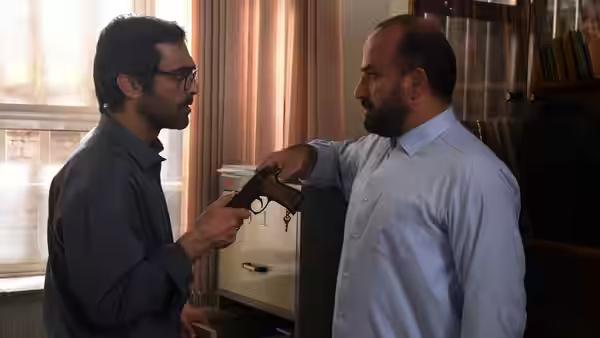
Rasoulof, who also wrote it, states the idea plainly. Iman (Missagh Zareh) is promoted to investigating judge and handed a gun. Outside, women are pulling off their headscarves and being shot at. Inside, his daughters Rezvan (Mahsa Rostami) and Sana (Setareh Maleki) are watching it happen on their phones. Iman’s colleague Ghaderi (Reza Akhlaghirad) tells him the job is to sign what he is given. He signs. Then the gun disappears, and we will say nothing about who has it, except that Iman’s first suspects are the three women he lives with.

Soheila Golestani is the reason it works. Najmeh begins as the regime’s most useful citizen: a woman who believes what she is told and polices her daughters so their father does not have to. Golestani never plays her as stupid. Watch her at the door when Sadaf (Niousha Akhshi) arrives bleeding, weighing what it will cost the family to let the girl in, and then letting her in anyway. The scene that follows, Najmeh at the bathroom sink with tweezers, pulling pellets out of a young woman’s face, is the one we have not been able to shake. We flinched at every pellet, and then we noticed Najmeh’s hands were steady and her mouth was not, and we understood which way this woman was going to go.

Pooyan Aghababaei shoots the flat close and dim, in the yellow of overhead bulbs, so that the family seems to be in one another’s way. He does nothing to the phone footage, which is real, vertical and shaky, and editor Andrew Bird cuts it into the drama without softening it. The first time a clip of a real girl being beaten appeared inside a scripted scene, it stopped us cold, and we think Rasoulof wants it to. Karzan Mahmood’s score is sparse, low and mostly absent from the flat. Amir Panahifar dresses the place as respectable and slightly too small, the home of people who have done what they were told and are waiting to be rewarded.

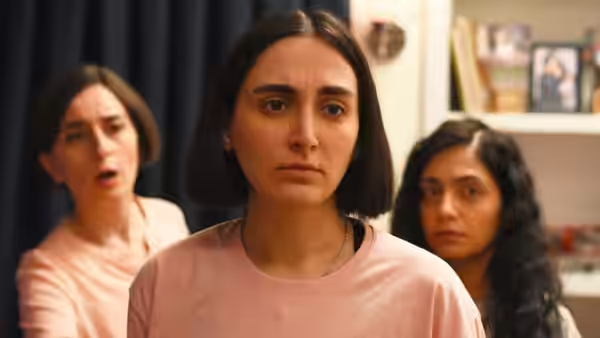
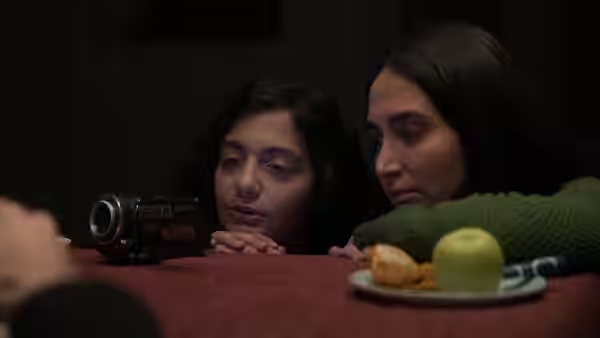
Zareh has the harder job. Iman is a weak man handed a little power, and for a long stretch Zareh plays him as tired rather than cruel, a father who wants his daughters to stop making things difficult. The dinner-table confrontations, in which Rostami’s Rezvan will not let a lie pass and Maleki’s Sana watches her mother for a sign, are the best-written scenes in the film. Nazanin Tavasoli’s costumes do quiet work here: the daughters’ clothes loosen, scene by scene, while Najmeh’s stay exactly as they were.

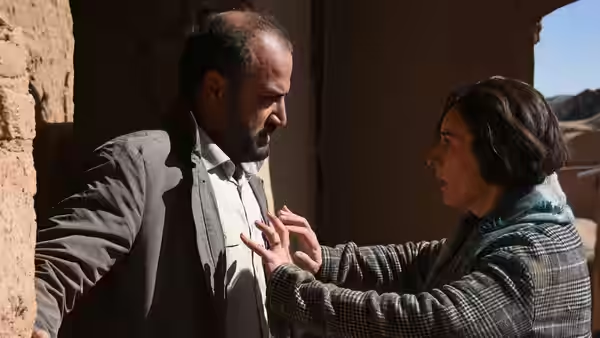
The last stretch is a different film, and we will not describe it. Rasoulof leaves the flat, and once the gun is out of the drawer Iman sits his wife and daughters down and questions them one by one, and they answer him in speeches about duty, God and what a father owes, aimed at the camera as much as at him. Some of Aghababaei’s daylight is striking, bleached until stone looks like bone, but we had been frightened for two hours by a family at a table, and we were not frightened by what replaces it. It runs twenty minutes too long, and every one of them is here.

Rasoulof’s earlier work was quieter and more oblique, and this is his angriest film. We do not hold that against it; there is a great deal to be angry about, and the anger is what puts the bathroom scene and the dinner table on screen. It is also what tips the ending into melodrama.

It is a 15 certificate, and the phone footage is the reason. See it for Golestani, and for the first two hours, and forgive it the third. We did.

Critical consensus AI synthesised

80
Positive
18
Mixed
4
Negative
0

Most critics are on the film’s side, and none of the reviews turn against it. They describe a family drama that becomes a domestic thriller once the state’s paranoia gets inside the flat, and they take the household as a stand-in for the country. Praise clusters on the cast, above all Soheila Golestani as the mother Najmeh, whose slow loss of certainty several critics single out as the film’s centre. Rasoulof’s unflashy direction and his use of real protest footage also draw approval.

The reservations gather around the last act, which even admirers call overblown, and which a few find slips into a more ordinary thriller and upsets the earlier balance. A handful think the allegory too blunt and the opening didactic. The spread is narrow and tilted upward: four reviews are mixed, none negative. Paste goes furthest, finding the film obvious and its characters flat; Slant judges the symbolism overloaded.

Evening Standard
6 February 2025 · ★★★★★ · Nick Howells
100

Howells calls the film gripping, intelligent and essential viewing, despite noting that some may find its finale excessive. He singles out Soheila Golestani’s restrained performance and the tense, escalating family crisis for praise.

Read the full review →
Time Out
24 May 2024 · ★★★★★ · Phil de Semlyen
100

The review presents the film as a masterly, exceptionally bold family drama. It singles out its forceful attack on Iran’s repressive state.

Read the full review →
IndieWire
27 November 2024 · A- · Ryan Lattanzio
90

Lattanzio calls the film a shattering masterwork and an ultimately hopeful allegory about repression. He praises its gripping domestic-thriller descent and the understated, courageous performances.

Read the full review →
The AV Club
27 November 2024 · A- · Matt Schimkowitz
90

The review finds the film an unpredictable domestic thriller where personal life and politics are inseparable. It praises the way Rasoulof builds paranoia inside the family’s apartment and turns the household into a microcosm of the country.

Read the full review →
Empire
5 February 2025 · Ian Freer
85*

Freer calls the film a bold, timely and gripping achievement. He particularly praises how its understated performances and unflashy filmmaking connect the personal and political.

Read the full review →
Los Angeles Times
27 November 2024 · Tim Grierson
85*

Grierson finds the drama absorbing, grim and ultimately cathartic in its portrayal of repression entering family life. He especially praises Soheila Golestani’s moving performance as a mother whose unquestioned beliefs begin to unravel.

Read the full review →

Straight answers AI written, from our review

Is The Seed of the Sacred Fig worth watching?
The Seed of the Sacred Fig is worth watching for anyone who can sit through 167 minutes of a family drama that grips like a thriller, and we scored it 80. Soheila Golestani carries the first two hours as a mother deciding whose side she is on. The last stretch tips into speeches and melodrama, and we would have cut twenty minutes.
How long is The Seed of the Sacred Fig, and what is it rated?
The Seed of the Sacred Fig runs 2h 47m. It is a drama and thriller film.
Where can I watch The Seed of the Sacred Fig in Azerbaijan?
The Seed of the Sacred Fig is not on any streaming or rental service in Azerbaijan at the moment. It is available in 19 other countries; change your country at the top of the page to see where. Availability is checked daily.
How violent or frightening is The Seed of the Sacred Fig, and is it suitable for children?
The Seed of the Sacred Fig is a UK 15 and not suitable for children. The real phone footage of protesters being beaten, cut into the drama without softening, is the reason for the certificate, and a scene of pellets being pulled from a young woman's face made us flinch. The threat is mostly a father with a gun; it is tense rather than graphic.
What should I watch after The Seed of the Sacred Fig?
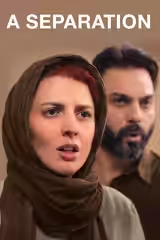
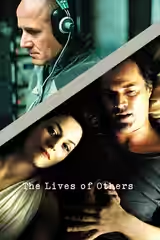
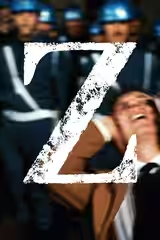
After The Seed of the Sacred Fig, try A Separation (2011, Fi1m 93): Farhadi’s Tehran marriage drama, where a single lie divides a household and a courtroom. Then The Lives of Others (2006, Fi1m 84): East Berlin, a Stasi listener and the slow discovery that the state is wrong; and Z (1969, Fi1m 84): Costa-Gavras’s political thriller about a cover-up, cut like a chase and just as angry.

Cast

Awards

Lumière Award for Best International Co-Production, 2025

Won
Lumière Award for Best International Co-Production

European Film Award for Best Film, 2024

Nominated
European Film Award for Best Film

If you liked this, try…

  1. A Separation (2011, Fi1m 93)Farhadi’s Tehran marriage drama, where a single lie divides a household and a courtroom.

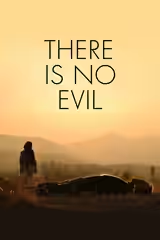
  2. There Is No Evil (2020) · not on Fi1m yetRasoulof’s earlier film on the death penalty, quieter and told in four parts.

  3. The Lives of Others (2006, Fi1m 84)East Berlin, a Stasi listener and the slow discovery that the state is wrong.

  4. Holy Spider (2022) · not on Fi1m yetA serial killer in Mashhad and the women who will not let him be excused.

  5. Z (1969, Fi1m 84)Costa-Gavras’s political thriller about a cover-up, cut like a chase and just as angry.