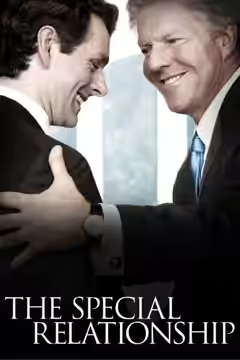
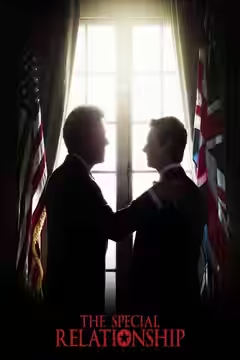
Peter Morgan’s third film about Tony Blair, with Michael Sheen in the part for the third time, is brisk, intelligent and over before it has settled. Sheen and Hope Davis are worth the evening; Dennis Quaid’s Clinton stays an impression, and 93 minutes is not enough for four years.
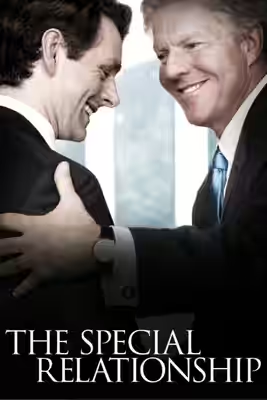
Peter Morgan has written about Tony Blair twice before, in The Deal (2003) and The Queen (2006), and both times Michael Sheen played him. The Special Relationship closes the set by crossing the Atlantic: Blair in opposition, flying to Washington to learn from Bill Clinton’s people how a centre-left party wins, and then Blair in power, finding out what the lesson cost. It is a decent film and a hurried one. Richard Loncraine directs it cleanly, the cast is mostly good, and at 93 minutes it skims four years of two governments that would have filled a series.
Sheen is the reason to watch. He has the grin, the hand on the forearm, the way of leaning into a conversation as if it were an embrace, and he has had three films to find what is underneath them. What is new here is confidence arriving: the pupil in the Oval Office, nodding and taking notes, turns over the course of the film into a man who thinks he knows better, and Sheen does it by degrees, mostly in how long he lets Clinton finish a sentence. Helen McCrory’s Cherie Blair is sharper than the script strictly needs, suspicious of Washington from the first handshake and the only person in the film who says so out loud. Adam Godley’s Jonathan Powell and Mark Bazeley’s Alastair Campbell bustle about behind them and look like men who have slept in the office.
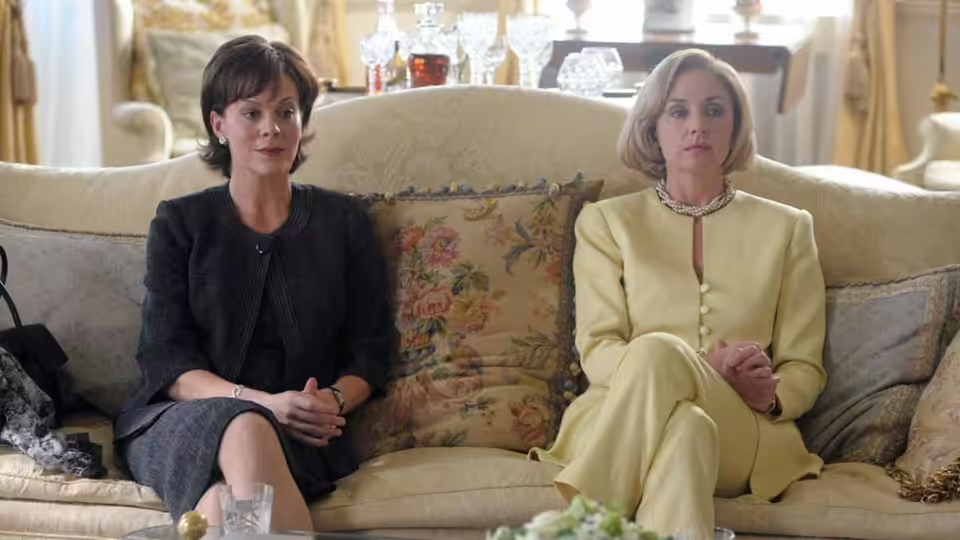
Dennis Quaid has done the work. He has the Arkansas vowels, the bulk, the jabbing thumb, the habit of making a room feel it has been personally forgiven. What he does not have is a Clinton we believe exists when the camera is elsewhere. We watched a performance, admired it, and never once forgot we were watching it. Hope Davis is far better as Hillary Clinton, playing her as the cleverest person in every room and the one most tired of having to prove it. When the scandal arrives, and the film treats it as the middle act, Davis mostly listens, and the one time The Special Relationship got past our guard was a shot of her face while her husband talks, saying nothing, giving nothing, and plainly deciding something. It is over in seconds and it is the most honest moment in the film.
The craft is tidy and unshowy. Barry Ackroyd shoots it loosely, often handheld, in offices, planes and corridors, so that the camera seems to be eavesdropping rather than staging. Maria Djurkovic’s rooms, the cream and gilt of the Oval Office, the lamps and borrowed furniture of Downing Street, look like places people pass through rather than own. Consolata Boyle dresses Blair in suits he grows into and Clinton in jackets he already fills. Alexandre Desplat’s score is light on its feet, piano and strings keeping the tone amused, and it tells us this is a comedy of manners even in the scenes where the subject is bombing. Melanie Oliver cuts it fast, with news footage stitched in to carry us across the years, and that speed is the problem as well as the method.
Because Morgan has built the film out of telephone calls, and two men on telephones is a dramatic form with limits. An election, a scandal, Northern Ireland and a war each get a scene and a caption and are gone. The stretch in the last third where the friendship turns is the best written material in the film, and also the most rushed; we will not describe it, except to say that it needed twenty minutes and gets about eight. We were never bored. We were hurried, which is a different complaint, and we kept checking how much was left and finding there was not much.
The Queen had one week and one house, and The Deal had one restaurant table and a decade of resentment. This one has two capitals and no centre of gravity, and Loncraine, for all his tidiness, never slows it down long enough to find one. The reviews so far are split roughly down the middle, and we can see why: every virtue here is real, and every one of them is interrupted.
Watch it at home, after the other two, where its 93 minutes feel less like a shortfall and more like a long final episode. Stay for Sheen, stay for Davis, and do not expect to learn anything about Bill Clinton that a good impressionist could not have told you.