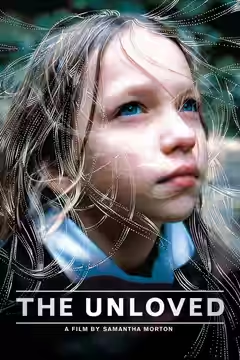
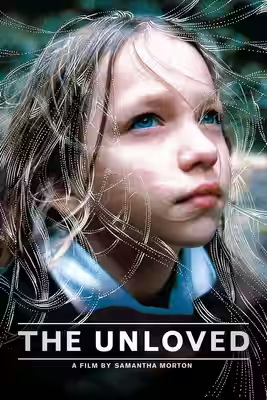
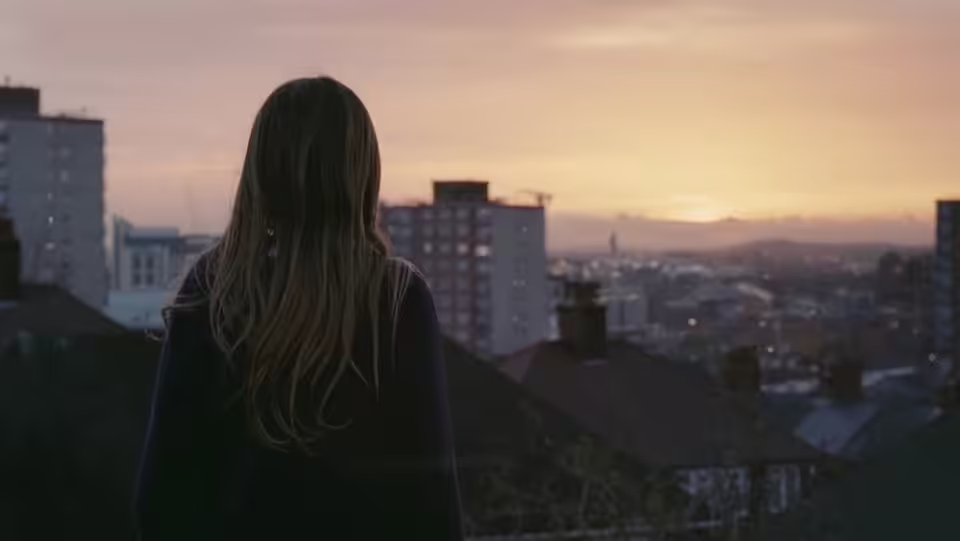
A girl stands with her back to the camera, looking over city rooftops at sunset
Film review

The Unloved

2009 · Directed by Samantha Morton · 1h 46m

In a sentenceNobody in this film shouts, and we have rarely wanted a child out of a room more

Nottingham. Eleven-year-old Lucy (Molly Windsor) lives with her father (Robert Carlyle) in a flat where the smallest lapse earns a beating with a belt. After one such night she is taken by social services to a children’s home. Her mother (Susan Lynch) has a new life and says she cannot take her. At the home Lucy is put in a room with Lauren (Lauren Socha), an older girl who comes and goes as she pleases, and watched over by staff including Ben (Craig Parkinson). Lucy wants to go home, or to any home; what stands in the way is that nobody who could give her one wants to. She goes to church alone, walks the city, and keeps her own counsel.

Plays from YouTube when you press play; nothing loads from them until then.

Fi1m review

Samantha Morton’s first film as director puts an eleven-year-old girl into care and watches, closely and without comment, for 106 minutes. It is patient to the point of monotony in places, but Molly Windsor and Lauren Socha make it an evening worth having.

Samantha Morton grew up in care, and her first film as director, written with Tony Grisoni, is about a girl who is sent there. It is not a message film. It follows an eleven-year-old called Lucy from her father’s flat into a Nottingham children’s home and stays at her shoulder for 106 minutes, listening to what adults say about her and watching what they do. It is a good film, slow and hard and well acted, and it is worth your evening if you can stand to be left alone with it.

The opening is the hardest thing in it. Lucy’s father (Robert Carlyle) comes home, finds something not done, and takes his belt to her. Morton lets the scene run, and Carlyle plays him not as a monster but as a tired man who believes he is being firm, which is worse. We were horrified, and we were still thinking about it an hour later, because Molly Windsor’s face does almost nothing while it happens. Lucy has learnt that reacting makes it last longer.

Windsor carries the film with that stillness. She is in nearly every shot, she rarely has more than a line at a time, and she makes a watching child into a point of view, so that every adult who leans down to tell her it will be all right is seen from below and found out. Lauren Socha, as the older girl who shares her room, is the opposite kind of presence, loud and quick and generous and already half gone to the streets outside, and the two of them together are the best thing here. There is something between Lauren and one of the staff, Ben (Craig Parkinson), that Lucy sees before she understands it. We will leave it there. Susan Lynch has one long scene as Lucy’s mother, a woman who has decided she cannot cope and would like the decision to be somebody else’s, and it is the one time the film raises its voice.

Thomas Townend shoots in what looks like the light that was there: grey Nottingham afternoons, orange streetlit nights, strip lighting in the home’s corridors. He holds takes long enough for a room to become familiar, and he keeps the focus shallow so that Lucy is sharp and the adults behind her often are not. Jane Levick’s children’s home is magnolia walls, a locked office, a television nobody has chosen the channel on; it is not squalid, which is the point. The music is by Colleen. Colin Monie cuts with the same patience, holding on a face for a beat after the line, and most of the time that is right.

Most of the time. Somewhere past the hour the film settles into a rhythm of corridor, bedroom, street, church, and we noticed we had stopped waiting for anything. Morton gives Lucy a private faith, and the church scenes are the one place where the film tells us what to feel rather than letting us find it. The pace that is a virtue in the first half becomes a habit in the second. We were never bored exactly, but we were aware of the running time, and a film this careful should not let that happen.

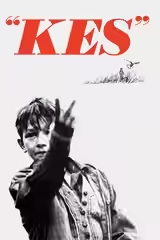
Set against the British films it will be compared with, Ken Loach’s Kes (1969) above all, this is a smaller, quieter thing, and it is a first film, and it shows in the middle. It does not show in the performances or in the way Morton trusts a child’s face to carry a scene. It was made for television and it belongs there: watch it at home, with the lights off, and do not plan anything cheerful for afterwards. It carries a 15 certificate, and the opening is the reason.

Critical consensus AI synthesised

69
Positive
5
Mixed
2
Negative
1

Most critics are won over by Samantha Morton’s directorial debut, and the praise clusters on the performances. Molly Windsor’s lead and Lauren Socha are named again and again, with the confrontation between the girl and her mother and the final shot of Lucy trying to smile picked out as the moments that land hardest. Several reviewers also admire the long, unflinching takes and a direction that keeps close to the child’s point of view.

The reservations are about pace and temperature. A minority find the deliberately even tone monotonous, with The Hollywood Reporter judging the film less involving than Morton’s own acting, and Den of Geek finding it too dreary and muted to move as it means to. Others concede the symbolism is heavy in places and the story drifts, but still recommend it. The spread is wide, from warm admiration to one outright dismissal, though positive verdicts clearly outnumber the rest.

The Guardian
18 February 2010 · Xan Brooks
85*

Brooks finds the film a fierce, heartfelt and convincing account of childhood in care. He singles out Lauren Socha’s mesmerising performance and the quietly gut-wrenching confrontation between the girl and her mother.

Read the full review →
Empire
27 January 2010 · Phil de Semlyen
82*

The review finds the film bleak but ultimately moving, insightful and uplifting. It singles out the final shot of Lucy trying to smile as especially heartbreaking.

Read the full review →
Time Out
16 February 2010 · ★★★★ · Trevor Johnston
80

The four-star rating indicates a positive verdict on Morton’s directorial debut. The review singles out its cinematic feel and long, unflinching takes.

Read the full review →
Variety
21 September 2009 · festival review · Dennis Harvey
80*

Harvey finds the film a delicate, wistful portrait that nearly merits the company of great cinematic childhood stories. He especially praises Samantha Morton’s child-centered direction and Molly Windsor’s intimate performance.

Read the full review →
Screen Daily
18 September 2009 · David D'Arcy
64*

The page identifies this as a review, but its critical verdict is unavailable in the accessible text. No specific element of praise or complaint can be confirmed.

Read the full review →
The Hollywood Reporter
23 September 2009 · festival review · The Associated Press
30*

The critic finds the film’s deliberately relentless approach monotonous and less captivating than Morton’s acting. They praise its occasional inventive use of sound, while wishing it offered more variation and dimension.

Read the full review →

Straight answers AI written, from our review

Is The Unloved worth watching?
The Unloved is worth watching for anyone who can take a slow, hard drama about a child in care, and we scored it 74. Samantha Morton's first film as director is patient to the point of monotony in its second half, but Molly Windsor and Lauren Socha make it an evening worth having. Watch it at home and plan nothing cheerful afterwards.
How long is The Unloved, and what is it rated?
The Unloved runs 1h 46m. It is a drama film.
Where can I watch The Unloved in Hungary?
The Unloved is not on any streaming or rental service in Hungary at the moment. It is available in 2 other countries; change your country at the top of the page to see where. Availability is checked daily.
How violent or frightening is The Unloved, and is it suitable for children?
The Unloved carries a UK 15 certificate and is not for children; the opening scene, in which a father beats his eleven-year-old daughter with a belt, is the reason. There is almost no shouting and nothing graphic beyond that, but the quiet is its own kind of hard. Older teenagers who can sit with a sad film will manage it.
How does The Unloved compare to Kes?
The Unloved is a smaller, quieter film than Kes, and Kes is the better of the two. Loach's film is funny as well as bruising and holds its shape throughout, where Morton's first film sags in the middle. What they share is a trust in a child's face to carry a scene, and on that ground Molly Windsor stands up beside David Bradley.
What should I watch after The Unloved?
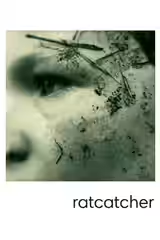
After The Unloved, try Kes (1969, Fi1m 88): The British film about a boy nobody wants that everything since has been measured against. Then Ratcatcher (1999, Fi1m 88): Lynne Ramsay’s Glasgow childhood, shot with the same patience and a sharper eye for beauty; and Nobody Knows (2004, Fi1m 87): Four Tokyo children left alone in a flat; Kore-eda watches without ever raising his voice.

Cast

If you liked this, try…

  1. Kes (1969, Fi1m 88)The British film about a boy nobody wants that everything since has been measured against.

  2. Ratcatcher (1999, Fi1m 88)Lynne Ramsay’s Glasgow childhood, shot with the same patience and a sharper eye for beauty.

  3. Nobody Knows (2004, Fi1m 87)Four Tokyo children left alone in a flat; Kore-eda watches without ever raising his voice.

  4. Ponette (1996, Fi1m 84)A four-year-old grieves her mother in a French film that trusts its child completely.

  5. The Selfish Giant (2013, Fi1m 88)Two Bradford boys and a scrap dealer; Clio Barnard’s film is harder and faster than this one.

Free account

Know what to watch tonight

Two lists that know where things are streaming, collections you can share, your own score beside ours, and Discover that remembers what you have seen.

  • Want to see, sorted by what is streaming now
  • Seen, with your score out of ten
  • No adverts, ever