Jafar Panahi turns a child’s search for a goldfish into an absorbing street drama. Aida Mohammadkhani makes Razieh’s persistence funny and urgent, though the unhurried pace occasionally leaves us waiting longer than we need to.
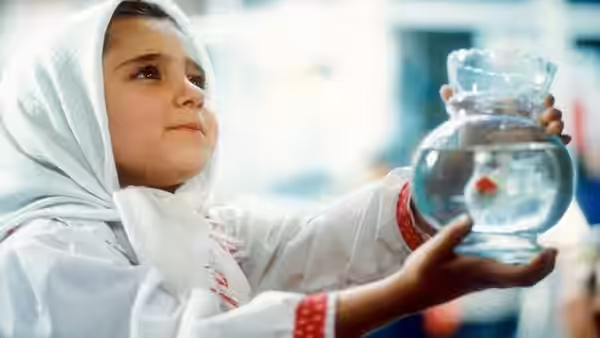
Wanting a goldfish is enough to keep Razieh occupied, and Jafar Panahi makes it enough to occupy us too. The White Balloon is a warm, quietly suspenseful film which takes a child’s errand seriously without making its importance sound implausible. There is pleasure in how little explanation we need before accepting that this matters. He lets the search unfold through Tehran’s busy streets, where Razieh’s concentration has to compete with everything else going on around her.
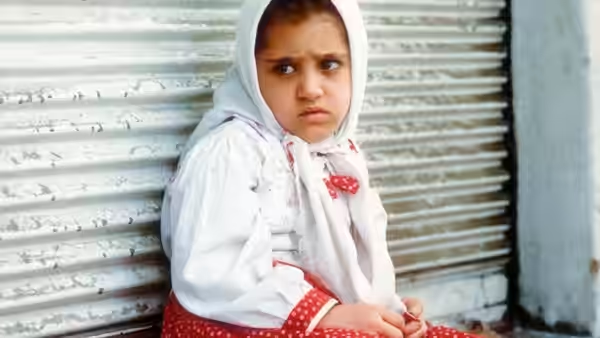
Aida Mohammadkhani makes that concentration funny because she never appears to be offering it as a joke. Razieh’s persistence is recognisably childish, including the unreasonable certainty that what she wants should concern everybody else. We laughed at her insistence on getting the goldfish, then grew anxious for her as she made her way through the streets. She holds our attention without having to soften Razieh into a child whose every demand deserves applause.
Farzad Jadat’s cinematography makes the street bustle part of that anxiety. The close-ups and point-of-view camerawork keep our attention near Razieh, while the city remains busy enough to suggest how easily a small person’s wishes can be overlooked. We are given time to study her face rather than merely register where the errand has reached. The approach works because the streets remain interesting in their own right; a less attentive film would let them become anonymous scenery.
The production design, credited to Jafar Panahi and Hamid Reza Ashtianipoor, gives those encounters an everyday setting. The streets feel occupied by people with tasks to finish, which helps prevent the film from becoming precious about its young lead. We never feel that Tehran has been cleared for the benefit of one child and her errand. Abbas Kiarostami’s screenplay finds humour in how much getting the fish means to Razieh and how little it need mean to anybody else.
As editor, Jafar Panahi is willing to let that concentration set the pace. At 85 minutes, the film is short, but there is no attempt to hurry Razieh along for an adult audience. For the most part, the unhurried rhythm allows the child performances and the street life to hold us. There are stretches where the wait feels prolonged, and Razieh’s persistence begins to tell us something we have already understood.
Family films can be too quick to explain what a child ought to learn from an encounter. This one is more interested in letting us see how thoroughly a desire can take over a child’s attention. The simplicity of the search gives us room to notice behaviour, and the performances keep that behaviour from feeling like an illustrated lesson. Razieh’s determination is easy to understand, even when we might wish she would make things easier for herself.
We recommend it warmly, and not only as a film to put on for children. The humour stops it feeling dutiful, and the lead performance gives us someone whose company we enjoy even when she is being difficult. Give it an evening when nobody needs the plot to get a move on.