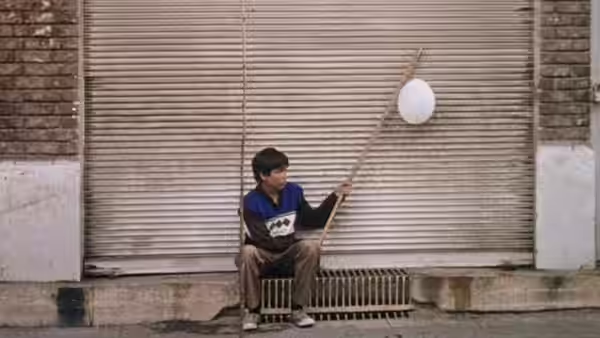
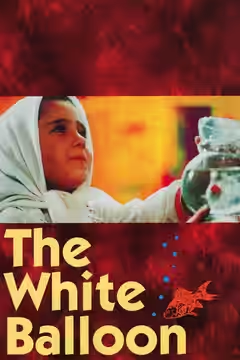
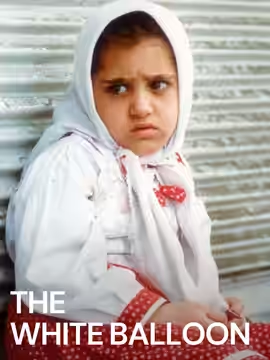
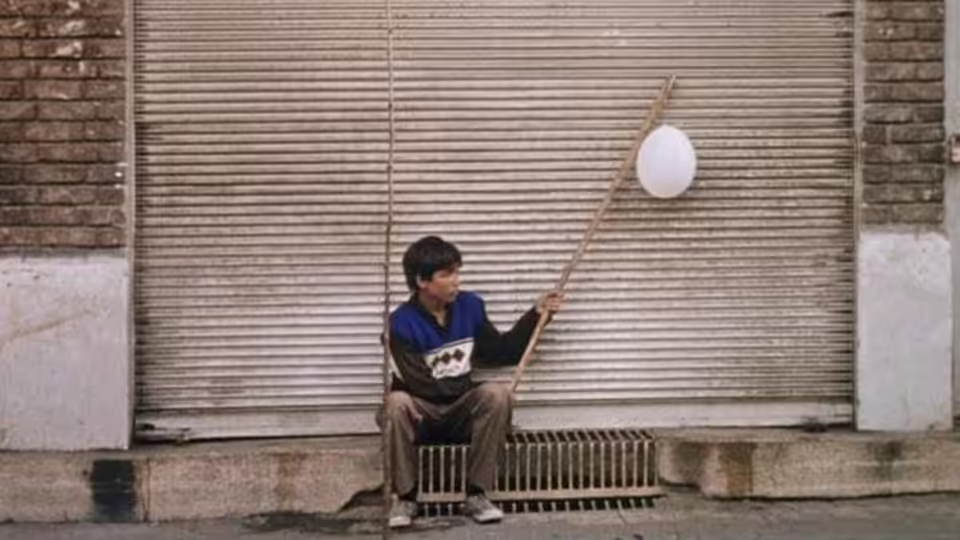
Ali (Mohsen Kafili) sits by a shutter, holding a pole with a white balloon
Film review

The White Balloon

1995 · Directed by Jafar Panahi · 1h 25m

In a sentenceAll this fuss over a goldfish, and we were quite prepared to make more

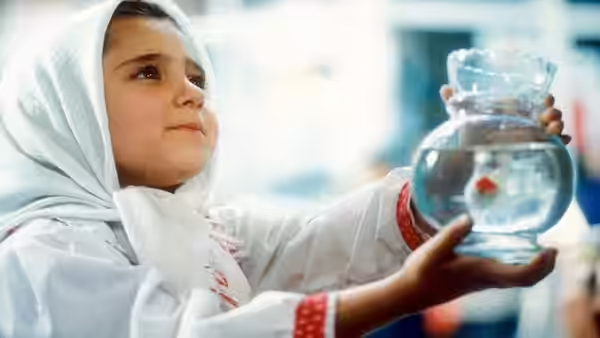
In Tehran, Razieh (Aida Mohammadkhani) wants a goldfish and sets out on her first journey alone. The people around her include Mother (Fereshteh Sadr Orafaee) and Ali (Mohsen Kafili), alongside shopkeepers and snake charmers. Out in the busy streets, her attention stays on getting the fish while the adults have their own business to attend to. The errand brings her into contact with people beyond her familiar company. Razieh persists, with no intention of treating her search as a minor matter that can simply be put aside.

Fi1m review

Jafar Panahi turns a child’s search for a goldfish into an absorbing street drama. Aida Mohammadkhani makes Razieh’s persistence funny and urgent, though the unhurried pace occasionally leaves us waiting longer than we need to.

Wanting a goldfish is enough to keep Razieh occupied, and Jafar Panahi makes it enough to occupy us too. The White Balloon is a warm, quietly suspenseful film which takes a child’s errand seriously without making its importance sound implausible. There is pleasure in how little explanation we need before accepting that this matters. He lets the search unfold through Tehran’s busy streets, where Razieh’s concentration has to compete with everything else going on around her.

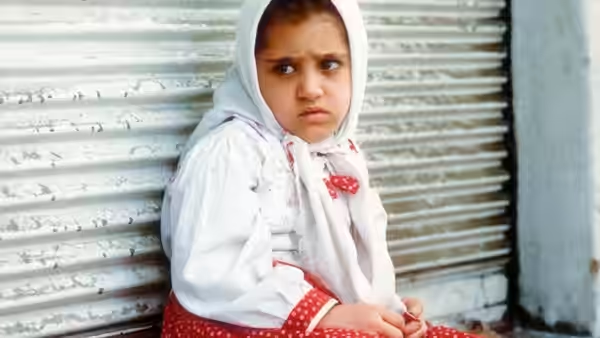
Aida Mohammadkhani makes that concentration funny because she never appears to be offering it as a joke. Razieh’s persistence is recognisably childish, including the unreasonable certainty that what she wants should concern everybody else. We laughed at her insistence on getting the goldfish, then grew anxious for her as she made her way through the streets. She holds our attention without having to soften Razieh into a child whose every demand deserves applause.

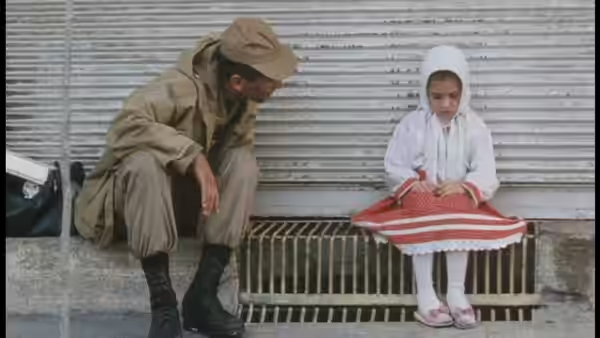
Farzad Jadat’s cinematography makes the street bustle part of that anxiety. The close-ups and point-of-view camerawork keep our attention near Razieh, while the city remains busy enough to suggest how easily a small person’s wishes can be overlooked. We are given time to study her face rather than merely register where the errand has reached. The approach works because the streets remain interesting in their own right; a less attentive film would let them become anonymous scenery.

The production design, credited to Jafar Panahi and Hamid Reza Ashtianipoor, gives those encounters an everyday setting. The streets feel occupied by people with tasks to finish, which helps prevent the film from becoming precious about its young lead. We never feel that Tehran has been cleared for the benefit of one child and her errand. Abbas Kiarostami’s screenplay finds humour in how much getting the fish means to Razieh and how little it need mean to anybody else.

As editor, Jafar Panahi is willing to let that concentration set the pace. At 85 minutes, the film is short, but there is no attempt to hurry Razieh along for an adult audience. For the most part, the unhurried rhythm allows the child performances and the street life to hold us. There are stretches where the wait feels prolonged, and Razieh’s persistence begins to tell us something we have already understood.

Family films can be too quick to explain what a child ought to learn from an encounter. This one is more interested in letting us see how thoroughly a desire can take over a child’s attention. The simplicity of the search gives us room to notice behaviour, and the performances keep that behaviour from feeling like an illustrated lesson. Razieh’s determination is easy to understand, even when we might wish she would make things easier for herself.

We recommend it warmly, and not only as a film to put on for children. The humour stops it feeling dutiful, and the lead performance gives us someone whose company we enjoy even when she is being difficult. Give it an evening when nobody needs the plot to get a move on.
Critical consensus AI synthesised

83
Positive
5
Mixed
1
Negative
0

Most critics respond warmly to The White Balloon, with praise clustering around its child performances, simple storytelling and close attention to street life. The young lead’s persistence in searching for a goldfish supplies humour, while the modest scale of her predicament allows for suspense. The reviews credit Panahi’s close-ups, point-of-view camerawork and understated visual choices with keeping the child’s experience central. Several also find the story accessible, with an unhurried pace that strengthens its sense of everyday life.

The differences are chiefly in emphasis: some reviews favour the performances and charm, others the simplicity and visual control. The recorded scores cluster closely apart from one lower assessment associated with The New York Times. Its review text is inaccessible, however, so no specific reservation can be verified. The available commentary supplies no clear recurring complaint to set against the praise.

Empire
1 January 2000 · William Thomas
90*

Thomas gives the film a strongly positive verdict, calling it remarkable and unusually real. He singles out Panahi’s close-up direction and point-of-view camerawork for immersing viewers in the bustling streets and Razieh’s dilemma.

Read the full review →
Los Angeles Times
6 September 1998 · Kenneth Turan
85*

Turan finds the film charming and satisfying in its unhurried slice-of-life approach. He especially praises the young lead’s comical persistence as she searches for a goldfish.

Read the full review →
Time Out
· WH
85*

The critic presents the film as an extraordinary, subtly accomplished debut. They praise its audacious simplicity in following a child’s first solo journey through Tehran.

Read the full review →
Variety
31 May 1995 · festival review · Lisa Nesselson
85*

Nesselson finds the film a charming, suspenseful slice of life with near-universal appeal. She praises the child performances and the lively street cinematography for conveying a strong sense of place.

Read the full review →
The New York Times
29 September 1995 · festival review
64*

The page content is inaccessible, so the critic’s verdict cannot be determined. No praise or complaint can be verified from the available text.

Read the full review →
HeyUGuys
11 July 2010 · Martyn Warren
90*

Warren strongly recommends the film as a beautiful, accessible family story. He praises its simple, universal screenplay and Panahi’s understated visual choices.

Read the full review →

Straight answers AI written, from our review

Is The White Balloon worth watching?
The White Balloon is warmly recommended for patient viewers who enjoy closely observed everyday drama, and we score it 87 out of 100. Aida Mohammadkhani makes Razieh’s determination to get a goldfish funny and quietly suspenseful, though some stretches prolong the wait beyond what her small errand needs.
How long is The White Balloon, and what is it rated?
The White Balloon runs 1h 25m. It is a drama and family film.
Where can I watch The White Balloon in Australia?
The White Balloon is streaming on MUBI and Amazon Prime Video in Australia. Availability is checked daily; the links above go straight to each service.
How does The White Balloon compare to The Kid?
The White Balloon is our pick over The Kid for quiet street drama, while Chaplin’s film is the better choice for sharply judged comedy. Both take a child’s needs seriously: Razieh’s goldfish errand brings humour and anxiety, with some prolonged waits, whereas The Kid finds warmth in caring for a child with little to spare, occasionally leaning too heavily on sentiment.
What should I watch after The White Balloon?
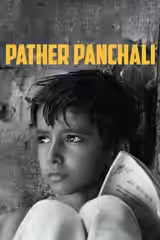
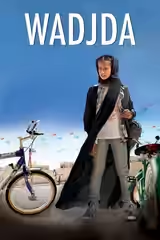
After The White Balloon, try The Kid (1921, Fi1m 84): For more street-level comedy that takes a child’s needs seriously. Then Pather Panchali (1955, Fi1m 93): A child’s curiosity meets adult hardship, with patience and little sentimental reassurance; and Wadjda (2012, Fi1m 80): Another determined girl wants something the adults consider more complicated than she does.

Cast

Awards

International Submission to the Academy Awards, 1996

Nominated
International Submission to the Academy Awards

If you liked this, try…

  1. Where Is the Friend's House? (1987) · not on Fi1m yetAnother small errand becomes urgent through a child’s unwavering sense of responsibility.

  2. The Kid (1921, Fi1m 84)For more street-level comedy that takes a child’s needs seriously.

  3. Pather Panchali (1955, Fi1m 93)A child’s curiosity meets adult hardship, with patience and little sentimental reassurance.

  4. Wadjda (2012, Fi1m 80)Another determined girl wants something the adults consider more complicated than she does.

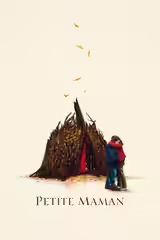
  5. Petite Maman (2021) · not on Fi1m yetEqually attentive to children, with a stranger story and similarly modest means.

The White Balloon (1995) review: A small errand worth our time (Australia) | Fi1m