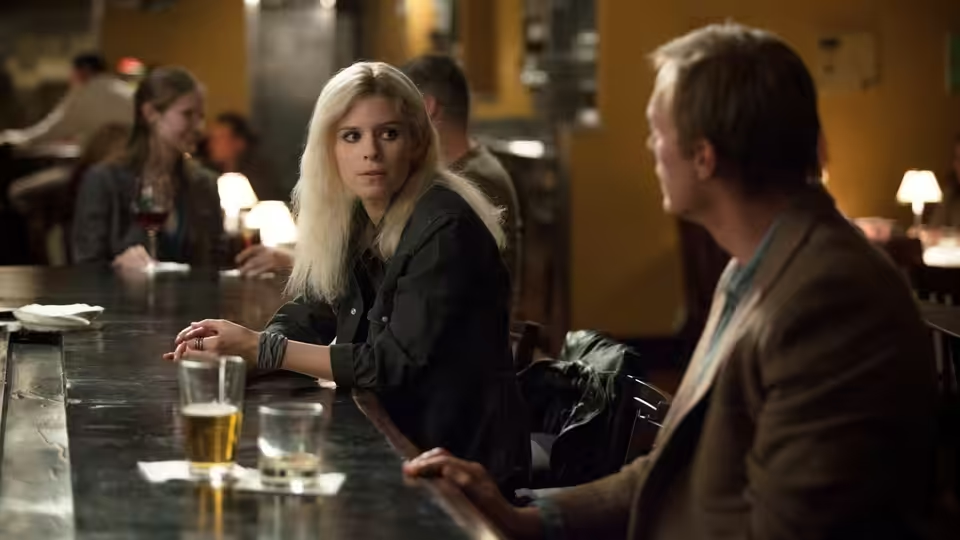
A blonde woman and a man sit facing each other at a bar
Film review

Transcendence

2014 · Directed by Wally Pfister · 1h 59m · KMRB 12

In a sentenceJohnny Depp spends most of the film as a face on a monitor, which is not the demotion it sounds

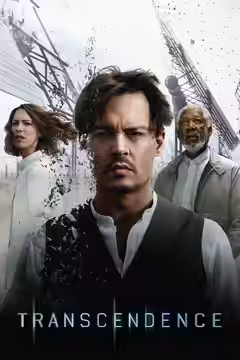
Berkeley. Dr. Will Caster (Johnny Depp) is the leading researcher in artificial intelligence, a man who would rather garden than give speeches, and his wife Evelyn (Rebecca Hall) is the one who wants the work to change the world. At a fundraising lecture he describes the moment a machine will outthink every human alive and calls it transcendence. Minutes later a man from an anti-technology group shoots him as he leaves. The bullet is laced with polonium, and he has weeks to live. Evelyn and their friend Max Waters (Paul Bettany) copy his mind into the lab’s experimental computer before he dies, while Joseph Tagger (Morgan Freeman) and FBI agent Donald Buchanan (Cillian Murphy) hunt the shooters, led by Bree (Kate Mara). Then the machine asks to be put online.

Fi1m review

Wally Pfister’s first film as director looks as good as you would expect from Christopher Nolan’s cinematographer and thinks about as hard as a pamphlet. Rebecca Hall is better than it deserves; everything around her explains itself to death.

Wally Pfister was Christopher Nolan’s cinematographer for more than a decade, and Transcendence is his first film as director. Jack Paglen’s script asks a serious question: if you could copy a dying man’s mind into a computer, would what came out the other side still be him, and would his wife be able to tell. It is a good question. The film answers it by having people stand in front of monitors and tell each other what the monitors mean, for 119 minutes, and the result is a handsome, sincere film that has been talked to death.

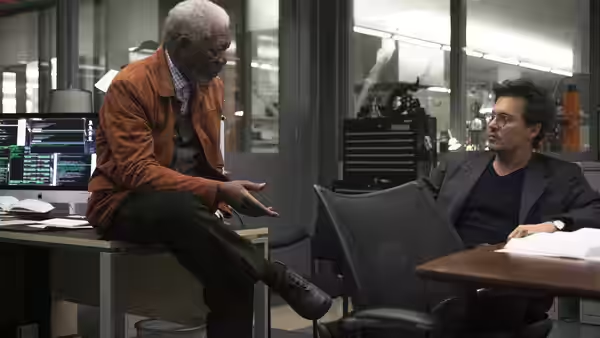
Rebecca Hall is the reason to stay. Her Evelyn is a scientist who has decided, the way grieving people do, that the thing she wants to be true is true, and Hall plays every scene with that decision showing behind her eyes. When Will’s voice first comes out of a speaker, stammering and digitised, the camera stays on her rather than on the screen, and we were moved, not by the resurrection but by a woman hearing exactly what she needed to hear and knowing she should not trust it. It is the one moment where the film’s idea and its feeling are in the same room. Paul Bettany, as the friend Max who helped do it and wishes he had not, is the other grown-up on screen; he gives the doubts a tired, decent face.

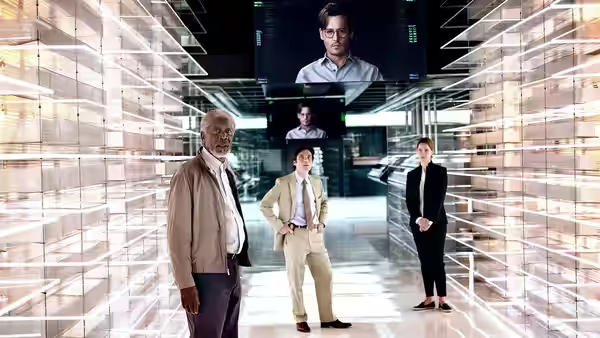
It looks as good as you would expect. Jess Hall shoots the Berkeley lab in soft white light with the sun always behind somebody, and the desert later in a hard noon glare that bleaches the sand to paper. Chris Seagers gives the second half an underground facility of long white corridors and a field of solar panels that tilt together like a congregation, and there are a few images, a drop of water, a sunflower, a server room lit like a chapel, that we would happily hang on a wall. Mychael Danna scores it with slow strings that keep insisting this is a tragedy. The film is never ugly.

The trouble starts with Will. Johnny Depp plays him as a mild, tired man before the shooting and as a mild, tired face on a screen after it, and nothing we could see passes between the two states. The script needs us to wonder whether the machine is still him; Depp gives us no him to compare it with. He murmurs lines about curing disease and healing the planet in a voice that could be reading the weather. We kept waiting for the moment the digital Will wanted something, anything, and when it finally arrives it is announced in a line of dialogue.

Paglen’s script explains everything and dramatises almost nothing. Characters announce what has happened offscreen, months of it, in captions and briefings, and David Rosenbloom’s cutting hurries from one briefing to the next so that no scene has time to become a scene. Morgan Freeman’s Joseph Tagger exists to look grave and pass notes. Cillian Murphy’s Agent Donald Buchanan has a gun and a frown and nothing to decide. Kate Mara’s Bree, who leads the people who shot Will, is given a motive in a speech and then sent to run around in the desert. The second half takes a turn we will not describe, except to say that it swaps the question for a siege, and the siege is shot like an expensive advert.

Somewhere in the second hour we noticed we had stopped listening and were watching the light instead, and then felt sorry about it, because the film plainly means every word. Pfister’s camera has made other directors’ ideas look like the most important thing in the world; here the idea is his own, or Paglen’s, and it has been handed to a cast who speak it rather than live it. Against the films it is reaching for, the ones about a mind in a machine and the people left outside it, this is the tidiest and the one with the least going on inside.

Most critics landed around where we have, and the few who rated it higher were giving it credit for asking the question at all. We would rather give it credit for Hall, who finds something true in it every time the camera lets her. Watch it at home, where you can pause and look things up when it stops making sense, which is more or less what the characters are doing anyway.

Critical consensus AI synthesised

41
Positive
2
Mixed
8
Negative
15

Most critics reject this one, and fifteen of the 25 reviews are outright negative. Where there is agreement, it is on two points. The ideas are ambitious: most reviews credit the film with asking serious questions about machine intelligence and what survives of a person uploaded into one. And Rebecca Hall is the thing that works, praised across the spread for grounding the story in loss; several reviews name her as its only human presence. The cinematography draws steady, if faint, approval too.

The reservations cluster on the script. Critics call the romance lifeless, the plot muddled, the exposition clunky, and Johnny Depp’s performance distant and listless. Several find the philosophical musings and the commercial action working against each other. The spread is wide, from 15 to 75. The Los Angeles Times is the clear dissenter, finding the film provocative and its refusal to simplify a virtue; IndieWire is the only other review that leans positive.

Los Angeles Times
17 April 2014 · Kenneth Turan
75*

Turan finds the film ambitious and provocative, with its nuanced treatment of artificial intelligence outweighing its shortcomings. He particularly praises its refusal to simplify the difficult questions raised by Will’s transformation.

Read the full review →
IndieWire
15 April 2014 · B- · Eric Kohn
70

Kohn finds the film intellectually provocative and potentially prescient, but uneven and less engaging than its ideas. He especially praises Rebecca Hall’s credible pathos and the film’s lasting relevance in its exploration of technology and reality.

Read the full review →
RogerEbert.com
16 April 2014 · ★★½/4 · Matt Zoller Seitz
62

The review finds the film disappointing despite its ambitious ideas. Its treatment of artificial intelligence is singled out as a weakness.

Read the full review →
Radio Times
★★★ · Terry Staunton
60

Staunton gives the film three stars, indicating a mixed verdict. He singles out its complicated techno-fable premise as a defining feature.

Read the full review →
The AV Club
17 April 2014 · C- · A.A. Dowd
50

Dowd finds the film humorless, outdated, and dramatically lifeless. He especially criticizes its unconvincing central romance and lack of humanity.

Read the full review →
Screen Daily
16 April 2014 · Tim Grierson
40*

The review suggests the film’s grand themes lack resonance. It finds greater emotional impact in the more modest exploration of intimate relationships.

Read the full review →

Straight answers AI written, from our review

Is Transcendence worth watching?
Transcendence is a mixed film, handsome and sincere but talked to death, and we scored it 45. Rebecca Hall is the reason to stay, playing a grieving scientist who hears what she needs to hear and knows she should not trust it. Everyone else explains the plot to a monitor, and the second half swaps the question for a siege.
How long is Transcendence, and what is it rated?
Transcendence runs 1h 59m and is rated 12 by the KMRB in South Korea. It is a thriller and science fiction film.
Where can I watch Transcendence in South Korea?
Transcendence is not on any streaming or rental service in South Korea at the moment. It is available in 25 other countries; change your country at the top of the page to see where. Availability is checked daily.
How violent or frightening is Transcendence, and is it suitable for children?
Transcendence is a 12A, and its violence is brief: a shooting outside a lecture early on, and a siege in the second half shot like an expensive advert rather than for shock. The ideas about a dying man's mind copied into a computer are more likely to bore young children than frighten them. Teenagers interested in science fiction should be fine.
How does Transcendence compare to Her?
Transcendence asks the same question as Her, whether a mind in a machine is a person, but asks it through briefings and server farms where Spike Jonze's film asks it through a voice in an earpiece. Her is the better film by some distance, funnier, warmer and more persuasive about affection. Transcendence has the finer images and far less going on inside them.
What should I watch after Transcendence?
After Transcendence, try Her (2013, Fi1m 84): The same question asked quietly, with a voice in an earpiece instead of a server farm. Then Ghost in the Shell (1995, Fi1m 83): Anime about where a mind ends and the machine begins, with real ideas and rain.

Cast

If you liked this, try…

  1. Her (2013, Fi1m 84)The same question asked quietly, with a voice in an earpiece instead of a server farm.

  2. Marjorie Prime (2017) · not reviewed yetA widow talks to a hologram of her husband; small, patient and properly sad.

  3. Colossus: The Forbin Project (1970) · not reviewed yetA computer goes online and the grown-ups panic; brisk, cold and still unsettling.

  4. Ghost in the Shell (1995, Fi1m 83)Anime about where a mind ends and the machine begins, with real ideas and rain.

  5. Demon Seed (1977) · not reviewed yetThe house computer wants a child; lurid, nasty and far more honest about it.