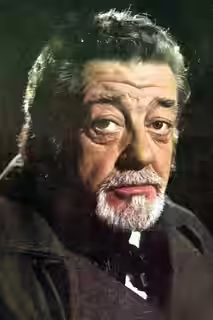
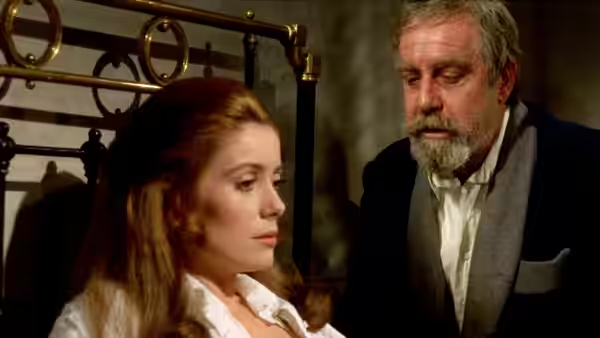
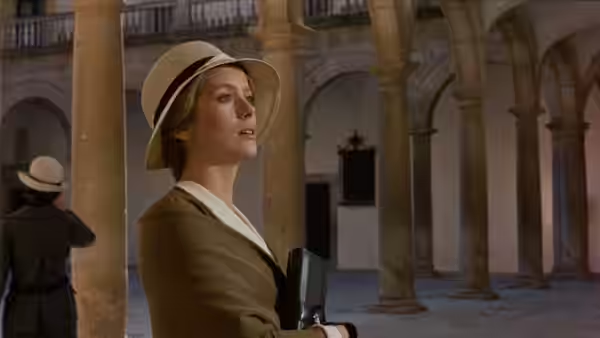
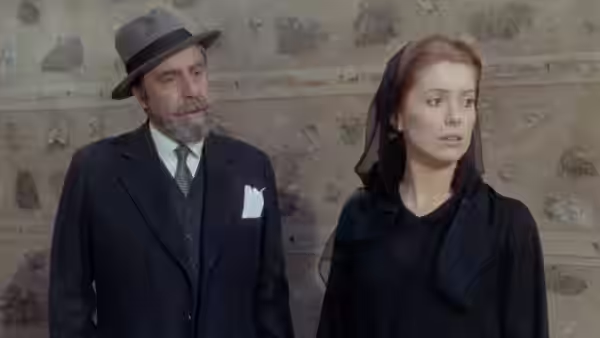
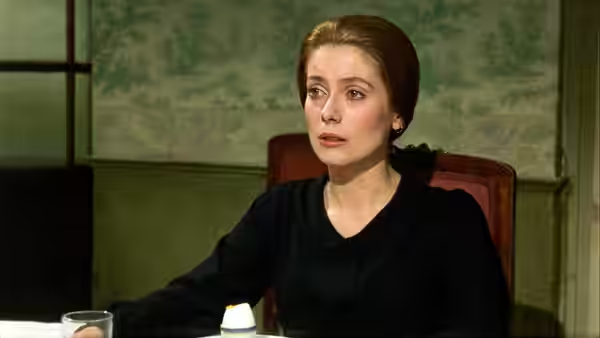
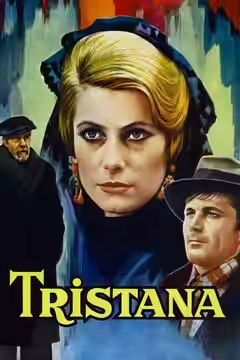
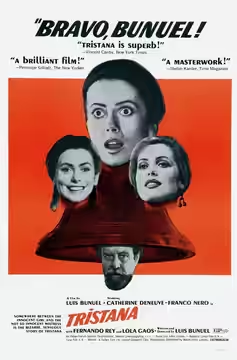
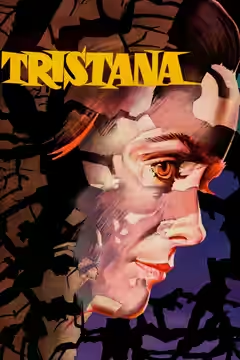
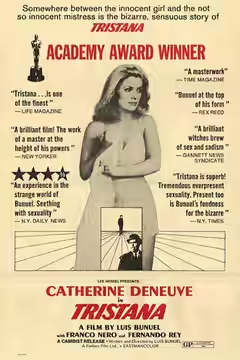
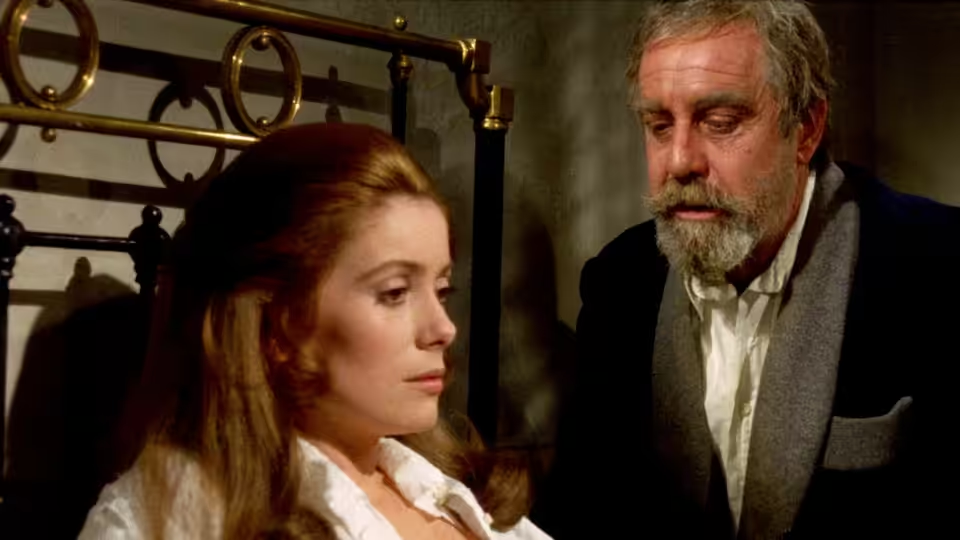
Tristana (Catherine Deneuve) and Don Lope (Fernando Rey) stand beside a coat rack
Film review

Tristana

1970 · Directed by Luis Buñuel · 1h 38m · Eirin R18+

In a sentenceFernando Rey makes a gentleman’s good intentions sound like grounds for changing the locks

In Toledo, Tristana (Catherine Deneuve) lives under the guardianship of the older Don Lope (Fernando Rey), with Saturna (Lola Gaos) part of the life around them. Tristana wants room to make decisions for herself, but her dependence gives Don Lope the power to impose his wishes. What begins as a relationship of care becomes a question of how much authority he can claim over her. His standing as her guardian makes it difficult to separate his responsibilities from his desires, and leaves Tristana trying to establish what she is entitled to decide.

Plays from YouTube when you press play; nothing loads from them until then.

Fi1m review

Luis Buñuel’s Tristana is an unsettling drama worth seeing for Catherine Deneuve and Fernando Rey, despite some blunt dialogue. They make the unequal relationship between a young ward and her guardian difficult to dismiss or forget.

Luis Buñuel’s Tristana is a good, disquieting drama with two performances that survive its occasional insistence on explaining itself. In Toledo, the young Tristana lives under the authority of her older guardian, Don Lope. The arrangement gives his wishes a practical advantage over hers, and the film finds both cruelty and bleak comedy in how readily that advantage passes for something respectable. Fernando Rey and Catherine Deneuve are usually more persuasive than the dialogue.

Luis Buñuel and Julio Alejandro adapt the novel by Benito Pérez Galdós without making the guardian’s authority seem safely remote. This is familiar territory for a domestic drama: someone who needs care must accept the conditions imposed by the person providing it. The film is sharpest when those conditions speak for themselves. It becomes less interesting when the dialogue tells us how to understand an inequality already plain on screen.

Fernando Rey makes Don Lope difficult to dismiss, which is essential to the film’s discomfort. He gives the guardian enough humanity that we cannot simply file him away as a monster and stop attending to him. We were disturbed by the ease with which Don Lope treats Tristana’s dependence as an entitlement to obedience. The performance makes that assumption seem ordinary, and therefore more unpleasant than a display of obvious villainy would have been.

Catherine Deneuve gives Tristana a reserve that keeps the film from becoming merely a study of her guardian. She does not make the young woman’s inner life readily available, and that makes the unequal relationship harder to watch. There are stretches when the performance holds us too far away, however, leaving us to study her predicament without feeling much closer to her. She remains compelling even when warmth is in short supply.

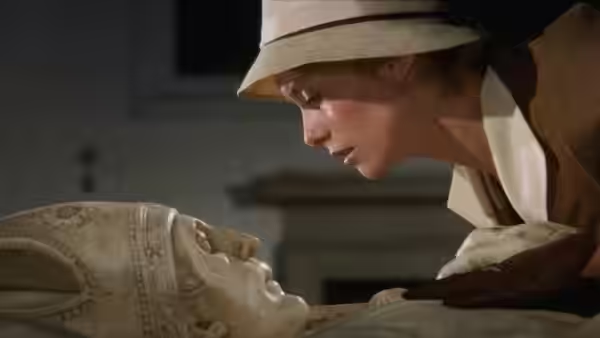
José Fernández Aguayo’s photography uses muted colour to keep the setting from becoming a pleasant distraction. That restraint suits a story in which respectable appearances provide so little reassurance. Enrique Alarcón’s production design supports the subdued look, keeping the surroundings from competing with the actors for attention. The visual quietness works well around the central performances, though it also means that when a passage goes flat there is little else to occupy the eye.

Pedro del Rey’s editing gives the uneasy relationship time to register, but it also leaves some blunt dialogue exposed. At 98 minutes, the film is not overlong; the problem is that certain points arrive after the actors have already made them clear. Luis Buñuel sometimes seems unwilling to let us miss the ugliness of Don Lope’s authority. Those explanations slow the drama more than its measured pace does.

The dreamlike strangeness is more rewarding, allowing uncertainty into a film that can otherwise be rather sure of its conclusions. Its bleak humour also prevents the subject of repression from becoming a solemn duty for the audience. There is pleasure here, although little comfort, and the emotional distance remains a caveat. Choose Tristana when the appeal of a domestic drama lies in watching people whose manners offer no guarantee that they will behave well.

Critical consensus AI synthesised

74
Positive
5
Mixed
4
Negative
0

The reviews lean favourable, with praise clustering around the performances and Buñuel’s treatment of repression, corruption and unequal relationships. Catherine Deneuve draws admiration for her chilling performance, while Fernando Rey earns praise even from critics less persuaded by the film around him. The more enthusiastic readings find complicated characters, unsettling dreamlike passages and a sly connection between sexual and political repression; they value the film’s resistance to simple explanations.

The spread runs from strong enthusiasm to qualified approval, with disagreement chiefly over how much subtlety and irreverence Buñuel brings to the material. Slant Magazine finds an accessible introduction to his work, but faults the blunt symbolism and obvious dialogue. Variety is more reserved, describing a sombre, unusually respectful film with only intermittent flashes of mischief, though it singles out Rey for praise. These reservations concern the handling of the material rather than the central performances.

Radio Times
★★★★★ · David Parkinson
100

Parkinson calls the film a bitter, brilliant indictment of corruption and decay. He praises Fernando Rey’s performance as Don Lope and Catherine Deneuve’s chilling portrayal of the victim turned tormentor.

Read the full review →
Los Angeles Times
22 February 2013 · Critic's Pick · Betsy Sharkey
84*

Sharkey presents the restored film as a rare opportunity to appreciate Buñuel’s range and rebellious vision. She especially praises Catherine Deneuve’s performance and the restoration’s subtle, muted colors.

Read the full review →
The AV Club
20 March 2013 · B+ · Scott Tobias
83

Tobias finds the film rich in mystery and meaning, with characters too complicated to reduce to simple types. He praises Buñuel’s layered treatment of the story and the film’s elusive, dreamlike strangeness.

Read the full review →
The New Yorker
19 November 2015 · Richard Brody
80*

Brody presents the film as a forceful, slyly satirical drama. He praises how Buñuel links sexual repression and political repression without sacrificing the story’s disturbing immediacy.

Read the full review →
Slant Magazine
11 September 2003 · ★★★/4 · Ed Gonzalez
75

Gonzalez finds the film mundane but competent, and a useful entry point to Buñuel. He praises its surrealist force near the end, while criticizing its blunt symbolism and obvious dialogue.

Read the full review →
Time Out
· CA
67*

The available description frames the film as a mockingly sensible black comedy. It singles out the Toledo setting and the young ward’s relationship with her old guardian.

Read the full review →

Straight answers AI written, from our review

Is Tristana worth watching?
Tristana is worth watching for its unsettling performances by Catherine Deneuve and Fernando Rey, and we score it 79 out of 100. We recommend it to those who enjoy measured domestic dramas about power and dependence, with the caveat that blunt dialogue sometimes explains what the actors have already made clear.
How long is Tristana, and what is it rated?
Tristana runs 1h 38m and is rated R18+ by the Eirin in Japan. It is a drama film.
Where can I watch Tristana in Japan?
Tristana is not on any streaming or rental service in Japan at the moment. It is available in 8 other countries; change your country at the top of the page to see where. Availability is checked daily.
How violent or frightening is Tristana, and is it suitable for children?
Tristana is an unsettling adult drama rather than a choice we recommend for children; its US certificate advises parental caution for under-13s, and no UK certificate is supplied. The discomfort we identify comes from a guardian treating a young woman’s dependence as permission to control her, rather than any specific violence or frightening imagery we can substantiate.
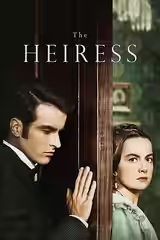
How does Tristana compare to The Heiress?
Tristana shares The Heiress’s concern with a young woman whose household restricts her choices, but we recommend The Heiress more strongly for its precision and emotional force. Tristana offers bleak comedy and dreamlike strangeness alongside its unequal relationship; its occasional over-explanation and Deneuve’s reserve make it a more emotionally distant choice.
Is Tristana based on a true story or a book?
Tristana is adapted from a novel by Benito Pérez Galdós, with the adaptation credited to Luis Buñuel and Julio Alejandro, rather than presented as a true story. We make no claim about its fidelity to the book, but its central conflict between a dependent young woman and her controlling guardian is clear without knowing the source.
What should I watch after Tristana?
After Tristana, try The Heiress (1949, Fi1m 90): Another young woman’s choices are narrowed by a household certain it knows better. Then The Servant (1963, Fi1m 89): Domestic authority becomes difficult to locate, with discomfort in every polite exchange; and The Piano (1993, Fi1m 88): Female desire and male entitlement collide, with rather more emotional heat.

Cast

Awards

Academy Awards, 1971

Nominated
Best International Feature Film

International Submission to the Academy Awards, 1971

Nominated
International Submission to the Academy Awards

Medal of the Circle of Cinematographic Writers for the best film, 1971

Won
Medal of the Circle of Cinematographic Writers for the best film

If you liked this, try…

  1. The Heiress (1949, Fi1m 90)Another young woman’s choices are narrowed by a household certain it knows better.

  2. The Housemaid (1960) · not on Fi1m yetA household’s respectable arrangements prove alarmingly vulnerable to desire and dependence.

  3. The Servant (1963, Fi1m 89)Domestic authority becomes difficult to locate, with discomfort in every polite exchange.

  4. The Piano (1993, Fi1m 88)Female desire and male entitlement collide, with rather more emotional heat.

  5. A Separation (2011, Fi1m 93)Family obligations become competing claims that no amount of righteousness can settle.