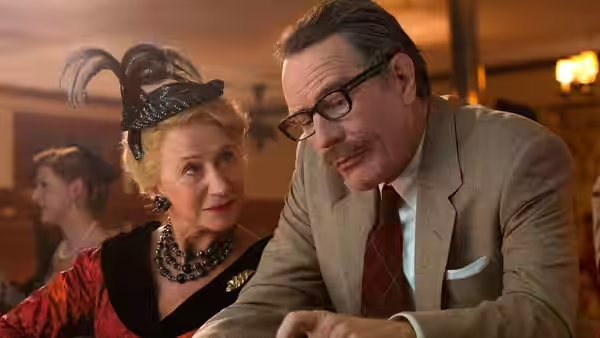
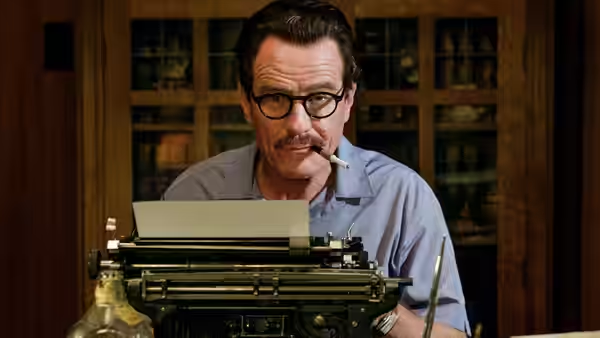
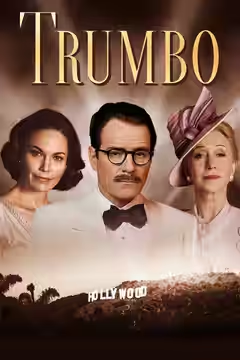
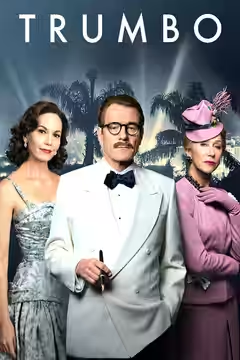
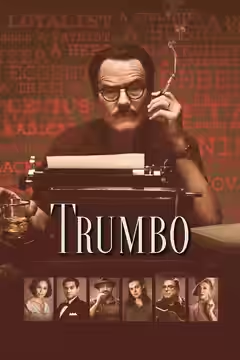
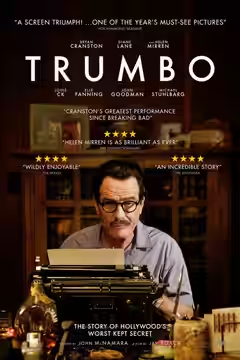
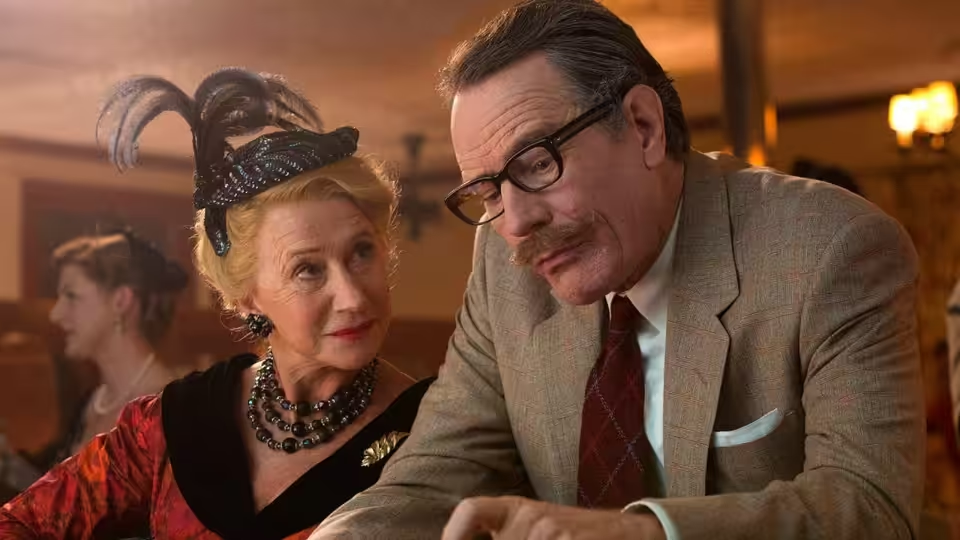
Hedda Hopper (Helen Mirren) and Dalton Trumbo (Bryan Cranston) lean together at a table
Film review

Trumbo

2015 · Directed by Jay Roach · 2h 04m

In a sentenceThe blacklist retold as a caper, where the loot is a screen credit and the villain wears a hat

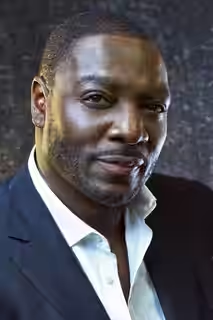
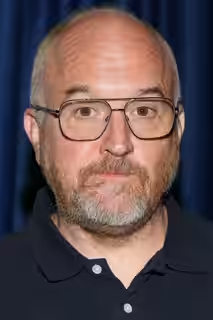
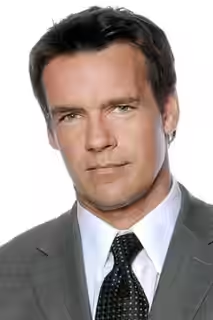
Hollywood, 1947. Dalton Trumbo (Bryan Cranston), one of the best-paid screenwriters in town and a member of the Communist Party, lives on a ranch with his wife Cleo (Diane Lane) and daughter Niki (Elle Fanning), and writes his scripts in the bath. The House Un-American Activities Committee has begun summoning Hollywood names to Washington, with gossip columnist Hedda Hopper (Helen Mirren) and John Wayne (David James Elliott) cheering it on and Edward G. Robinson (Michael Stuhlbarg) among the friends taking Trumbo’s side. Trumbo and fellow writer Arlen Hird (Louis C.K.) decide to refuse the committee’s questions, which makes them unemployable the moment they stand up to do it, and leaves Trumbo a wife, a ranch and a mortgage to keep going with no studio willing to put his name on a cheque.

Plays from YouTube when you press play; nothing loads from them until then.

Fi1m review

Jay Roach turns the Hollywood blacklist into a brisk, amiable comedy of survival, and Bryan Cranston has a fine time in the bathtub. It is lively and handsomely dressed, and it treats the worst thing Hollywood ever did to its own as a problem of paperwork.

Dalton Trumbo was one of the best-paid screenwriters in Hollywood in 1947, a member of the Communist Party, and one of the ten who went to prison rather than tell Congress about it. Jay Roach’s film takes him from the first subpoena through the years of writing under other men’s names, and it does so briskly, warmly and with a great many hats. It is never dull. It is also never difficult, and for a film about the blacklist that is a strange thing to be able to say. We enjoyed most of its 124 minutes and believed about half of them.

Bryan Cranston plays Trumbo as a man already giving a performance: speeches in full paragraphs, a cigarette holder waved like a conductor’s baton, a typewriter balanced on a plank across the bath. It is a large turn and it knows it, and since Trumbo by every account was a large man, Cranston gets away with it. What John McNamara’s script does not give him is anything underneath. We hear that he is a genius and we see him type; we never see him think. His politics are a few lines about fairness delivered to his daughter, and his compromises, a radical with a ranch and a studio salary, are raised once by a friend and then dropped.

The friend is Arlen Hird, played by Louis C.K. as a tired, coughing man who believes the things Trumbo only says, and his scenes are the closest the film comes to an argument. Helen Mirren’s Hedda Hopper is the other reason to stay. Daniel Orlandi puts her in hats that get larger as her power does, and she plays the columnist not as a cartoon but as a professional who has found something that sells better than gossip. David James Elliott’s John Wayne is a sketch with good shoulders. Michael Stuhlbarg plays Edward G. Robinson as a decent, frightened man, and his one long scene with Cranston is the only time the film puts the cost of the blacklist on a face rather than into a speech. Diane Lane is given almost nothing to do as Cleo and does it with grace.

The best stretch is the middle, when Trumbo turns out scripts under false names for Frank King (John Goodman), a producer of monster pictures who does not care who wrote a thing as long as it is on his desk by Thursday. Goodman shouts, bargains and at one point picks up a baseball bat, and we laughed out loud, twice, both times at him. Alan Baumgarten cuts these years as montage, pills and envelopes and a telephone that never stops, and Theodore Shapiro’s score turns brassy and jaunty beneath it, so that the whole business plays as a caper. It is enjoyable. It is also the moment the film decides what the blacklist was: a nuisance that a clever man could work around.

That is the trouble, and it runs through everything. Jim Denault lights the ranch, the hearing room and the prison yard in the same warm amber, and Mark Ricker’s sets, the ranch house, Frank King’s office with its lurid posters, are handsome and safe. Nothing in the frame looks dangerous. The people who lost careers and did not get them back are referred to; the camera stays with the one who ended up fine. The committee men are bullies and the communists are kind people who like unions, and the film never wonders whether any of them believed anything harder than that.

We came out entertained and faintly cross, because a subject this serious had been made this comfortable, and because the film seemed to think the comfort was the point. Roach directs it as a comedy of manners, which is why it moves and why it never bites. Good Night, and Good Luck (2005) covered the same fear in the same years and let the silence do the work; here nobody is quiet for long enough.

Watch it as a Sunday afternoon film, for Cranston, Mirren and Goodman, and for the bathtub. Then look up what happened to the people in this story who were not Dalton Trumbo. The film will not tell you.
Critical consensus AI synthesised

59
Positive
8
Mixed
7
Negative
6

The reviews are divided almost down the middle, with a slight lean towards approval. Most critics agree the film is lively and easy to sit through, and the praise gathers around Bryan Cranston, whose performance is repeatedly called commanding and is often the reason a lukewarm review tips into a positive one. The supporting cast draws warm notices too, especially Helen Mirren’s Hedda Hopper, John Goodman’s scene of comic force and Michael Stuhlbarg’s Edward G. Robinson. Several critics single out the black-market screenwriting episodes as the film’s most entertaining stretch.

The reservations are consistent. The film is called conventional, cautious and morally simplistic, with the blacklist and Trumbo’s politics flattened into clichés, and a few find the story played too much for laughs. The spread is wide: Deadline calls it hugely entertaining and absorbing, while Collider finds it flat and dramatically unconvincing. The Evening Standard dissents on Cranston too, finding the performance overworked.

Los Angeles Times
5 November 2015 · Rebecca Keegan
75*

Keegan finds the film engaging and timely, though occasionally too conventional and morally simplistic. She especially praises Bryan Cranston’s confident performance and the vivid period details, including the costumes.

Read the full review →
Empire
25 January 2016 · Dan Jolin
70*

The review finds the film visually and structurally plain but ultimately positive, thanks to the heroism of its subject. It singles out Bryan Cranston’s commanding performance as the film’s chief strength.

Read the full review →
Evening Standard
9 October 2015 · festival review
70*

The review finds the film rewarding despite a slow start and an overworked performance from Bryan Cranston. It praises Helen Mirren’s portrayal of Hedda Hopper and John Goodman’s comic force.

Read the full review →
The AV Club
5 November 2015 · B- · Tasha Robinson
70

Robinson finds the film an engaging but unfocused history lesson that never makes its central figure’s genius convincing. She praises the vivid supporting performances, while criticizing the film for failing to show what made Trumbo’s writing effective.

Read the full review →
The Guardian
13 September 2015 · festival review · Henry Barnes
70*

Barnes finds the film lively and ultimately a fitting tribute, though its Hollywood self-regard and tonal wobbles invite skepticism. He praises Helen Mirren’s sharply balanced portrayal of Hedda Hopper.

Read the full review →
Screen Daily
13 September 2015 · Allan Hunter
64*

The accessible page does not reveal the critic’s verdict. It also provides no specific praise or complaint to report.

Read the full review →

Straight answers AI written, from our review

Is Trumbo worth watching?
Trumbo is worth watching as a brisk Sunday afternoon film about the Hollywood blacklist, and we scored it 58. Bryan Cranston, Helen Mirren and John Goodman are good company for 124 minutes, but Jay Roach plays the blacklist as a caper and never shows what it cost the people who did not end up fine. Entertaining, and faintly cross-making.
How long is Trumbo, and what is it rated?
Trumbo runs 2h 04m. It is a drama film.
Where can I watch Trumbo in South Africa?
Trumbo is not on any streaming or rental service in South Africa at the moment. It is available in 25 other countries; change your country at the top of the page to see where. Availability is checked daily.
How violent or frightening is Trumbo, and is it suitable for children?
Trumbo carries a 15 certificate in the UK and an R in the US, but it is a talky period drama rather than a violent or frightening one. The certificate reflects adult language and the subject of political persecution, not anything on screen that would alarm a teenager. It is too slow and speech-heavy for younger children.
How does Trumbo compare to Good Night, and Good Luck.?
Trumbo and Good Night, and Good Luck. cover the same fear in the same years, and the earlier film is the better of the two. George Clooney lets silence and precise storytelling do the work, while Jay Roach reaches for speeches, hats and a jaunty score. Trumbo is the warmer and easier evening; Good Night, and Good Luck. is the one that bites.
What should I watch after Trumbo?
After Trumbo, try Good Night, and Good Luck (2005, Fi1m 83): The same fear, same years, black and white, and nobody makes a speech in a bathtub. Then Hail, Caesar! (2016, Fi1m 72): The Coens’ Hollywood communists hold study groups; funnier and, oddly, more honest.

Cast

Awards

Academy Awards, 2016

Nominated
Best Actor

Paul Selvin Award, 2015

Won
Paul Selvin Award

If you liked this, try…

  1. The Front (1976) · not reviewed yetWritten by a blacklisted writer, so the jokes about fronts have teeth this one lacks.

  2. Good Night, and Good Luck (2005, Fi1m 83)The same fear, same years, black and white, and nobody makes a speech in a bathtub.

  3. Guilty by Suspicion (1991) · not reviewed yetRobert De Niro as a director on the list; sober where this is sunny.

  4. Hail, Caesar! (2016, Fi1m 72)The Coens’ Hollywood communists hold study groups; funnier and, oddly, more honest.

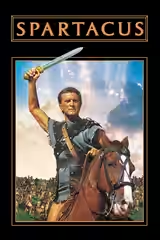
  5. Spartacus (1960) · not reviewed yetWhat Trumbo wrote once his name was his own again; see the work, not the story about it.

Trumbo (2015) review: the blacklist as brisk, shallow comedy (South Africa) | Fi1m