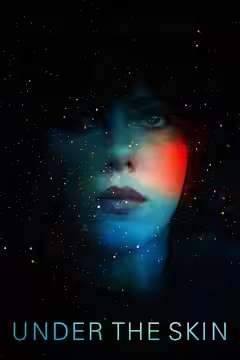
Scarlett Johansson in profile wearing a brown fur coat outdoors
Film review

Under the Skin

2014 · Directed by Jonathan Glazer · 1h 48m · BBFC 15

In a sentenceScarlett Johansson cruises Glasgow in a white van asking men the way, and the men are the ones who should worry

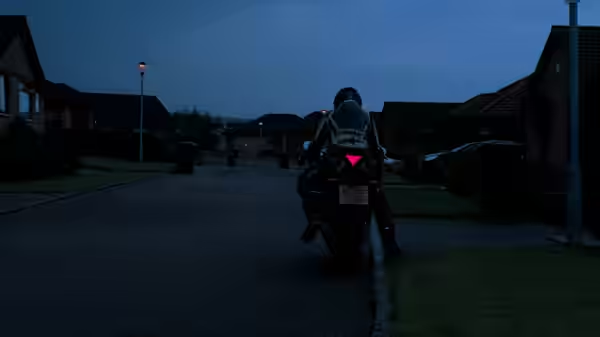
Glasgow. A man on a motorbike (Jeremy McWilliams) carries a motionless young woman (Lynsey Taylor Mackay) from a roadside, and in a white room a second woman (Scarlett Johansson) puts on her clothes. She drives a white van into the city, pulls up beside men walking alone, asks them the way and offers a lift to the ones with no family waiting at home. She takes them to a house where the rooms are black and the floor gives way under them. The motorcyclist follows at a distance and tidies up behind her. Between pickups she tries on lipstick in a shopping centre and watches the crowds. On a windy beach she meets a swimmer (Kryštof Hádek) and a family, and stays to watch.

Plays from YouTube when you press play; nothing loads from them until then.

Fi1m review

Jonathan Glazer strips Michel Faber’s novel to a woman, a van and the men of Glasgow, and for eighty minutes it is cold, exact and frightening. It loosens once she stops hunting, but Mica Levi’s score and Scarlett Johansson’s face carry it home.

Jonathan Glazer has made three films in fourteen years, and this is the strangest. He and Walter Campbell take Michel Faber’s novel and keep almost nothing of it except the idea: a woman who is not a woman drives a white van around Glasgow, asks men the way, and takes home the ones nobody will miss. Glazer never tells us where she is from or what she is for. What he has made is cold, exact and frightening for about eighty minutes, and slower and less certain for the last thirty. We would still send you to it.

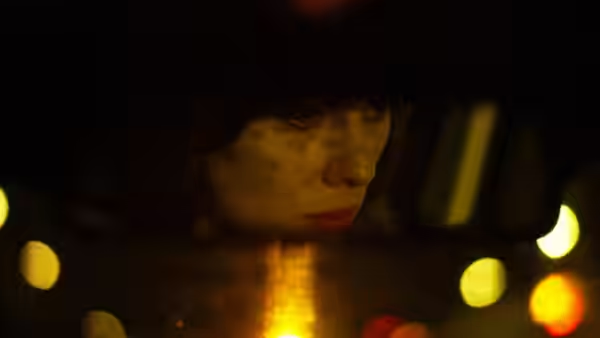
How it was shot matters. Dan Landin fitted the van with small hidden cameras, and many of the men Scarlett Johansson talks to on the street were not actors and did not know they were in a film until afterwards. You can tell. They lean into the window, they laugh a beat late, they give directions with great care. Against this Chris Oddy builds the place she takes them: a black room with no visible walls and a floor that behaves like a shallow pool of oil. The men undress and walk towards her and go down into it without a splash. The cut from a Glasgow pavement to that room is the whole film in one edit, and Paul Watts makes it again and again without the shock wearing off.

Mica Levi’s score does a great deal of the work and does it with very little. A viola slides up and holds, a drum keeps something like a heartbeat under it, and three falling notes come in whenever she has found a man worth stopping for. It is music that sounds slightly broken. When the film goes quiet, which it does for long stretches, the traffic and the rain and the club noise do the job instead.

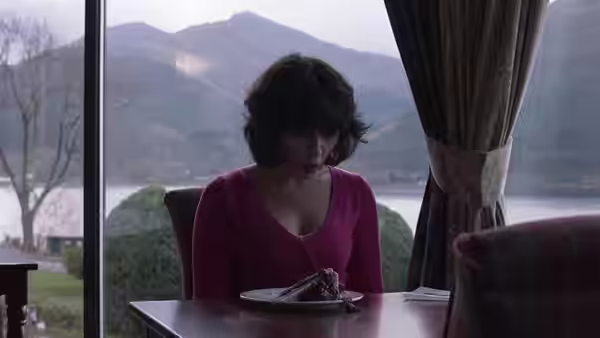
Johansson is remarkable in a part with perhaps two pages of lines. Stephen Noble puts her in a fake fur, tight jeans and a black bob, the outfit of someone who has studied what women wear rather than worn it, and she plays the face to match: a smile that arrives on cue and goes the moment the man looks away. Watch her in the shopping centre trying on lipstick. She is learning how the thing works. Later, when the learning starts to cost her, she barely changes her expression, and that is where the performance is.

We were horrified by one sequence and have not shaken it. On a beach in the wind, a family goes into the sea, a swimmer (Kryštof Hádek) goes in after them, and she watches from the shingle, and what she does when it is over is done without haste or interest. Glazer shoots it from far off, in long takes, with no music, and the surf carries on as if nothing had happened. We have seen more violent scenes in British films; we have not seen a colder one.

The trouble comes when she stops hunting. The film heads north, into forest and mist, and it slows to match her. Glazer will not tell us what is going on inside her, and for most of the film that works: we read her the way the men do, from outside. In the last stretch, though, the film needs us to believe she has changed, and it has put away every tool it could have used to show it. A few scenes in a house and on a hillside could belong to a gentler picture. The ending itself is hard and right, and we will not describe it.

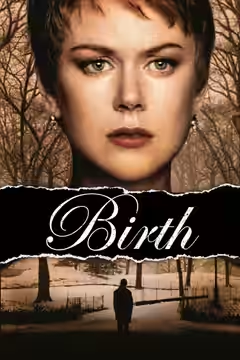
Glazer’s Sexy Beast (2000) was a gangster comedy full of dialogue. Birth (2004) had less of it. This has almost none, and it is the most complete thing he has made. The nearest film to it is Nicolas Roeg’s The Man Who Fell to Earth (1976), another alien in Britain who learns how people work by copying them, and Glazer’s is the stricter of the two.

See it in a cinema if you can, in the dark, with the sound up, because Levi’s score was built for a room and the black pool needs a big screen to look like nothing at all. At home it becomes an odd, quiet film about a woman in a van, which it also is. It runs 108 minutes and carries a 15.


Critical consensus AI synthesised

72
Positive
16
Mixed
1
Negative
3

Most critics admire it, and the praise gathers in the same places. Scarlett Johansson’s near-silent performance as the alien is singled out again and again, as is Mica Levi’s score, which several reviews credit with much of the film’s unease. Glazer’s decision to strip away the novel’s backstory and shoot on the streets of Glasgow is widely taken as the film’s strength: an alien’s-eye view of ordinary humanity, cold at first, then something closer to pity.

The reservations cluster around the absence of plot and the slow, elliptical pacing. The spread is wide: three of twenty reviews are outright negative. The Hollywood Reporter, writing from a festival screening, finds it loses coherence and offers too little substance beneath the images. The New Yorker argues the alien’s inner life is never developed and the music is left to do the work. The Times goes furthest, calling it pretentious and a reductive parable of womanhood.

Little White Lies
13 March 2014 · 5/5/5 · Violet Lucca
100

The review celebrates the film's hypnotic visuals, Mica Levi score and philosophical depth as a feminist sci-fi fable that lingers powerfully. It singles out a harrowing beach sequence for its icy matter-of-fact depiction of human vulnerability and opportunism.

Read the full review →
The Telegraph
13 March 2014 · Robbie Collin
95*

Collin calls the film a masterpiece, praising its astonishing, abstract approach that strips the story to its essentials and renders Johansson iconic as the nameless alien femme fatale. He highlights the extraordinary score and the film's hypnotic blend of realism and surrealism.

Read the full review →
Film Comment
· Jonathan Romney
90*

The critic praises Glazer's audacious, experimental approach to the alien narrative and its defamiliarizing effect on human experience. Johansson delivers a singular, alert performance amid vérité footage and striking, otherworldly imagery.

Read the full review →
Los Angeles Times
3 April 2014 · Betsy Sharkey
90*

Sharkey describes the film as a genesis moment of sci-fi fable and performance, urging viewers to surrender to its primal, sensory experience and abstraction. She singles out Scarlett Johansson’s fearless, emotionally baring work as the alien protagonist becomes more human, along with the authentic street scenes and Mica Levi’s unsettling score.

Read the full review →
Sight and Sound
13 March 2014 · Sam Wigley
90*

The critic highlights Glazer's austere, estranging approach that turns Scotland into an alien landscape and uses the alien protagonist's gradual awakening to explore what it means to be human. He praises the film's clinical detachment and rigorous ending that avoids sentimentality.

Read the full review →
The Guardian
13 March 2014 · Peter Bradshaw
85*

Bradshaw finds the film visually stunning and deeply disturbing, a pure injection of mood that blends futuristic body horror with social-realist grit in Glasgow streets. He singles out the casting of Scarlett Johansson as the ultimate alien predator and the film's eerie, erotic power.

Read the full review →

Straight answers AI written, from our review

Is Under the Skin worth watching?
Under the Skin is worth watching for its frightening, spare science fiction, Scarlett Johansson’s performance and Mica Levi’s unsettling score; we give it 81 out of 100. We recommend it to viewers comfortable with long silences and unanswered questions, though the final stretch slows and makes its central character’s changes harder to believe.
How long is Under the Skin, and what is it rated?
Under the Skin runs 1h 48m and is rated 15 by the BBFC in the UK. It is a thriller and science fiction film.
Where can I watch Under the Skin in the UK?
Under the Skin is streaming on Amazon Prime Video and Apple TV in the UK, and it is also available to rent from Amazon Prime Video and Apple TV from £3.49. Availability is checked daily; the links above go straight to each service.
How violent or frightening is Under the Skin, and is it suitable for children?
Under the Skin carries a UK 15 certificate and is not suitable for children: men undress during predatory encounters, and its cold treatment of people in danger is deeply frightening. We find the beach sequence particularly horrifying because of the central character’s indifference; viewers sensitive to sustained dread have good reason to be cautious.
How does Under the Skin compare to The Man Who Fell to Earth?
Under the Skin is the more controlled film beside The Man Who Fell to Earth, though both follow an alien learning human behaviour by imitation. We favour Glazer’s precision for sustained unease; Roeg’s film offers a gentler, more moving central performance from David Bowie, but its wandering second half asks for more patience than it always earns.
Is Under the Skin based on a true story or a book?
Under the Skin is adapted from Michel Faber’s novel, not based on a true story, and keeps little beyond the central premise of an alien woman picking up men in a van. We would approach it as a separate work rather than a faithful adaptation: familiarity with the book is not needed, and the film deliberately leaves much unexplained.

Cast

Awards

European Film Award for Best Composer, 2014

Won
European Film Award for Best Composer

If you liked this, try…

Under the Skin (2014) review: cold, exact and hard to shake off (the UK) | Fi1m