Jonathan Glazer strips Michel Faber’s novel to a woman, a van and the men of Glasgow, and for eighty minutes it is cold, exact and frightening. It loosens once she stops hunting, but Mica Levi’s score and Scarlett Johansson’s face carry it home.
Jonathan Glazer has made three films in fourteen years, and this is the strangest. He and Walter Campbell take Michel Faber’s novel and keep almost nothing of it except the idea: a woman who is not a woman drives a white van around Glasgow, asks men the way, and takes home the ones nobody will miss. Glazer never tells us where she is from or what she is for. What he has made is cold, exact and frightening for about eighty minutes, and slower and less certain for the last thirty. We would still send you to it.
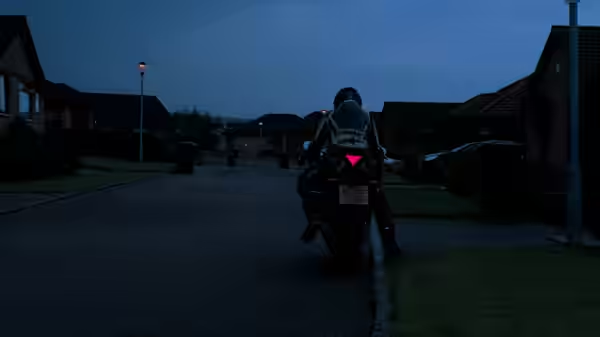
How it was shot matters. Dan Landin fitted the van with small hidden cameras, and many of the men Scarlett Johansson talks to on the street were not actors and did not know they were in a film until afterwards. You can tell. They lean into the window, they laugh a beat late, they give directions with great care. Against this Chris Oddy builds the place she takes them: a black room with no visible walls and a floor that behaves like a shallow pool of oil. The men undress and walk towards her and go down into it without a splash. The cut from a Glasgow pavement to that room is the whole film in one edit, and Paul Watts makes it again and again without the shock wearing off.
Mica Levi’s score does a great deal of the work and does it with very little. A viola slides up and holds, a drum keeps something like a heartbeat under it, and three falling notes come in whenever she has found a man worth stopping for. It is music that sounds slightly broken. When the film goes quiet, which it does for long stretches, the traffic and the rain and the club noise do the job instead.
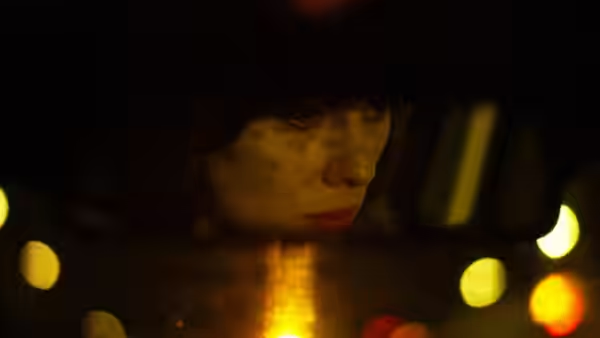
Johansson is remarkable in a part with perhaps two pages of lines. Stephen Noble puts her in a fake fur, tight jeans and a black bob, the outfit of someone who has studied what women wear rather than worn it, and she plays the face to match: a smile that arrives on cue and goes the moment the man looks away. Watch her in the shopping centre trying on lipstick. She is learning how the thing works. Later, when the learning starts to cost her, she barely changes her expression, and that is where the performance is.
We were horrified by one sequence and have not shaken it. On a beach in the wind, a family goes into the sea, a swimmer (Kryštof Hádek) goes in after them, and she watches from the shingle, and what she does when it is over is done without haste or interest. Glazer shoots it from far off, in long takes, with no music, and the surf carries on as if nothing had happened. We have seen more violent scenes in British films; we have not seen a colder one.
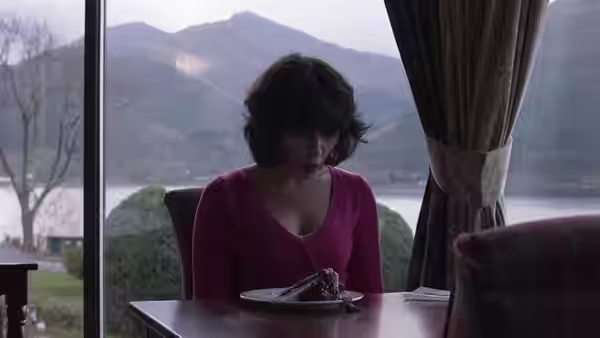
The trouble comes when she stops hunting. The film heads north, into forest and mist, and it slows to match her. Glazer will not tell us what is going on inside her, and for most of the film that works: we read her the way the men do, from outside. In the last stretch, though, the film needs us to believe she has changed, and it has put away every tool it could have used to show it. A few scenes in a house and on a hillside could belong to a gentler picture. The ending itself is hard and right, and we will not describe it.
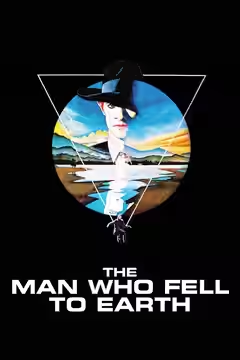
Glazer’s Sexy Beast (2000) was a gangster comedy full of dialogue. Birth (2004) had less of it. This has almost none, and it is the most complete thing he has made. The nearest film to it is Nicolas Roeg’s The Man Who Fell to Earth (1976), another alien in Britain who learns how people work by copying them, and Glazer’s is the stricter of the two.
See it in a cinema if you can, in the dark, with the sound up, because Levi’s score was built for a room and the black pool needs a big screen to look like nothing at all. At home it becomes an odd, quiet film about a woman in a van, which it also is. It runs 108 minutes and carries a 15.