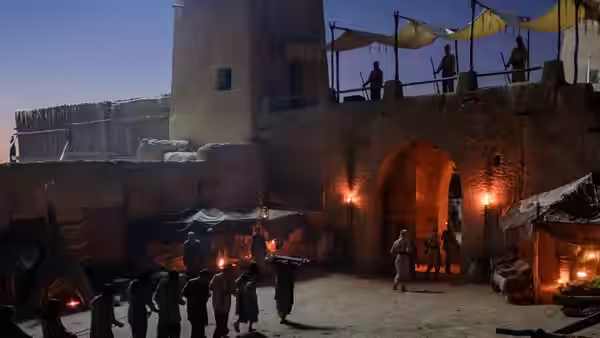
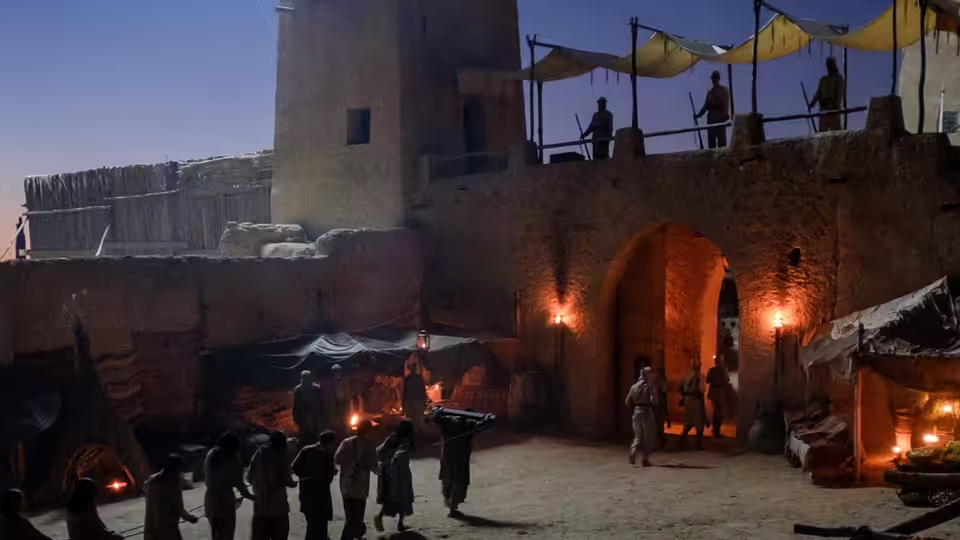
Soldiers guard a fortress courtyard as figures gather beneath the illuminated archway
Film review

Waiting for the Barbarians

2019 · Directed by Ciro Guerra · 1h 52m

In a sentenceMark Rylance frets beautifully in cream linen for two hours while the Empire does exactly what the title promised

At a walled frontier settlement on the edge of an unnamed Empire, the Magistrate (Mark Rylance) has kept the peace for years, settling disputes and digging wooden slips covered in a script nobody can read out of the ruins beyond the walls. The nomads the capital calls barbarians trade at the gate and go away again. Then Colonel Joll (Johnny Depp) arrives from the capital wearing dark glasses, sent to find out whether the barbarians are preparing to attack. He questions an old man and a boy the soldiers have brought in, gets the answers he wants by hurting them, then rides out into the desert to bring back more prisoners. When he leaves, a girl (Gana Bayarsaikhan), her feet broken and her eyes damaged, is left begging by the wall, and the Magistrate takes her in.

Plays from YouTube when you press play; nothing loads from them until then.

Fi1m review

Ciro Guerra’s film of J.M. Coetzee’s novel is grave, handsome and carried almost entirely by Mark Rylance. It is also so careful to be a parable that it forgets to be a story, and 112 minutes is a long time to watch one point being made.

Ciro Guerra has filmed J.M. Coetzee’s 1980 novel faithfully: an outpost at the edge of an Empire that is never named, a mild Magistrate who has kept the peace for decades, and a Colonel from the capital who arrives to find an enemy and, finding none, makes one. It is a story about how torture produces the thing it claims to be looking for, and the film understands this. What it does not understand is how to make us feel the days pass rather than count them. Waiting for the Barbarians is sombre, well made and largely inert, and Mark Rylance is the reason to sit through it.

Rylance plays the Magistrate as a man who has been comfortable so long he has come to think of comfort as decency. He potters among the ruins outside the walls, greets Colonel Joll (Johnny Depp) with the courtesy of a host who assumes the guest will be gone by the weekend, and only slowly notices what is being done in his name. His best work is in the pauses: the half-smile that dies when he hears what happened in the granary overnight, the way he keeps washing his hands once the Girl (Gana Bayarsaikhan) is in his rooms. It is a good performance built from small failures of nerve.

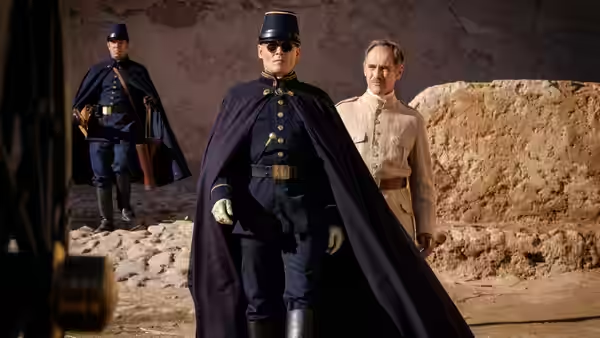
Depp is better than we expected. Joll’s dark glasses are a novelty at the frontier, and he explains them to the Magistrate with the patience of a man describing a spoon. He says that pain is the only reliable route to truth and then goes off to demonstrate it, and Depp plays the certainty without a flicker of enjoyment, which is what makes it frightening. Robert Pattinson arrives in the second half as Officer Mandel, a cruder instrument of the same policy, and is nasty and effective in about four scenes. Greta Scacchi has almost nothing to do as Mai and does it warmly.

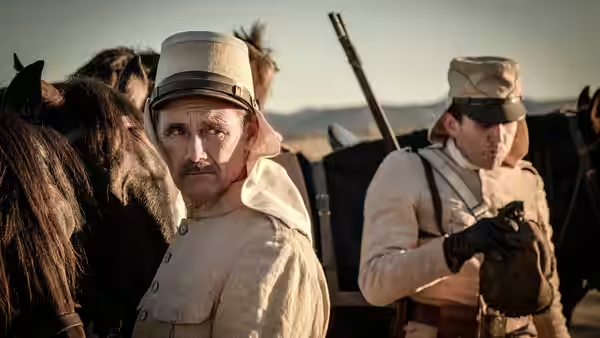
Chris Menges shoots the town in ochre and shadow and the desert as a flat white glare that hurts to look at, which is presumably why Joll brought the glasses. The frame is wide and the people in it are small; when the Magistrate’s party crosses the salt flats the riders look like insects on a plate. Crispian Sallis builds the settlement from mud brick and timber, with a granary that becomes a prison. Carlo Poggioli puts the Empire in black uniforms from no century in particular and the Magistrate in cream linen that gets dirtier as he does. Giampiero Ambrosi’s score is low and sparse and stays out of the way.

When Guerra does show what Joll’s men do, he holds the shot and does not cut away, and the crowd watching includes children. We found we were watching the children rather than the soldiers, and it horrified us. That is the film working as Coetzee meant it to. It is also nearly the only time it does.

The trouble is pace, and it belongs to Jacopo Quadri’s cut as much as to Guerra. Scenes run past their point. The film has said everything it has to say by the end of the first hour, and the second hour says it again more quietly. The Magistrate’s relationship with the Girl is a series of polite washings, and Bayarsaikhan is given so little to say that the film seems to be hoping we will mistake her silence for depth. We began the evening sombre and ended it restless, and then annoyed that a story about complicity had let its hero off so gently.

Guerra’s Embrace of the Serpent (2015) and Birds of Passage (2018) were about the same subject, and they were full of particular places and particular faces. Coetzee left his Empire unnamed because he wanted it to stand for every empire, and on the page the prose does the specifying for him. On screen the town plays as a set and the soldiers as a costume department.

See it for Rylance and for Menges’s desert. It runs 112 minutes and carries a 15. Watch it at home, where the slowness looks more like patience, and expect to have made up your mind about it some time before the film has.

Critical consensus AI synthesised

56
Positive
3
Mixed
5
Negative
4

The reviews split three ways, with mixed verdicts the largest group and the overall lean cool rather than hostile. Almost every critic, whatever the final judgement, praises Mark Rylance’s performance as the Magistrate, describing it as humane, nervous and expressive, and more than one says he comes close to holding the film together on his own. The widescreen desert photography is the other point of agreement, admired even by those who find little else to like.

The reservations cluster on the allegory. Most critics find the film’s version of empire too vague and its characters too archetypal to land, and several call the pacing stolid or bloated. Sight and Sound finds it a fresh and vital parable and Radio Times is similarly warm, while The Independent faults it for never examining its hero’s complicity. The spread is wide, from warm four-star notices to reviews that think it dull, and Johnny Depp’s restrained villain earns praise only at Slant.

Sight and Sound
6 September 2019 · John Bleasdale
85*

Bleasdale finds the film a fresh and vital parable of empire, despite its potentially over-neat allegory and familiar message. He singles out Mark Rylance’s quietly humane performance for praise.

Read the full review →
Radio Times
★★★★ · Andrew Collins
80

Collins gives the film a positive four-star verdict. He singles out Mark Rylance’s soulful portrayal of the Magistrate amid the colonial brutality.

Read the full review →
Variety
6 September 2019 · festival review · Guy Lodge
65*

Lodge finds the adaptation uneven at first but increasingly poetic, powerful, and stirring. He especially praises the desert journey’s widescreen cinematography and its evocative compositions.

Read the full review →
The New York Times
6 August 2020
64*

The URL identifies a review of the 2019 film, but the page returned only an access error. Its verdict and specific praise or criticism cannot be verified.

Read the full review →
Slant Magazine
3 August 2020 · ★★½/4 · Pat Brown
62

Brown finds the adaptation visually and emotionally less effective than Coetzee’s novel, though it retains awareness of colonialism’s consequences. He praises Johnny Depp’s restrained portrayal of authoritarian severity and the film’s refusal to treat symbolic gestures as meaningful reparation.

Read the full review →
IndieWire
6 September 2019 · C · Ben Croll
57

Croll finds the film disappointing, arguing that its anti-imperialist message is delivered without enough artistic boldness. He singles out the film’s vague allegorical world-building as a weakness, despite praising its performances and technical craft.

Read the full review →

Straight answers AI written, from our review

Is Waiting for the Barbarians worth watching?
Waiting for the Barbarians is worth watching mainly for Mark Rylance and Chris Menges's desert photography, and we scored it 53. It is sombre, handsome and faithful to Coetzee, but it has made its point by the end of the first hour and spends the second repeating it. Patient viewers who like slow, grave parables will get the most from it.
How long is Waiting for the Barbarians, and what is it rated?
Waiting for the Barbarians runs 1h 52m. It is a drama and history film.
Where can I watch Waiting for the Barbarians in Colombia?
Waiting for the Barbarians is streaming on Paramount+ and Apple TV in Colombia. Availability is checked daily; the links above go straight to each service.
How violent or frightening is Waiting for the Barbarians, and is it suitable for children?
Waiting for the Barbarians carries a 15 certificate for its torture scenes, which Guerra films without cutting away, with children among the crowd watching. There is little else that would trouble adults, but the violence is deliberate and upsetting rather than exciting, and we would not show it to younger children. Teenagers who can take a slow film should be fine.
How does Waiting for the Barbarians compare to Embrace of the Serpent?
Waiting for the Barbarians is the weaker of the two Ciro Guerra films, and Embrace of the Serpent is the one to see first. Both are about empire and complicity, but the Amazon film is full of particular places and faces where this one plays as a set and a costume department. The earlier film is stranger, more beautiful and better paced, though it also states its point out loud too often.
Is Waiting for the Barbarians based on a true story or a book?
Waiting for the Barbarians is based on J.M. Coetzee's 1980 novel of the same name, not on a true story, and the Empire in it is deliberately never named. Guerra's film follows the book faithfully in plot and intent, but Coetzee's prose does the work of making the place feel real, and the film has nothing equivalent. You do not need to have read the novel, though it is the richer version.

Cast

If you liked this, try…

  1. The Desert of the Tartars (1976) · not on Fi1m yetA fortress waits for an enemy that never comes; the waiting is the point, and it works.

  2. Zama (2017) · not on Fi1m yetAnother colonial official rotting at his post, but Martel makes the boredom funny and strange.

  3. Embrace of the Serpent (2015, Fi1m 82)Guerra’s Amazon film, in black and white, with all the specificity this one lacks.

  4. Disgrace (2008) · not on Fi1m yetCoetzee filmed with more nerve; John Malkovich as a man who deserves his humiliation.

  5. Beau Travail (1999) · not on Fi1m yetLegionnaires in Djibouti, drilling under a white sky; Denis says more with bodies than words.