Stephen Frears’s 70-minute film is plain, hard to sit through and worth it. Ian McKellen plays a man nobody has planned for, and the film follows him into the one place that was always going to take him.
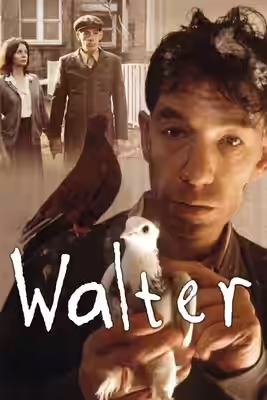
On the evening of 2 November 1982 a new British television channel showed, as the first thing it had ever made, a film about a man with learning disabilities whose parents die and leave him to the state. It was a declaration of some kind, and Walter still feels like one. Stephen Frears directs a script by David Cook, from Cook’s own novel, and keeps it to 70 minutes. We recommend it, with the caveat that it is one of the bleakest hours British television has produced and it does not soften at the end.
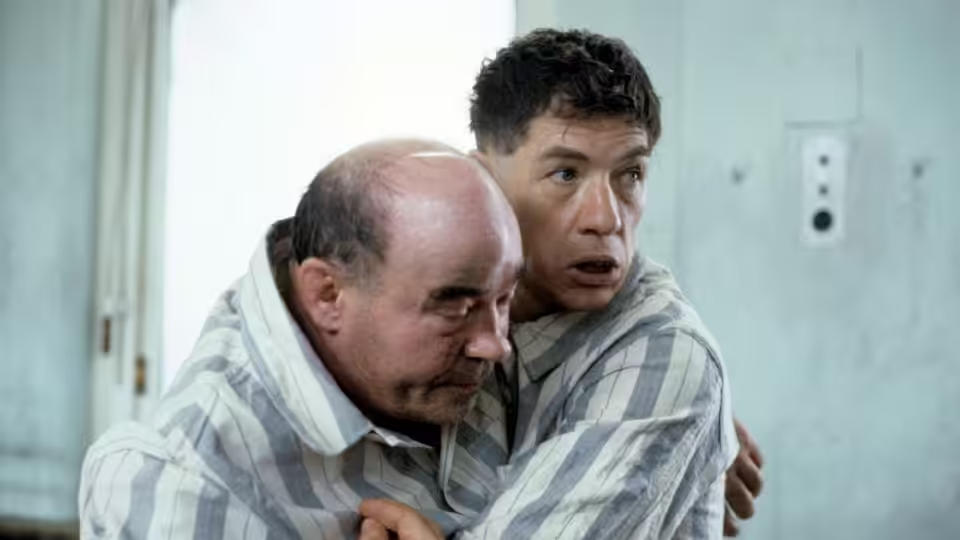
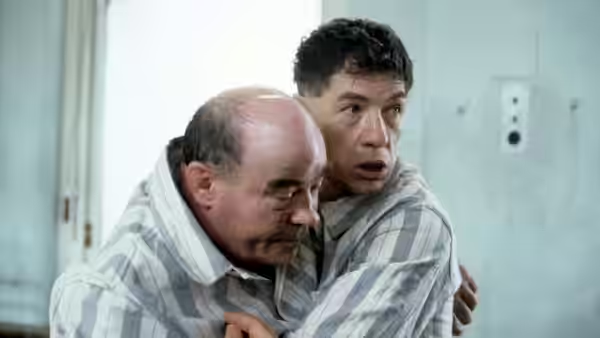
Ian McKellen is the whole film and knows it. He plays Walter with his jaw slack, his eyes mostly on the floor, his hands never quite sure where they should be. He says his few words twice, as if checking they came out. There is no music in the performance, no moment where the actor steps out and asks for our sympathy, and that is why it works. When Walter is happy, usually with a bird in his hands, McKellen lets a small, closed pleasure cross his face and then shuts it away again before anyone can take it off him. It is a careful, physical piece of work and it never asks to be admired.
Barbara Jefford’s Sarah loves her son and has confused that love with God’s. She talks to him in the voice of a woman explaining things to a wall she is fond of. Arthur Whybrow, as the father, has almost no lines and spends them wisely; he watches his wife and his son and seems to know what is coming. Chris Menges shoots the house with the light that comes through the net curtains and no more, so the rooms are brown and the faces grey, and the only colour is the pigeons. He stays close to McKellen’s face and lets the rest of the frame go soft, which puts us where Walter is: able to see one thing at a time.
The stockroom scenes are the film’s warmest and they are not warm. Keith Allen’s Mike treats Walter as a running joke and Lesley Clare O’Neill’s Jean laughs along until she doesn’t. Tony Melody’s Mr Hingley tolerates him the way a manager tolerates a filing cabinet that sometimes falls over. Cook writes these people without malice, which is the point: nobody here is cruel on purpose, and nobody is going to help either.
Then the parents are gone and Walter is taken away, and the film becomes something else. We will not describe what Walter does, or what is found, when his mother dies; it is the image people remember and it should be met cold. What follows is a ward. Jim Broadbent’s Joseph and Kenny Ireland’s Angus are the orderlies, and they are not monsters; they are tired, underpaid and in charge of too many men. We were horrified in that ward, and not by anything that was done to Walter. It was the noise, the men rocking and shouting under strip lights, the sense that this room had been going on for years before the camera arrived and would go on after it left. Menges shoots it wide and flat, and George Fenton’s score stays out, and we found ourselves wanting the film to be shorter than 70 minutes.
The flaws are the flaws of its kind. Walter has an inner life only when he has a bird; the rest of the time he is what happens to him, and a 70-minute film has no room to find out whether there was more. Sarah’s religion is a single note, struck often. The ward edges toward the grotesque in a couple of shots, and the film would have been harder to argue with without them. And the question of an actor without a learning disability playing a man with one is a question the film does not know it is raising; viewers now will raise it, and they will be right to.
Frears would go on to My Beautiful Laundrette (1985) and The Queen (2006), films that look nothing like this one, and the thing they share is here already: a director who trusts his actors and does not get in their way. Walter is a small, hard, decent film. Watch it when you are not tired, with someone who will not want to talk straight afterwards.