Angelina Jolie’s Without Blood has two committed leads and an affecting opening, but its talk about violence grows vague and repetitive. Salma Hayek and Demián Bichir cannot make a thin conversation sustain a whole film.
Without Blood is a sincere, carefully acted drama that has too little to say about the violence it asks us to consider. Angelina Jolie writes and directs this adaptation of a novel by Alessandro Baricco, building it around an extended conversation and returns to the past. The aim is clear enough: to consider how people live after violence, and whether they can stop repeating it. The trouble is that the film keeps returning to those questions without making them more difficult or more revealing.
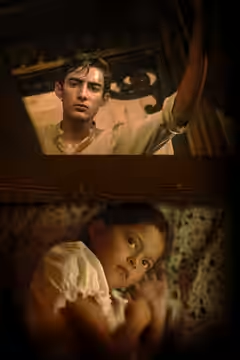
The opening is considerably stronger than the discussion that follows. Seamus McGarvey frames the attack with care, while editors Joel Cox and Xavier Box establish a pace that makes the violence register. We were shaken by it, because the controlled framing and timing make the threat immediate before anybody has to explain what it means. For this stretch, the director trusts what is happening on screen to hold our attention.
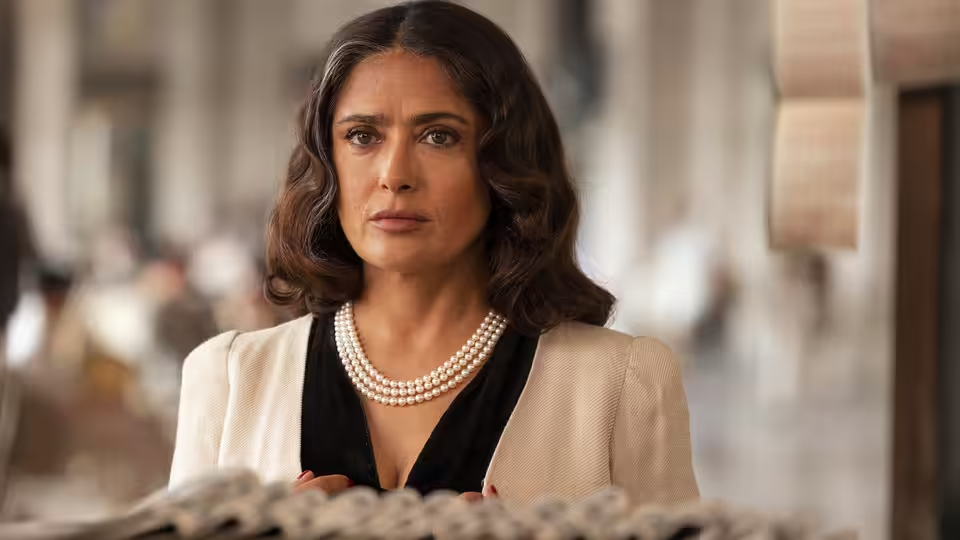
Salma Hayek, as Nina, and Demián Bichir, as Tito, provide the other substantial reason to stay. Both make shared trauma feel like something that complicates what can be said between two people. Their performances allow uncertainty about what either person can bear to acknowledge, and that makes the encounter briefly absorbing. We want the director to give them more space, because their handling of the conversation is more persuasive than the ideas being spoken aloud.
Instead, the flashbacks repeatedly take us away from them. The editors’ cutting between the conversation and earlier violence keeps restarting a tension that needs time to grow. Returning to violent scenes also makes those scenes less disturbing, since repetition begins to feel like an instruction to take the subject seriously. The subject already has our attention, and these reminders become unnecessary. At 91 minutes, the film still makes the central exchange feel prolonged.
Angelina Jolie’s screenplay is the larger problem. Jon Hutman supplies the production design and Rutger Hoedemaekers the music, but the sense of confinement comes chiefly from dialogue that keeps circling the same concerns. The two leads are asked to carry broad thoughts about war without enough particular conflict to make those thoughts convincing. They keep the encounter watchable longer than the material warrants, though even their commitment cannot prevent the discussion from dragging.
A chamber drama is a reasonable form for this subject, because listening to someone can be difficult enough without further interruptions. Yet the exchanges need to change what we understand about the people speaking, and the director is too cautious to press them far enough. The wish to break a cycle of violence is admirable, but the film barely tests how that might happen. Those drawn to the two leads may find sufficient reward in the performances. We would not choose it for the discussion.