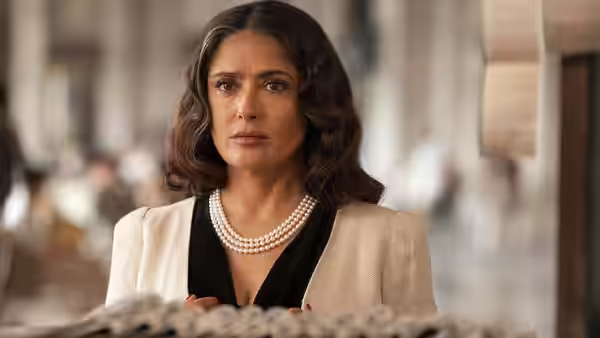
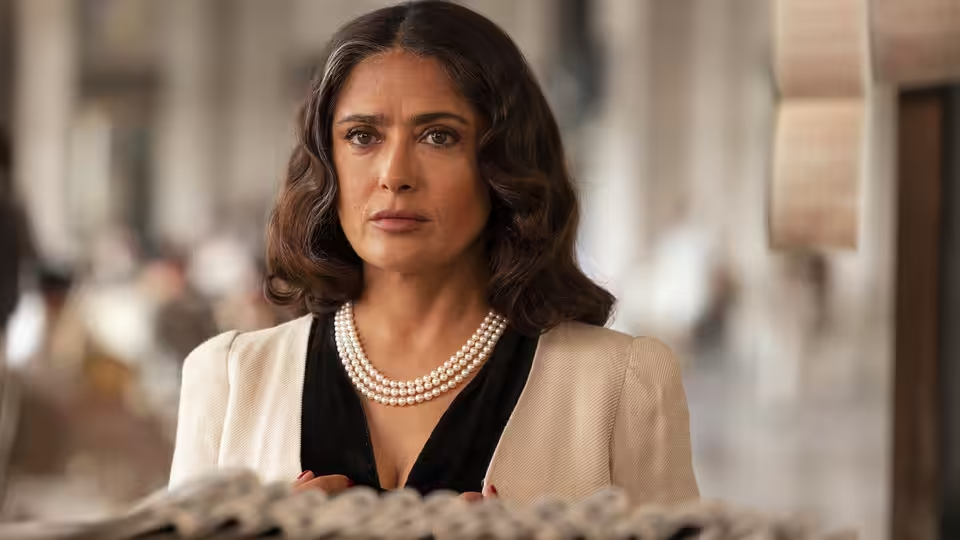
Nina (Salma Hayek) sits behind a desk in a beige jacket and pearl necklace
Film review

Without Blood

2025 · Directed by Angelina Jolie · 1h 31m

In a sentenceSalma Hayek and Demián Bichir might get somewhere if the flashbacks would let them finish

Nina (Salma Hayek) and Tito (Demián Bichir) attempt to speak about the violence that has shaped their lives. An attack opens the drama, and flashbacks bring violent episodes into the conversation as the two reckon with shared trauma. Manuel Roca (Alfredo Herrera) also figures in a story that asks whether people marked by violence can find a way to stop its repetition. The central encounter gives Nina and Tito the chance to consider what living with that past means.

Plays from YouTube when you press play; nothing loads from them until then.

Fi1m review

Angelina Jolie’s Without Blood has two committed leads and an affecting opening, but its talk about violence grows vague and repetitive. Salma Hayek and Demián Bichir cannot make a thin conversation sustain a whole film.

Without Blood is a sincere, carefully acted drama that has too little to say about the violence it asks us to consider. Angelina Jolie writes and directs this adaptation of a novel by Alessandro Baricco, building it around an extended conversation and returns to the past. The aim is clear enough: to consider how people live after violence, and whether they can stop repeating it. The trouble is that the film keeps returning to those questions without making them more difficult or more revealing.

The opening is considerably stronger than the discussion that follows. Seamus McGarvey frames the attack with care, while editors Joel Cox and Xavier Box establish a pace that makes the violence register. We were shaken by it, because the controlled framing and timing make the threat immediate before anybody has to explain what it means. For this stretch, the director trusts what is happening on screen to hold our attention.

Salma Hayek, as Nina, and Demián Bichir, as Tito, provide the other substantial reason to stay. Both make shared trauma feel like something that complicates what can be said between two people. Their performances allow uncertainty about what either person can bear to acknowledge, and that makes the encounter briefly absorbing. We want the director to give them more space, because their handling of the conversation is more persuasive than the ideas being spoken aloud.

Instead, the flashbacks repeatedly take us away from them. The editors’ cutting between the conversation and earlier violence keeps restarting a tension that needs time to grow. Returning to violent scenes also makes those scenes less disturbing, since repetition begins to feel like an instruction to take the subject seriously. The subject already has our attention, and these reminders become unnecessary. At 91 minutes, the film still makes the central exchange feel prolonged.

Angelina Jolie’s screenplay is the larger problem. Jon Hutman supplies the production design and Rutger Hoedemaekers the music, but the sense of confinement comes chiefly from dialogue that keeps circling the same concerns. The two leads are asked to carry broad thoughts about war without enough particular conflict to make those thoughts convincing. They keep the encounter watchable longer than the material warrants, though even their commitment cannot prevent the discussion from dragging.

A chamber drama is a reasonable form for this subject, because listening to someone can be difficult enough without further interruptions. Yet the exchanges need to change what we understand about the people speaking, and the director is too cautious to press them far enough. The wish to break a cycle of violence is admirable, but the film barely tests how that might happen. Those drawn to the two leads may find sufficient reward in the performances. We would not choose it for the discussion.

Critical consensus AI synthesised

43
Positive
1
Mixed
3
Negative
4

The reviews lean negative on Without Blood, with most critics finding its serious treatment of violence and trauma more sincere than compelling. Praise clusters around Salma Hayek Pinault and Demián Bichir, whose tense, committed performances give the central encounter emotional weight. The opening attack also draws approval for its framing and pace. Beyond that opening, recurring complaints concern a conversation that drags, abstract dialogue and ideas about war that remain too vague to sustain the drama.

The spread runs from qualified admiration to marked dissatisfaction, though even the favourable response comes with reservations. Deadline welcomes the exploration of breaking cycles of violence but finds the film stagey. IndieWire sees the flashbacks as interruptions to the central conversation, while The Wrap argues that repeated violence dulls its impact. The disagreement is chiefly over how much the performances and serious subject matter compensate for the slow, thinly developed storytelling.

The New York Times
17 September 2026
64*

The page is identified as a review, but its text is inaccessible. No critical verdict or specific praise or complaint can be verified.

Read the full review →
IndieWire
9 September 2024 · C · Vikram Murthi
57

Murthi finds the film sincere but dramatically inert, ultimately calling it mediocre. He criticizes its vague ideas about war and flashbacks that interrupt the central conversation.

Read the full review →
The Hollywood Reporter
9 September 2024 · festival review · Lovia Gyarkye
35*

Gyarkye finds the film overly cautious and its story too thin to carry its themes. She praises Hayek Pinault and Bichir’s tense performances, especially their nuanced portrayal of shared trauma.

Read the full review →
The Guardian
9 September 2024 · festival review · Radheyan Simonpillai
25*

The critic finds the drama well-meaning but unconvincing, weighed down by abstract dialogue and hollow material. They praise the affecting opening violence and the ambiguity of the final moment.

Read the full review →
The AV Club
18 September 2026 · Natalia Keogan
20*

Keogan finds Jolie’s morality tale lacking purpose. The headline singles out the film’s lack of purpose as its central failing.

Read the full review →
Deadline
17 September 2024 · festival review · Damon Wise
70*

Wise finds the film artful but stagey, praising its attempt to explore ways of breaking cycles of violence. He singles out the excellent performances by Salma Hayek Pinault and Demián Bichir.

Read the full review →

Straight answers AI written, from our review

Is Without Blood worth watching?
Without Blood is difficult to recommend beyond its committed performances from Salma Hayek and Demián Bichir; we score it 43 out of 100. The opening attack is affecting, but repeated flashbacks interrupt the leads, and the conversation about living after violence grows vague and prolonged.
How long is Without Blood, and what is it rated?
Without Blood runs 1h 31m. It is a drama film.
Where can I watch Without Blood in Slovakia?
Without Blood is not on any streaming or rental service in Slovakia at the moment. It is available in 1 other country; change your country at the top of the page to see where. Availability is checked daily.
How does Without Blood compare to A Separation?
Without Blood is the less rewarding drama beside A Separation, which we recommend for its precise performances and difficult judgements. Both give their actors demanding exchanges, but Jolie’s film repeats broad questions about violence, while Farhadi’s family drama uses conflicting accounts to make our understanding of its characters more complicated.
Is Without Blood based on a true story or a book?
Without Blood is adapted from a novel by Alessandro Baricco, rather than presented as a true story. Angelina Jolie writes and directs, centring the drama on a conversation interrupted by returns to past violence; we find the film’s difficulty lies in repetitive dialogue, not in anything that requires prior knowledge of the book.

Cast

If you liked this, try…

  1. Mass (2021) · not on Fi1m yetA sustained conversation lets grief and responsibility become specific, difficult and human.

  2. Death and the Maiden (1994) · not on Fi1m yetA tense encounter makes the legacy of political violence uncomfortably personal.

  3. The Official Story (1985) · not on Fi1m yetQuestions about family expose the private comforts that can shelter public cruelty.

  4. The Ascent (1977) · not on Fi1m yetWartime choices test compassion under pressures that talk alone cannot convey.

  5. A Separation (2011, Fi1m 93)Conflicting accounts and precise performances make every judgement harder to settle.

Without Blood (2025) review: strong acting, thin talk about war (Slovakia) | Fi1m