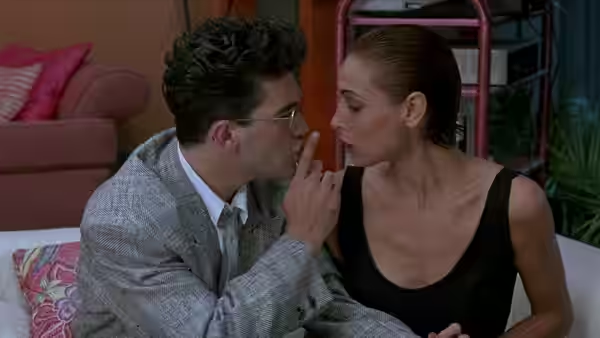
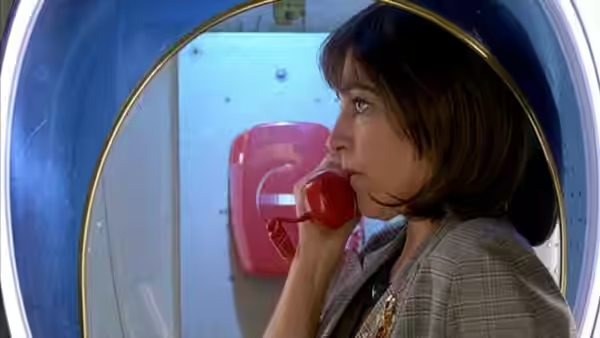
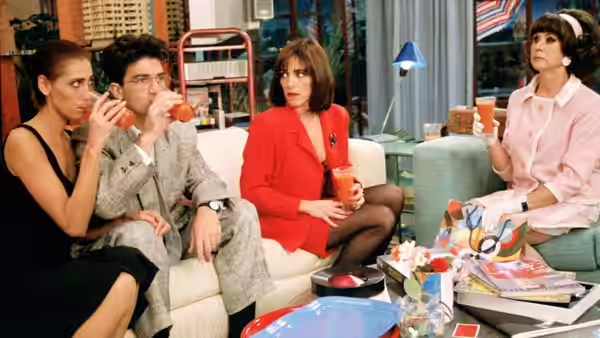
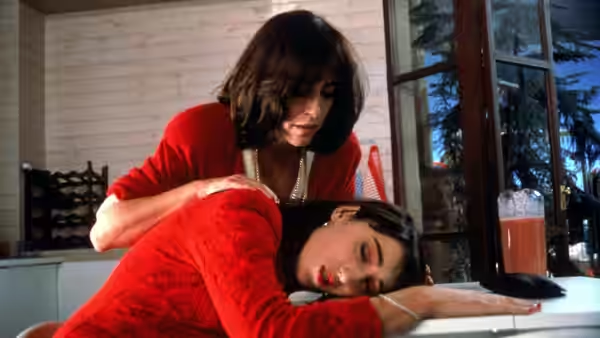
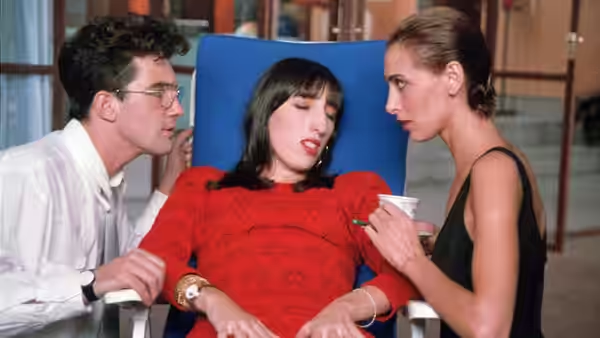
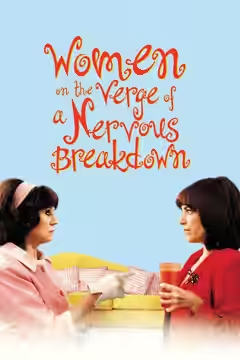
Man in gray suit leans close to woman in black top on couch
Film review

Women on the Verge of a Nervous Breakdown

1988 · Directed by Pedro Almodóvar · 1h 28m

In a sentenceCarmen Maura deserves a quiet afternoon, which would make a much less enjoyable film

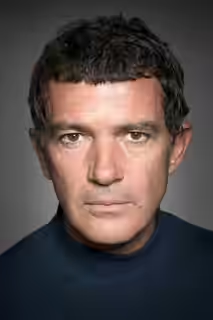
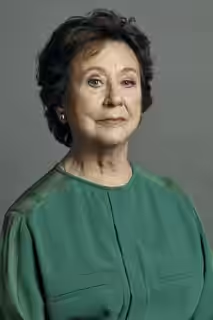
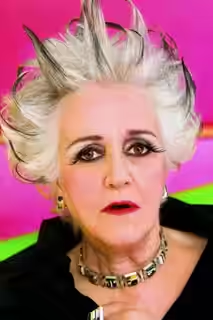
Pepa, played by Carmen Maura, is a woman beset by complications in Pedro Almodóvar’s comedy of mounting desperation. As her difficulties multiply, the people around her become part of an increasingly tangled farce, with Pepa trying to hold her ground amid the confusion. Antonio Banderas plays Carlos, Julieta Serrano plays Lucía and María Barranco plays Candela. Rossy de Palma appears as Marisa, Kiti Mánver as Paulina Morales and Fernando Guillén as Iván. The ensemble also includes Guillermo Montesinos as a taxi driver and Loles León as a secretary.

Plays from YouTube when you press play; nothing loads from them until then.

Fi1m review

Pedro Almodóvar’s farce is funny, colourful and held together by Carmen Maura’s practical, beleaguered Pepa. The plot occasionally becomes overbusy, but Maura keeps us interested in her even when another complication is the last thing anyone needs.

Women on the Verge of a Nervous Breakdown is a lively, generous farce, and Carmen Maura gives it the firmness it needs. Pedro Almodóvar, writing and directing, lets the complications accumulate around Pepa without asking us to regard her distress as proof that she is ridiculous. That matters when so much of the comedy depends on people being pushed beyond reasonable endurance. We recommend it warmly, with a reservation about the stretches when another complication is less welcome than a little breathing space.

Maura makes Pepa practical enough to earn our sympathy without smoothing away her desperation. She gives the impression of someone who might cope perfectly well if the next problem would only wait its turn, and that makes the growing confusion funnier. We laughed, then felt protective of her. It was Maura’s no-nonsense manner that did it: she holds on to Pepa’s self-respect while everything around her gets more outlandish.

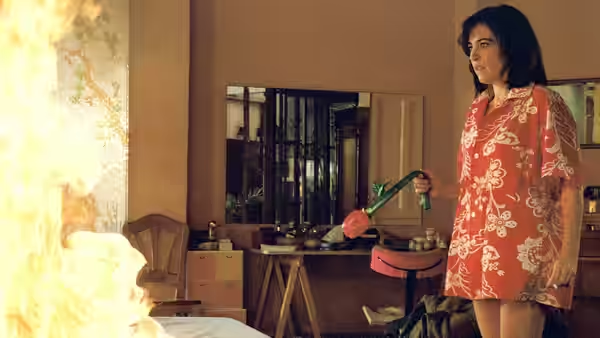
José Luis Alcaine’s cinematography gives the colour a richness that makes even the garish choices pleasurable. The production design has a similar appetite for odd detail, so there is usually something to enjoy beyond the immediate business of the plot. It is a busy look, but the exaggeration suits the performances. A more restrained image would make the characters seem stranded; here their agitation belongs to the same film as their surroundings.

José Salcedo’s editing is important to the film’s speed: the scattered action rarely has time to settle into separate, self-contained episodes. That keeps the company working together, with Antonio Banderas as Carlos, Julieta Serrano as Lucía and María Barranco as Candela contributing to a sense of trouble coming from several directions. Bernardo Bonezzi’s music supports the bustle without demanding much attention of its own. The comic rhythm still comes most clearly from Maura holding firm amid the agitation.

The writing is not equally persuasive throughout. Almodóvar sometimes adds another improbability when the people already in play seem capable of sustaining a scene without help, and the busyness can make an individual predicament harder to care about. Maura’s performance remains clear enough to follow, but some of the surrounding activity registers mainly as another demand on our attention. At 88 minutes, the film hardly overstays its welcome, though the crowded plotting can make it feel longer.

By the usual standards of farce, the sympathetic treatment of Pepa is the distinction worth stressing. The film does not need to punish her for being upset, nor does it require every person around her to become someone we would welcome into our lives. Rossy de Palma’s Marisa belongs to an ensemble whose differences help keep the comedy from becoming monotonous. Maura is the centre, but the film would be much thinner if everyone else simply stood aside for her.

The loose plotting is a caveat, especially for anyone who likes every comic complication to follow neatly from the last. Even so, the ensemble gives the busy stretches enough life to keep the film enjoyable. Choose it for Maura, and allow for rather more company than Pepa seems to want.


Critical consensus AI synthesised

80
Positive
8
Mixed
0
Negative
0

All eight reviews are favourable, and the praise gathers in the same two places. Most critics describe the film as a fast, free-wheeling farce, and nearly all of them dwell on the colour, which they call garish, rich or so saturated it looks edible. Carmen Maura’s Pepa is singled out in almost every review as the performance that holds the scattered plot together, admired for her glamour, her resilience and her refusal to fall apart completely.

The spread is narrow and the reservations are mild rather than structural. The cooler notices find the film slighter than its admirers do. Time Out calls it looser and dream-like, a picture in which a great deal happens while little actually occurs, and The New York Times finds it deliberately benign, charming rather than shocking. Variety, reviewing at the festival stage, praises it chiefly as the most coherent film Almodóvar has made to that point. Nobody dislikes it; the disagreement is over how much the fizz adds up to.

Slant Magazine
2 March 2017 · Jake Cole
90*

The film is an ebullient comedy propelled at a manic clip, drenched in colors so rich they seem edible, and one of the finest comedies of the 1980s. Maura’s performance as Pepa ties together the scattered plot and constantly rising action.

Read the full review →
The New Yorker
14 November 1988 · Pauline Kael
90*

Kael calls the film one of the jauntiest war-of-the-sexes comedies and the most visually assured of Almodóvar’s early features. She singles out its fizzier, sexier tone and the way it revels in overdramatizing without losing buoyancy.

Read the full review →
Little White Lies
30 March 2016 · Mathilde Dumazet
85*

The critic praises Almodóvar’s 1988 film as a liberating, colourful gem that balances suspense, laughter and tears while exploring women’s suffering at the hands of men. She singles out Carmen Maura’s performance for showing that being on the verge of a breakdown is not the same as fully freaking out, and highlights the film’s visual and thematic richness.

Read the full review →
Los Angeles Times
20 December 1988 · Kevin Thomas
85*

The critic praises the film as a funny, free-wheeling farce full of sly comic touches that moves Almodóvar into the mainstream while showcasing Carmen Maura's glamorous, expressive performance as Pepa. It highlights the director's keen sense of absurdity and cinematic style in a mostly apartment-bound story, with Maura's character gaining strength and self-possession through the chaos.

Read the full review →
Empire
1 January 2000 · David Parkinson
80*

The critic calls the film an explosion of garish colour, wacky detail and surreal complications that is very funny and overflows with the unexpected. Praise is singled out for Carmen Maura's superb performance as the resilient Pepa and the ensemble farce elements.

Read the full review →
The New York Times
11 November 1988 · Vincent Canby
70*

The critic calls it an entertaining, deliberately benign Spanish farce that charms rather than shocks. He singles out Carmen Maura's grand, no-nonsense performance as Pepa for special praise.

Read the full review →

Straight answers AI written, from our review

Is Women on the Verge of a Nervous Breakdown worth watching?
Women on the Verge of a Nervous Breakdown is worth watching for anyone who enjoys a fast, colourful farce with a sympathetic centre, and we scored it 84. Carmen Maura's practical, beleaguered Pepa holds the film together, and José Luis Alcaine's rich colour makes even the garish choices a pleasure. The plotting gets overbusy in stretches, so viewers who want every complication to follow neatly from the last should be warned.
How long is Women on the Verge of a Nervous Breakdown, and what is it rated?
Women on the Verge of a Nervous Breakdown runs 1h 28m. It is a comedy and drama film.
Where can I watch Women on the Verge of a Nervous Breakdown in Panama?
Women on the Verge of a Nervous Breakdown is not on any streaming or rental service in Panama at the moment. It is available in 11 other countries; change your country at the top of the page to see where. Availability is checked daily.
How violent or frightening is Women on the Verge of a Nervous Breakdown, and is it suitable for children?
Women on the Verge of a Nervous Breakdown carries a UK 15 certificate, so it is not intended for children, and it is a comedy rather than a frightening or violent film. Its adult content lies in the tangled romantic and sexual complications of the farce rather than in anything alarming. Teenagers of fifteen and over who like fast, adult comedy will be fine; younger children would find little for them.
How does Women on the Verge of a Nervous Breakdown compare to The Awful Truth?
Women on the Verge of a Nervous Breakdown and The Awful Truth are both fast comedies of romantic chaos with contrived plotting, but the earlier film is the tighter of the two. McCarey's performers know exactly when to stop; Almodóvar keeps adding complications when the people already in play could sustain the scene. Choose Almodóvar for colour, exaggeration and Maura's sympathetic Pepa, and McCarey for warmth and control.
What should I watch after Women on the Verge of a Nervous Breakdown?
After Women on the Verge of a Nervous Breakdown, try The Awful Truth (1937, Fi1m 89): Romantic chaos handled by performers who know exactly when to stop. Then Tampopo (1985, Fi1m 84): Another unruly ensemble comedy whose apparent digressions prove worth following; and Wild Tales (2014, Fi1m 83): For a harsher dose of ordinary frustration pushed into farce.

Cast

Awards

Academy Awards, 1989

Nominated
Best International Feature Film

International Submission to the Academy Awards, 1989

Nominated
International Submission to the Academy Awards

European Film Academy Special Aspect Award for Best Art Direction, 1988

Nominated
European Film Academy Special Aspect Award for Best Art Direction

European Film Award for Best Actress, 1988

Won
European Film Award for Best Actress

Young European Film of the Year, 1988

Won
Young European Film of the Year

If you liked this, try…

  1. The Awful Truth (1937, Fi1m 89)Romantic chaos handled by performers who know exactly when to stop.

  2. Tampopo (1985, Fi1m 84)Another unruly ensemble comedy whose apparent digressions prove worth following.

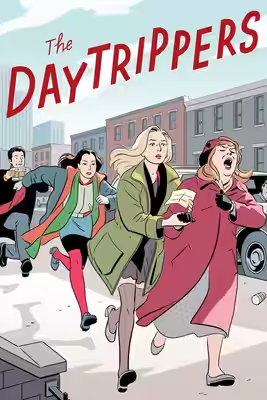
  3. The Daytrippers (1996) · not reviewed yetFamily interference and romantic disappointment, played with a drier comic touch.

  4. 8 Women (2002) · not reviewed yetColour, theatrical plotting and an ensemble happy to compete for attention.

  5. Wild Tales (2014, Fi1m 83)For a harsher dose of ordinary frustration pushed into farce.

Free account

Know what to watch tonight

Two lists that know where things are streaming, collections you can share, your own score beside ours, and Discover that remembers what you have seen.

  • Want to see, sorted by what is streaming now
  • Seen, with your score out of ten
  • No adverts, ever