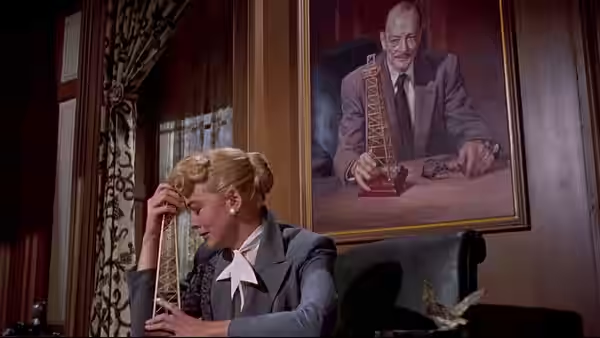
A woman presents display boards to a suited man in an office
Film review

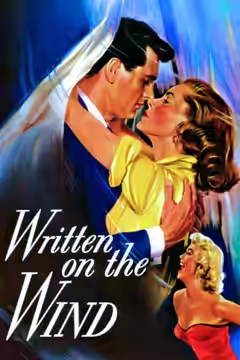
Written on the Wind

1956 · Directed by Douglas Sirk · 1h 39m

In a sentenceGood behaviour is a serious disadvantage in a film with Dorothy Malone

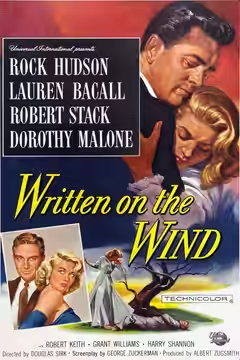
Lucy Moore Hadley (Lauren Bacall) marries Kyle Hadley (Robert Stack), whose best friend, Mitch Wayne (Rock Hudson), is also drawn to her. Marriage and friendship now make competing demands on the three, with attraction crossing the boundaries between them. Marylee Hadley (Dorothy Malone) and Jasper Hadley (Robert Keith) also figure in the Hadley story. The marriage establishes who is husband, wife and friend, but those positions do not settle their feelings. Wanting someone brings obligations to the other people involved, including the person who already trusts you.

Fi1m review

Douglas Sirk’s melodrama is forceful, compassionate and occasionally over-insistent. Robert Stack and Dorothy Malone make its most volatile characters worth caring about, even when the central romance struggles to compete with them.

Douglas Sirk’s Written on the Wind is a forceful melodrama, worth seeing despite a central romance that is less compelling than the people making trouble around it. George Zuckerman’s screenplay, adapted from Robert Wilder’s novel, takes its entanglement of marriage and friendship seriously. There is no need to pretend that jealousy is a small matter, or that an unreasonable person cannot also deserve sympathy. The film gives its most difficult people enough attention for us to care about them.

Robert Stack makes Kyle Hadley’s distress hard to dismiss. There is anger in the performance, but also a frightening lack of confidence; being wealthy has plainly not helped this man feel secure. We felt unexpectedly sorry for him, because Robert Stack makes the aggression look so close to panic. He gives the impression of someone who could be wounded by a remark that another person would barely notice.

Dorothy Malone gives Marylee Hadley an equally uncomfortable need to be wanted. Her anger and sexual appetite are played without much concern for making her agreeable, and that is a considerable part of the film’s appeal. The performance risks being excessive and sometimes is. Yet she remains interesting even when she is unreasonable, which makes the steadier company elsewhere seem rather thin.

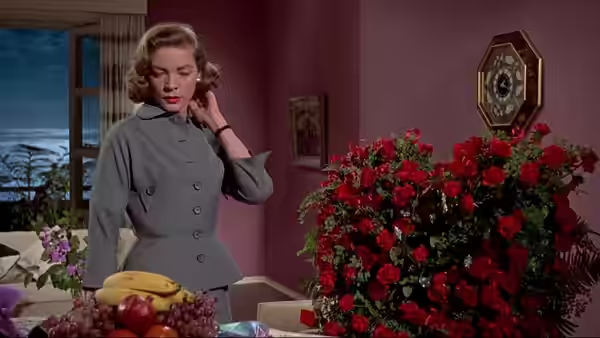
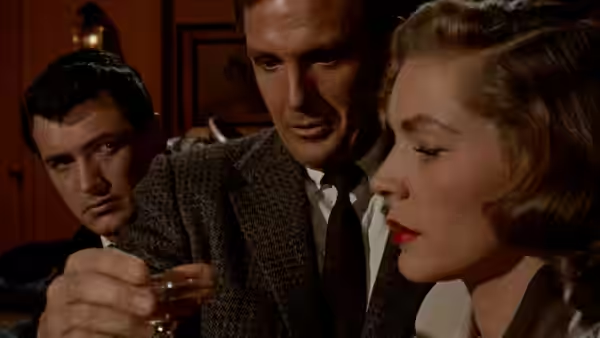
Russell Metty’s cinematography helps make that scale of acting convincing. The strong colour is not reassuring, and the dense shadows keep it from looking merely decorative. We found the brightness unsettling because it makes the characters’ unhappiness harder to ignore, rather than offering something pretty to look at around them. The lighting gives their anger and desire a convincing setting, although the visual emphasis can leave us wishing for a quieter moment.

Russell F. Schoengarth’s editing supplies welcome discipline. The story stays tightly organised even when the performances threaten to overwhelm it, and at 99 minutes the film avoids making intensity feel like a test of endurance. Frank Skinner’s score works within the same emphatic approach, though we would sometimes welcome less insistence from the music. A film pitched this high needs some control over its length, and the cutting provides it.

The main reservation is with Lauren Bacall and Rock Hudson, whose relative restraint does not always hold our attention. Neither performance seems careless, but both suffer from being placed beside people whose feelings are so much harder to contain. George Zuckerman makes the competing attachments easy to follow without making each of them equally persuasive. We understand who wants whom without always sharing the urgency. For a romance, that matters.

Melodrama needs us to take outsized feelings seriously, and Douglas Sirk largely earns that willingness here. The excess can be funny, but the film’s sympathy for its volatile characters keeps the amusement from turning unkind. We recommend it for that sympathy as much as for the colour and the two fiercer performances. Choose another film if everyone needs to behave reasonably tonight.

Critical consensus AI synthesised

78
Positive
7
Mixed
2
Negative
0

Most critics respond warmly to Written on the Wind, with praise clustering around Sirk’s forceful melodrama and the way its images express the characters’ passions. Colour, shadow and expressive lighting receive particular attention, alongside Russell Metty’s camerawork. The performances also draw strong notices, especially Robert Stack’s troubled wealthy man and Dorothy Malone’s portrayal of anger and desire. Several reviews find substance beneath the excess, stressing sympathy for the volatile family members or criticism of the American Dream.

The clearest disagreement concerns how much emotional depth accompanies that excess. Slant Magazine relishes the audacity but finds the film comparatively shallow in its understanding of people. The ratings range from mixed to strongly positive, with no negative notices recorded. The two mixed reviews are inaccessible, however, so their specific objections cannot be established; the available criticism supports a clearer account of the enthusiasm than of the reservations.

Sight and Sound
90*

The page presents Sirk’s melodrama as a deliriously bold, highly accomplished work. It especially praises Russell Metty’s camerawork and the film’s sympathies for the volatile family members.

Read the full review →
The New Yorker
17 December 2015 · Richard Brody
90*

Brody presents the film as one of Sirk’s greatest achievements and praises its ironic, operatic vision of American melodrama. He singles out the vivid colors and tangled shadows that turn the characters’ passions into striking visual tableaux.

Read the full review →
Empire
1 January 2000 · William Thomas
85*

The critic calls the film intense, powerful, and well worth seeing. They single out its tightly structured storytelling, expressive lighting, and symbolism.

Read the full review →
Radio Times
★★★★ · Tom Hutchinson
80

Hutchinson praises Sirk’s melodrama as a forceful indictment of the American Dream. He singles out Robert Stack and Dorothy Malone for outstanding portrayals of anger and arousal.

Read the full review →
Slant Magazine
4 March 2022 · ★★★★ · Eric Henderson
80

Henderson calls the film Sirk’s giddiest trash entertainment, while finding it the shallowest example of his humanist acuity. He praises its audacious melodrama, especially Marylee’s outrageous courtroom appearance and the film’s unabashed excess.

Read the full review →
Variety
31 December 1955 · Variety Staff
80*

The review is strongly positive, praising the film’s script, direction and performances. It singles out Robert Stack’s portrayal of a wealthy, psychologically troubled man as especially compelling.

Read the full review →

Straight answers AI written, from our review

Is Written on the Wind worth watching?
Written on the Wind is worth watching for its compassionate handling of volatile people, and we score it 83. We recommend it to anyone who enjoys forceful melodrama: Robert Stack and Dorothy Malone make jealousy and insecurity matter, though the central romance is less compelling and the music sometimes presses too hard.
How long is Written on the Wind, and what is it rated?
Written on the Wind runs 1h 39m. It is a drama and romance film.
Where can I watch Written on the Wind in Slovenia?
Written on the Wind is not on any streaming or rental service in Slovenia at the moment. It is available in 6 other countries; change your country at the top of the page to see where. Availability is checked daily.
How does Written on the Wind compare to All That Heaven Allows?
Written on the Wind is the fiercer melodrama, while All That Heaven Allows is the stronger choice for a tender romance. Both use colour and frustrated desire to examine social respectability. We find Stack and Malone’s volatility the chief attraction here; the companion film gives more weight to romantic unhappiness, with Jane Wyman doing much of the emotional work.
Is Written on the Wind based on a true story or a book?
Written on the Wind is adapted from Robert Wilder’s novel, with a screenplay by George Zuckerman. The film makes its competing attachments easy to follow without prior knowledge of the book, so we see no need to read it before watching.
What should I watch after Written on the Wind?
After Written on the Wind, try All That Heaven Allows (1955, Fi1m 86): Social respectability gets a similarly fierce examination through colour and frustrated desire. Then The Heiress (1949, Fi1m 90): Another wealthy household where wanting to be loved makes people dangerously vulnerable; and The Earrings of Madame de... (1953, Fi1m 87): For another romance in which money and manners make desire more complicated.

Cast

Awards

Academy Awards, 1957

Nominated
Best Supporting Actor
Won
Best Supporting Actress

If you liked this, try…

  1. All That Heaven Allows (1955, Fi1m 86)Social respectability gets a similarly fierce examination through colour and frustrated desire.

  2. The Heiress (1949, Fi1m 90)Another wealthy household where wanting to be loved makes people dangerously vulnerable.

  3. The Earrings of Madame de... (1953, Fi1m 87)For another romance in which money and manners make desire more complicated.

  4. The Bitter Tears of Petra von Kant (1972) · not on Fi1m yetAn even more claustrophobic melodrama, with desire making appalling behaviour painfully understandable.

  5. Far from Heaven (2002, Fi1m 87)Careful manners and rich colour cannot keep forbidden feelings from becoming visible.

Written on the Wind (1956) review: Bold, moving but a bit uneven (Slovenia) | Fi1m