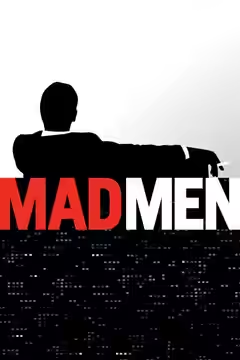
Christopher Manley helps make a roomful of people reveal who expects to be obeyed. We rate his cinematography on Mad Men highly, while his substantial move into directing gives us reason to keep watching.
Fi1m perspective
In Mad Men (2007), a person's place in the frame can tell us how much authority they think they have. It is precise, revealing work. The careful compositions encourage us to notice who seems secure and who needs the others to confirm their importance. Manley and fellow cinematographer Phil Abraham help make those distinctions visible. We found those rooms quietly unsettling because the framing makes confidence look so dependent on everyone else's consent.
Before that long television assignment, Manley shot Dahmer (2002). He joined Mad Men as director of photography in its second season, shooting 71 episodes in total, and began directing its episodes in 2012, eventually directing four. He supervised the move from film to digital without abandoning the series' period-appropriate restrictions on camera movement. That continuity matters to the controlled look we admire: attention stays on the people and their positions in the frame, rather than on what the equipment might now be capable of doing.
We would not give him sole credit for how persuasive these rooms are. Production designers Dan Bishop, Christopher Brown and Bob Shaw supply surroundings that do not turn each scene into a display of period objects. The people remain more interesting than the furnishings, which is not a small achievement in a period drama. The series can be smug about the past, and careful composition does not cure that. Our strongest enthusiasm for Manley remains for his cinematography; directing needs to be judged beyond the arrangement of a shot.
On Masters of Sex (2013), he again moved from cinematography into directing; Doom Patrol (2019) brought 11 directed episodes and a producing director role. His emphasis on collaboration with actors makes sense for someone whose images already pay such close attention to how people behave around one another. Start with Mad Men, and watch who seems entitled to the space and who has to earn it.
Biography
Christopher Manley, also credited as Chris Manley, is an American cinematographer, director and producer. He graduated from Temple University in Philadelphia and studied at the American Film Institute. He began his career as a director of photography working for Roger Corman.
Manley is best known for his work on the series Mad Men (2007), where he served as director of photography on 71 episodes across six seasons and directed four episodes. He has also worked as director of photography on series including the pilot of Homeland (2011), American Horror Story (2011), Masters of Sex (2013), DC's Stargirl (2020) and Foundation (2021). As a director, his credits include episodes of Doom Patrol (2019), Masters of Sex and Monarch (2022).
Manley has received multiple Emmy and ASC award nominations for his cinematography, including four Primetime Emmy nominations for Mad Men. He won a Primetime Emmy for Outstanding Achievement in Single Camera Photography for the miniseries The Phantom Eye. He has been a member of the American Society of Cinematographers since 2007.