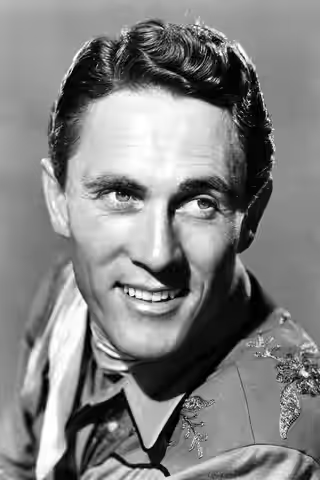
A big-band singer who found his real instrument in a borrowed drawl. In John Ford's Westerns he was the comic hand at the edge of the frame; as Festus Haggen on Gunsmoke he made the same man worth eleven years of watching.
Fi1m perspective
The voice came first, and it was not the one he started with. Ken Curtis sang with Tommy Dorsey's band in the early 1940s, fronted Columbia's low-budget singing-cowboy Westerns from 1945, and later joined the Sons of the Pioneers; the singer can be heard in Rio Grande (1950). None of it made him a star. What did was a joke. On the set of The Searchers (1956) he was fooling about in what he called a dry-land dialect, a slow rural drawl, and John Ford was listening. "He said, 'How would you say that in dry-land?' I did it for him, and he said 'Play it that way.'" Charlie McCorry was played that way, and so, in the end, was most of what followed.
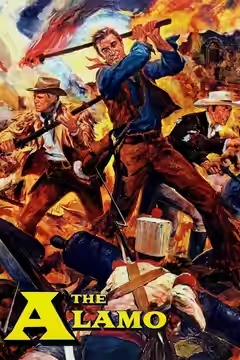
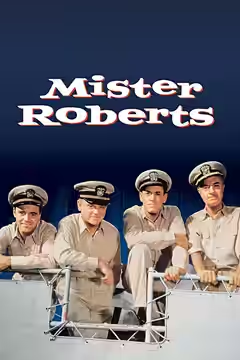
Ford kept him close. Eight films together, six with John Wayne, most of them small parts and some uncredited: the sailor, the hired hand, the man with something wry to say before the camera moves on. The two we have reviewed show the limits of that. In Mister Roberts (1955) he is Dolan, one of the crew on a cargo ship the war forgot, and the film belongs to four leads who could carry anything. In The Alamo (1960) he is Captain Almeron Dickinson, and the film belongs to Wayne's speeches. We went back through The Alamo looking for him and lost him among the hats more than once. That is not a complaint about Curtis. It is what the part was.
The screen that fitted him was the smaller one. From 1964 to 1975 he played Festus Haggen on Gunsmoke, a scruffy, cantankerous deputy who, by Curtis's own account, did things on his own instead of trailing along behind the marshal. The dry-land voice, tried out to amuse a film crew, became the part he is remembered for. He lent it to Nutsy in Disney's Robin Hood (1973) as well, which tells you how far a single sound had carried him.
What he did well is plain enough: comic timing in a Western, a rural manner that read as a person rather than a turn. The nearest thing to a criticism anyone has made is that the leading-man years in cheap 1940s Westerns went nowhere, and on the evidence they went nowhere because he was not yet doing the thing he was good at. He was a supporting player who found his lead on television, late, and stayed with it.
Our two reviews will not show you much of him. The Ford film we have not written up will, and so will any hour of Gunsmoke. Listen for the voice; it was the whole act.
Biography
Ken Curtis (1916–1991) was an American actor and singer. He played Dolan in the 1955 film Mister Roberts.
He is best known for portraying Festus Haggen in the television series Gunsmoke from 1964 to 1975. Curtis appeared in several films directed by John Ford, including The Searchers (1956) as Charlie McCorry, The Quiet Man (1952), The Horse Soldiers (1959) and How the West Was Won (1962). Other credits include The Alamo (1960) and voice work as Nutsy in Robin Hood (1973).
Before acting, Curtis sang with the Tommy Dorsey band and the Sons of the Pioneers. He served in the US Army during the Second World War and was married to Barbara Ford, daughter of director John Ford.