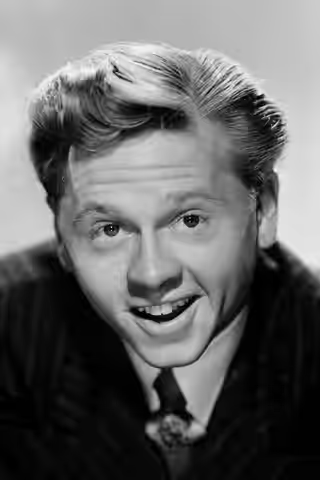
Mickey Rooney worked at one volume, loud, for most of ninety years, and was good company at it. Kept at the edge of the frame, as Victor Fleming did in Captains Courageous, he was a better actor than the noise suggests.
Fi1m perspective
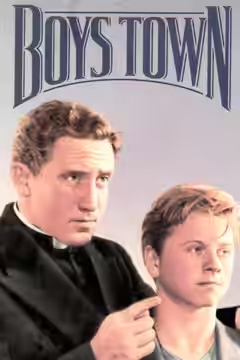
Whitey Marsh walks into Boys Town (1938) with a cigar in his teeth, his hat pushed back and a line of patter that does not stop, and for twenty minutes it is a pleasure to watch him sneer at people who will not be sneered at. Then it goes on. We laughed, and then we sat waiting for the boy underneath to show, and he did not arrive until the script sent a crisis large enough to force him out. That is Rooney in one part: the energy first and everything else late, if at all.
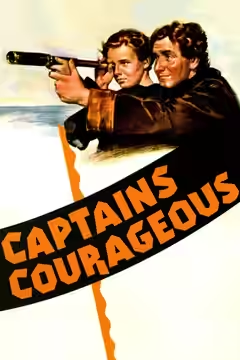
He had been performing since he was a toddler in his parents' vaudeville act, was in films by 1926 and had his own series, the Mickey McGuire shorts, from 1927. MGM signed him in 1934 and put him beside Spencer Tracy in Captains Courageous (1937) and Boys Town, three films with Tracy in all. Then came Andy Hardy, sixteen films from 1937 in which he was the studio's idea of the American boy, and ten films with Judy Garland, starting with Babes in Arms (1939), in which he sang, danced and fell over. Norman Taurog directed him six times and, on our evidence, never once asked him to do less.
What he did well is easiest to see when he has less to do. Dan Troop in Captains Courageous is the fishing boat's other boy, the one nobody has asked whether he wants to work, and Rooney plays the cheerfulness of someone who has not noticed the question. Fleming keeps him at the rail with Lionel Barrymore and John Carradine, and in company he is precise and unforced. Given the middle of the picture, as Taurog gave him in Boys Town, he keeps one setting for as long as the director will let him, and Taurog let him for a long time.
After the war the studio parts went and the character parts came, some of them broad and some of them in films that did not deserve him. Mr Yunioshi in Breakfast at Tiffany's (1961) is the one everybody remembers and nobody defends, a caricature that has not softened with age. Then, at 59, two things happened at once: Sugar Babies revived him on Broadway, and Henry Dailey in The Black Stallion (1979) drew the quietest notices of his life. We have not reviewed the latter and will not judge it here, but the fact that a man who spent forty years at full tilt could still surprise people by standing still tells you something about how much was always underneath.
He said it himself, late on: "I am proud of some of the things, and some of the things I wish I hadn't done. Like everybody." Start with Captains Courageous, where he is one boy among many and better for it. Then try Boys Town, and time how long the cigar stays funny.
Biography
Mickey Rooney (born Joseph Yule Jr.) was an American actor whose career spanned more than eight decades. He began performing in vaudeville as a child and made his film debut in 1926. Rooney appeared in over 300 films and was among the last surviving stars of the silent era.
He is known for the Andy Hardy series of films in the 1930s and 1940s, and for co-starring with Judy Garland in musicals including Babes in Arms (1939). Rooney received a special Academy Juvenile Award in 1939 and later earned Oscar nominations for supporting roles in The Bold and the Brave (1956) and The Black Stallion (1979). He also appeared in Captains Courageous (1937) as Dan Troop.
Rooney continued working in film, television and on stage into his later years, with roles in Night at the Museum (2006) and its sequel. He died in 2014.