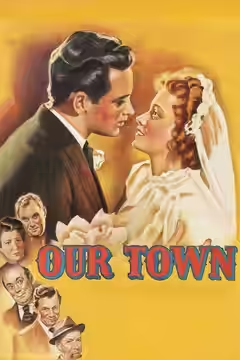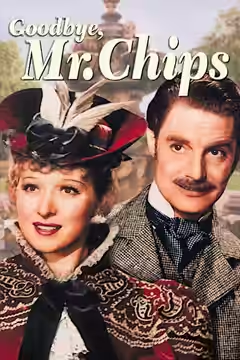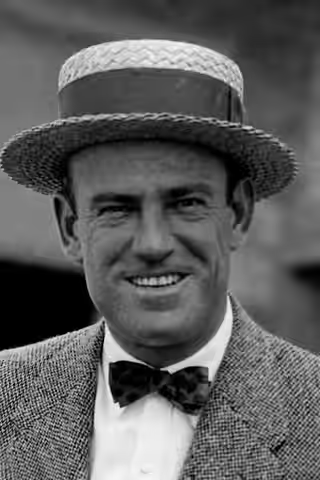
Sam Wood finished his pictures on time and under budget, kept his actors from over-acting and aimed at clarity. Goodbye, Mr. Chips shows both the virtue of that and its limit: a fine Robert Donat inside a film that does not vary its tempo.
Fi1m perspective
An old man dozes by the fire in a landlady's sitting room, kept in by a cold on the first day of term, and the school across the road goes on without him. Sam Wood opens Goodbye, Mr. Chips (1939) there, at the far end, and lets Robert Donat do the remembering. That is Wood in one scene: control the script, the camera and the performance, keep it clear, and permit no scenery chewing.
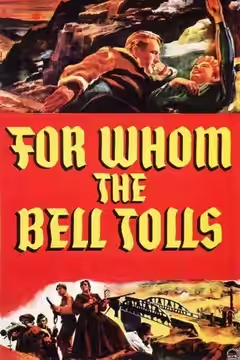
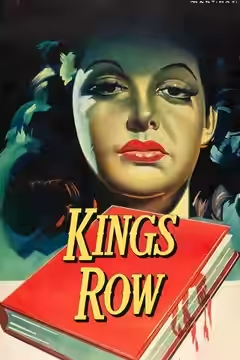
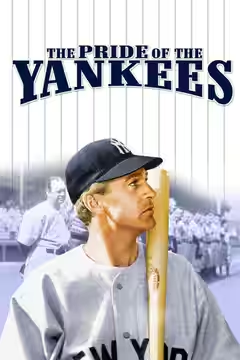
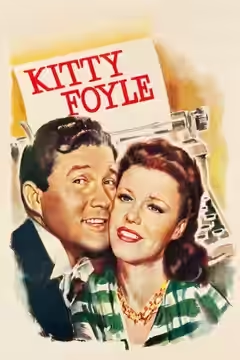
He came to it the long way. A real estate broker first, then an actor, then an assistant to Cecil B. DeMille from 1915, he directed his first features at Paramount in 1920 with stars such as Gloria Swanson and Wallace Reid. From 1927 to 1939 he was under contract at MGM, turning out routine pictures and, in the middle of them, A Night at the Opera (1935) and A Day at the Races (1937) for the Marx Brothers. Freelance from 1939, he made the run of dramas he is remembered for, Kitty Foyle (1940), Kings Row (1942), The Pride of the Yankees (1942) and For Whom the Bell Tolls (1943), and died in 1949. Studio people valued him because he finished on time. Critics have tended to call him competent and reliable, which is not an insult but is not quite praise either.
What he could do was direct actors. He talked to them and shot again rather than moving them about, and he would not permit over-acting. You can see the result in Goodbye, Mr. Chips, where Donat ages from a nervous young man losing his first class to a shuffling institution, and the performance is the reason to see the film. We were moved by that old man more than the tidy film around him had prepared us for, and what did it was Donat's shuffle, and the fact that Wood, true to his rule, never lets him overplay it. Greer Garson, in her first film, gets the same treatment and plays Kathy briskly enough to stop the part being a wish.
What he could not do, or would not, was change gear. The Tyrol and Vienna stretch of Chips runs long, with a ballroom waltz he plainly could not bear to shorten, and late on the film repeats itself: another tea, another dissolve, and we had spotted the pattern before it stopped. The same complaint, that the romance swallows everything else, has been made about For Whom the Bell Tolls, and we suspect it is the same fault. He is versatile in subject, from Marx Brothers farce to literary adaptation to a baseball life, but the tempo is the tempo.
His own rule, he said, was "If it isn't too good, keep it moving." See Goodbye, Mr. Chips for Donat, and notice that the one place Wood breaks his own rule is the one place the film sags.
Biography
Sam Wood was an American film director and producer. Born Samuel Grosvenor Wood on 10 July 1883 in Philadelphia, Pennsylvania, he began his career as an actor before working as an assistant director to Cecil B. DeMille. He directed his first films in the late 1910s and went on to direct more than seventy pictures over three decades.
Wood is credited as director on A Night at the Opera (1935), A Day at the Races (1937), Goodbye, Mr. Chips (1939), Kitty Foyle (1940), The Pride of the Yankees (1942), Kings Row (1942) and For Whom the Bell Tolls (1943). He received Academy Award nominations for best director for Goodbye, Mr. Chips, Kitty Foyle and Kings Row. He also produced several of his later films.
Wood helped found the Motion Picture Alliance for the Preservation of American Ideals in 1944 and served as its first president. He died of a heart attack on 22 September 1949 in Los Angeles.