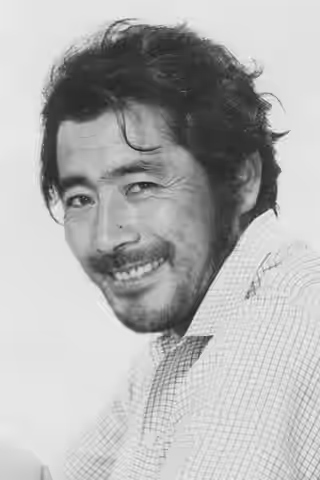
Toshirō Mifune makes an outsider's unease visible in the way he moves. We rate the force and humour of his acting highly, though the performances can keep insisting long after we have understood.
Fi1m perspective
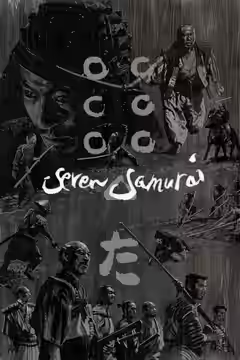
In Seven Samurai (1954), Toshirō Mifune's Kikuchiyo makes the company feel less settled whenever he becomes its centre. His performance is large, theatrical and often funny, with enough vigour to threaten to take over the picture. We rate that disruptive energy highly, even when the emphasis becomes tiring. Mifune makes being an outsider something we can see in a body, rather than something the dialogue needs to explain. There is little risk of confusing Kikuchiyo with any of the men around him.
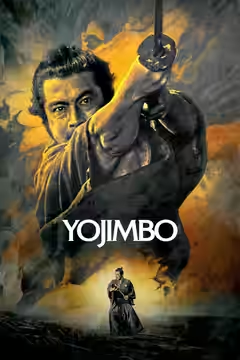
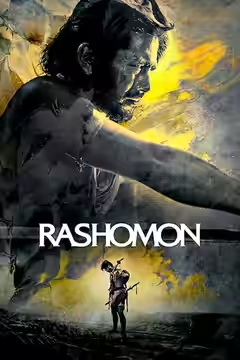
The partnership with Akira Kurosawa began with Drunken Angel (1948) and ran to sixteen films. Rashomon (1950), in which Mifune played the bandit Tajômaru, brought him international recognition. But the ferocious outsider was not the only part he could play: the laconic ronin of Yojimbo (1961) gives us a useful counterweight to Kikuchiyo. The distinction matters, because physical inventiveness need not mean constant commotion. Kurosawa's films gave him room for restrained dramatic acting as well as explosive action.
Seven Samurai also shows how much the ensemble matters to his acting. We laughed at Kikuchiyo's theatrical excess, because his vigour keeps unsettling the company around him. The other men remain recognisable, and Mifune's force does not reduce them to background figures. Yet Kurosawa sometimes lets him keep insisting on a point we have already understood; the director who gets so much out of him occasionally needs to call a halt. That is a real reservation about the performance in a film we would recommend to almost anyone.
Red Beard (1965) was the last of the Kurosawa collaborations, followed by international roles in the 1970s and Shogun (1980). That later turn should not obscure how much variety there already was within the partnership. Mifune could play authority as well as defiance, and convey vulnerability through an otherwise ferocious performance. For a first encounter, we would still choose Seven Samurai, where the company gives his exuberance something to work against. Then try Yojimbo before deciding that restraint was beyond him.
Biography
Toshirō Mifune was a Japanese actor. He was born on 1 April 1920 in Qingdao, China, and died on 24 December 1997 in Mitaka, Tokyo.
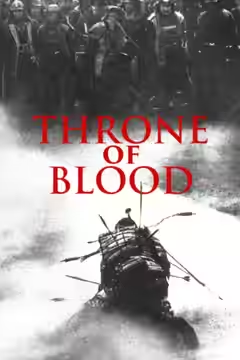
Mifune made his screen debut in 1947. He appeared in 16 films directed by Akira Kurosawa, beginning with Drunken Angel (1948). His roles for Kurosawa include Tajōmaru in Rashomon (1950), Kikuchiyo in Seven Samurai (1954), Washizu in Throne of Blood (1957), the ronin in Yojimbo (1961) and Sanjuro (1962), and Niide in Red Beard (1965).
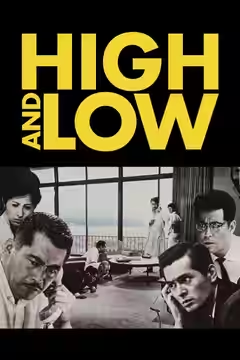
Mifune also worked with directors including Hiroshi Inagaki and Kenji Mizoguchi. His other notable films include High and Low (1963) and The Hidden Fortress (1958).