Minnelli designed theatre sets before he directed films. The colour and movement of his MGM musicals made his name, and underneath the decoration there is usually a family worrying about somebody leaving the house.
Fi1m perspective
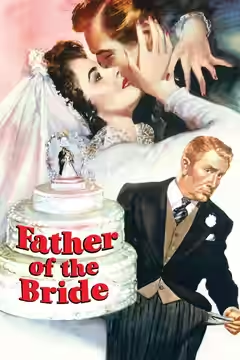
In Father of the Bride (1950), Spencer Tracy's daughter tells him she is getting married, and he spends the next 92 minutes losing control of his house, his bank balance and, he suspects, her. There is almost no plot, only a run of ordeals: the other parents, the engagement party, the guest list, the caterer. John Alton, whose usual trade was crime pictures and shadow, lights the Banks house evenly and brightly, so that everything Stanley stands to lose is on show. It is a modest, likeable film, and it is Minnelli in small: a designer's eye put to work on a father's fear.
He was a designer first. He built costumes and sets for Chicago theatres, moved to New York in 1931 and by 1935 was directing revues on Broadway and at Radio City Music Hall. Arthur Freed brought him to MGM in 1940, and after Cabin in the Sky (1943) came Meet Me in St. Louis (1944), the film that made him. He stayed at the studio for two decades, moving between musicals, comedies and dramas, and kept working freelance into the 1970s.
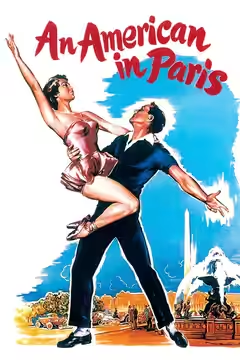
The musicals are what people mean when they say his name. Judy Garland made four films with him and Gene Kelly three, and the long ballet in An American in Paris (1951) and the Fred Astaire numbers in The Band Wagon (1953) are the peak of what the Freed unit could do. Gigi (1958) is the fullest example of his taste in colour and decor, and his rooms and costumes borrow openly from art nouveau, the Impressionists and the Surrealists. He could also drop the songs altogether: The Bad and the Beautiful (1952) is a drama about the film business with performances as strong as anything in his musicals.
The charge against him has always been that he was a decorator, a stylist whose crane shots and swirling fabric got in the way of the story. We do not think so, and Father of the Bride is why. We sat down expecting period jokes and got them, and what stayed with us afterwards was the sadness underneath, Tracy jealous, proud and bewildered in a bright, tidy house he no longer runs. Minnelli said it was always the story that interested him. On that evidence, we believe him.
What the swirl covers is usually the same worry. Meet Me in St. Louis loves a family house and dreads the day one of the family leaves it; Father of the Bride is that dread dressed as comedy, smaller and plainer, with Tracy there to let it show through. If you have never watched him, start with Father of the Bride, then go back to St. Louis. Watch how long he lets a room stay still before the camera moves.
Biography
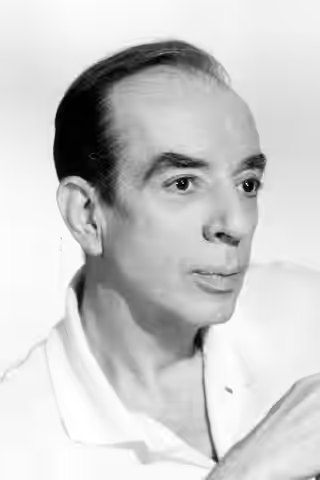
Vincente Minnelli (born Lester Anthony Minnelli) was an American film and stage director. Born in Chicago, Illinois, on 28 February 1903, he died in Beverly Hills, California, on 25 July 1986. He began his career as a costume and set designer in Chicago and New York before directing Broadway musicals and moving to Hollywood in 1940.
Minnelli directed numerous MGM musicals, comedies and dramas. His credits include Meet Me in St. Louis (1944), Father of the Bride (1950), An American in Paris (1951), The Bad and the Beautiful (1952), The Band Wagon (1953) and Gigi (1958). An American in Paris and Gigi both won the Academy Award for Best Picture; Minnelli received the Oscar for Best Director for Gigi and was nominated for An American in Paris.
He was married to Judy Garland from 1945 to 1951; their daughter is Liza Minnelli.