Film review

An American in Paris

1951 · Directed by Vincente Minnelli · 1h 53m · MPA G

In a sentenceA painter who cannot sell a canvas gets a whole city repainted for him in the last quarter of an hour

MusicRomanceComedy

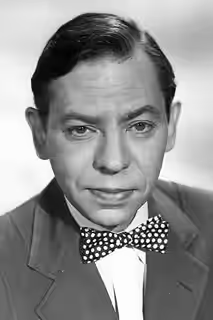
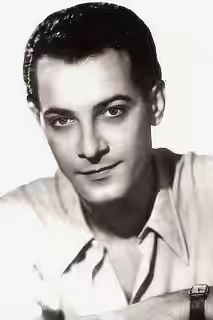
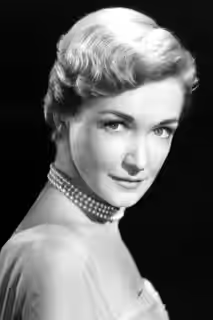
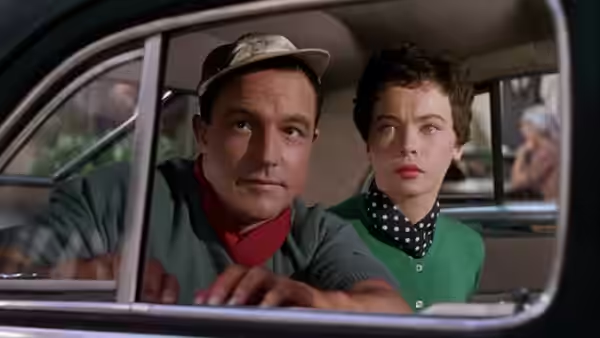
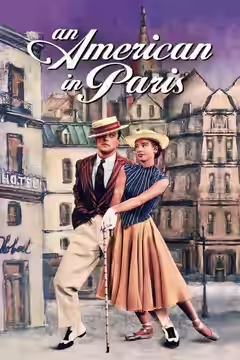
Paris, a few years after the war. Jerry Mulligan (Gene Kelly), an ex-GI who stayed on to paint, rents a garret above a Montmartre café and hangs his canvases on a railing in the street, where nobody buys them. Downstairs lives Adam Cook (Oscar Levant), a concert pianist who has never given a concert, and Adam’s friend Henri Baurel (Georges Guétary), a music-hall star, talks fondly of a young woman he means to marry. One morning Milo Roberts (Nina Foch), a rich American, buys two of Jerry’s paintings and offers to fund a show; her interest is not only in the paintings. That night, at a club, Jerry sees Lise Bouvier (Leslie Caron), a girl from a perfume shop who wants nothing to do with him, and decides she is the one.

Plays from YouTube when you press play; nothing loads from them until then.

Fi1m review

Minnelli’s Technicolor musical has a thin story, a pushy hero and a heroine asked to do little but be looked at. It also has Gershwin, Gene Kelly at full stretch and a closing ballet we have not stopped thinking about.

Arthur Freed’s production is a musical built around a dead composer’s back catalogue. George Gershwin’s songs, most of them written for the stage in the twenties and thirties, are stitched by Alan Jay Lerner into a story about an American painter in Paris, and the whole thing is aimed at a closing ballet set to Gershwin’s orchestral piece of the same name. Vincente Minnelli directs as if the ballet were the point and the rest were the price of admission. That is roughly how it plays.

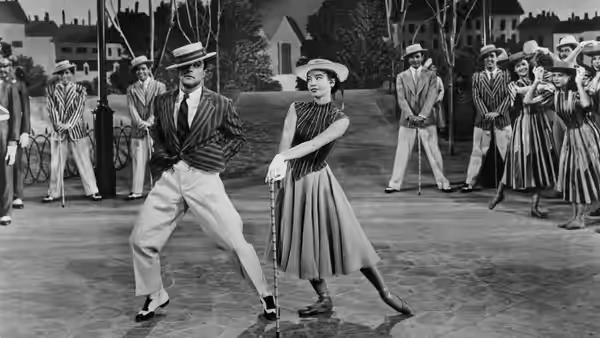
Gene Kelly’s Jerry Mulligan is an ex-GI who stayed on after the war to paint and cannot sell a canvas. Kelly dances on a café step with a crowd of French children, teaching them the words of “I Got Rhythm” and letting them shout the answers back, and we laughed out loud, because he is plainly enjoying the children more than the choreography. Later he dances on and around Oscar Levant’s piano for “Tra-La-La” and never once looks down to check where the lid is. Levant’s Adam Cook, a concert pianist who has never given a concert, gets the film’s best lines and delivers them as if he had just thought of them, which with Levant may have been the case.

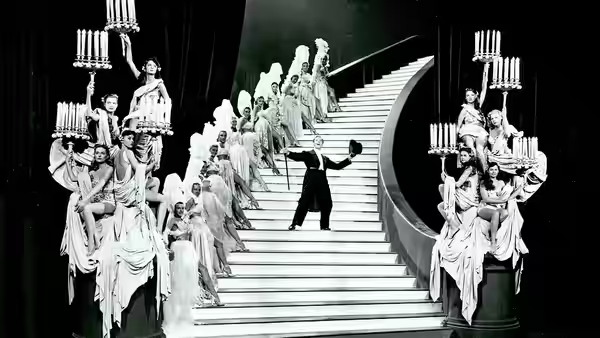
Levant also gets the film’s funniest idea: a daydream in which he plays the Concerto in F as soloist, conductor, every member of the orchestra and the audience, and applauds himself. Georges Guétary, as the music-hall star Henri Baurel, climbs a staircase that lights up under his feet for “I’ll Build a Stairway to Paradise”, and Alfred Gilks shoots it head-on in gold and black so that the man and the set are equally the act. The numbers are fine. It is what lies between them that tried us.

The trouble is Jerry. He sees Lise Bouvier (Leslie Caron) across a nightclub, talks his way to her table, wheedles her telephone number and then turns up at the perfume shop where she works until she agrees to meet him. Lerner writes this as ardour; we watched it as a man refusing to hear no, and we winced. This was Caron’s first film and it shows: she moves beautifully and speaks her lines as if reading them off Kelly’s forehead. The gap in years between them is plain on the screen, and the script does not so much as notice. Nina Foch’s Milo Roberts, the rich American who buys Jerry’s paintings and wants to fund a show, is the only adult in the love story, and the film uses her as an obstacle and then loses interest in her.

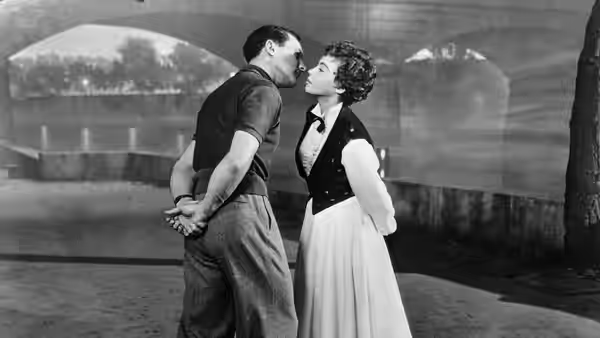
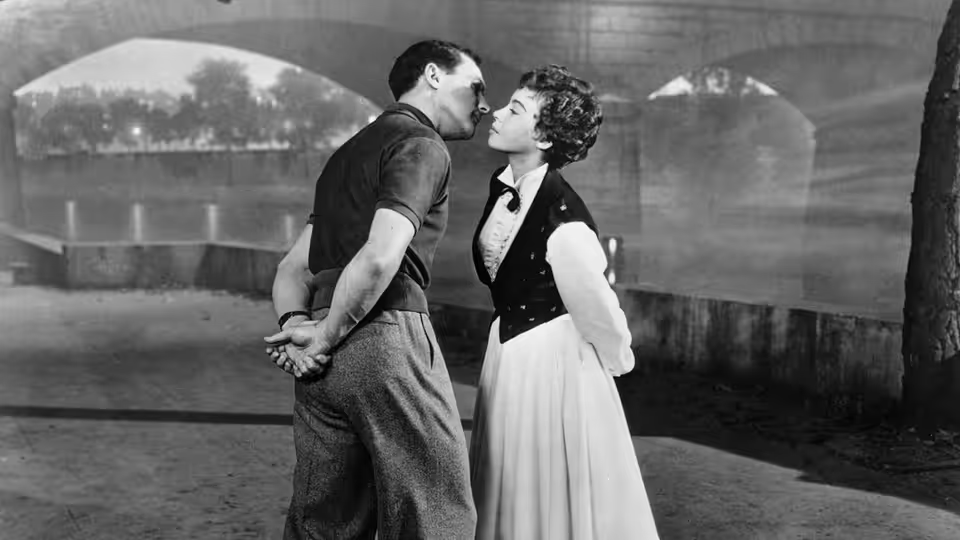
And yet the one quiet number moved us. Jerry and Lise on the bank of the Seine at night, a low wall, mist on the water, one lamp, and “Our Love Is Here to Stay” arranged by Conrad Salinger for strings kept so low you could talk over them. Kelly barely dances. He walks her along the wall, turns her once, and lets Gilks’s camera do the rest. For three minutes nobody is pushing.

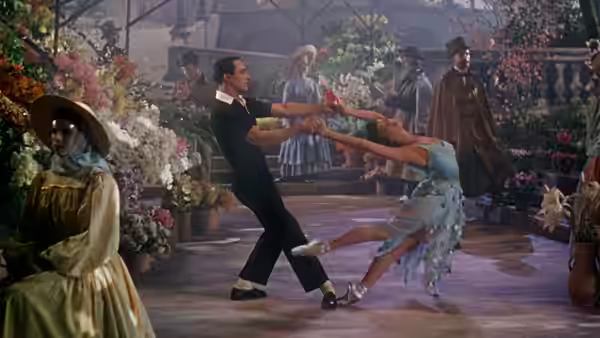
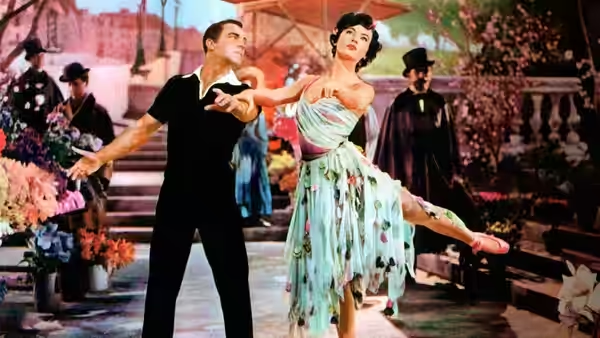
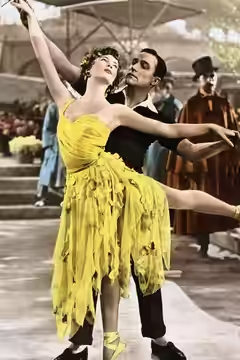
Then the ballet. It runs a quarter of an hour or so, has no dialogue, and puts Kelly and Caron through a Paris rebuilt on the MGM lot in the manner of French painters: a Place de la Concorde with Dufy’s spidery fountains, a flower market out of Renoir, a Rousseau jungle, a fairground in which Kelly appears as Toulouse-Lautrec’s Chocolat. The costumes, credited to Irene Sharaff, Orry-Kelly and Walter Plunkett, go from black and white at the Beaux Arts ball straight into every colour the Technicolor process could hold. Adrienne Fazan cuts on the music and holds on the dancing, so that you see whole phrases from Kelly’s feet to his hands without interruption. We sat forward. It still stopped us, mostly because of a single held moment when the crowd clears and Kelly is left alone in a grey set with a red rose. What it means for the story we will not say.

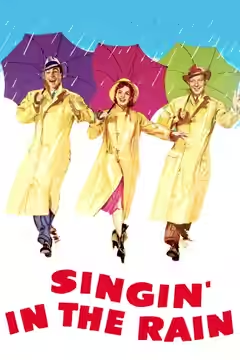
Kelly made Singin’ in the Rain the following year, and that film has jokes where this one has taste, which is why it has aged better. An American in Paris is a beautiful object with a tiresome hero at its centre. Sit through him. The last quarter of an hour is why the film exists, and it is a U, so the children can see what a musical used to be allowed to attempt.
Critical consensus AI synthesised

79
Positive
8
Mixed
1
Negative
0

Most critics are won over, and they are won over by the same things. Gene Kelly’s dancing and choreography draw the warmest praise, with Leslie Caron close behind, and nearly every review singles out the Gershwin score and Minnelli’s Technicolor palette. The closing ballet, running the best part of twenty minutes, is the sequence most often named as the reason to watch. Reviews from 1951 and from decades later land in much the same place.

The reservations are nearly as consistent. The plot is called thin, the romance corny, and several critics say it has dated less gracefully than other MGM musicals of the period. The Guardian finds it sugary and theatrical, The AV Club calls its ambitions muddled and a little pretentious, and Time Out notes an uncomfortable age gap in the love triangle. Roger Ebert ranks it below Singin’ in the Rain. Nobody dislikes it; the spread runs from fond to dutiful.

Empire
1 January 2000 · William Thomas
90*

The film is the archetypal MGM musical, with thin plotting that is outweighed by its Technicolor visuals, George Gershwin's music and Gene Kelly's choreography. It is an extravagant charmer.

Read the full review →
The New York Times
5 October 1951 · Bosley Crowther
90*

The lavish musical shines thanks to Gene Kelly, the enchanting Leslie Caron and a spectacular ballet sequence set to Gershwin music. Minnelli's direction and the Technicolor production create genuine romantic magic on screen.

Read the full review →
Variety
29 August 1951 · Variety Staff
90*

Metro has another sock boxoffice winner in this imaginative musical confection spotlighting Gene Kelly's dancing and new choreography talents alongside bright newcomers Leslie Caron and Georges Guetary. The title ballet is a masterpiece and the Gershwin score is given boffo treatment throughout.

Read the full review →
Evening Standard
10 April 2012
80*

Despite a thin plot, the classic musical has undeniable charm thanks to Gene Kelly's choreography, Alan Jay Lerner's screenplay and the Gershwin score. The 17-minute ballet sequence is a show-stopper, and the cast shines under Minnelli's direction; its seven Oscars were well deserved.

Read the full review →
Time Out
25 October 2011 · ★★★★ · Tom Huddleston
80

The critic praises the film's groundbreaking musical elements, Kelly's grace, Caron's face, Gershwin's score, and Minnelli's color palette, but notes some smugness in early scenes and a creepy age gap in the love triangle. The ballet sequence is highlighted as awe-inspiring yet cool compared to predecessors.

Read the full review →
The AV Club
10 September 2008 · B · Noel Murray
77

The film is muddled as an artistic statement and unsatisfying as conventional Hollywood product due to its pretentious ambition and reactionary streak, yet it earns credit for a multivalent meditation on aesthetics and the timeless appeal of its Gershwin songs.

Read the full review →

Cast

Awards

Academy Awards, 1952

Nominated
Best Director
Nominated
Best Film Editing
Won
Best Art Direction, Color
Won
Best Cinematography, Color
Won
Best Costume Design, Color
Won
Best Original Musical Score
Won
Best Picture
Won
Best Writing, Original Screenplay

If you liked this, try…

Singin' in the Rain poster93

Singin' in the Rain

1952 · Kelly again, a year later, with a script that is actually funny between the numbers.

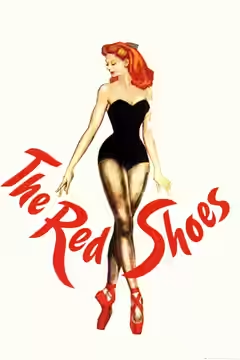
The Red Shoes poster92

The Red Shoes

1948 · The other great ballet-in-a-film, and this one takes the dancing seriously as a life.

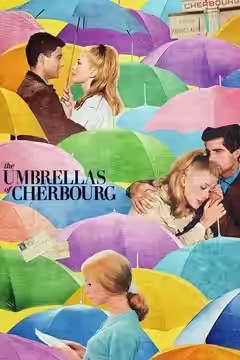
The Umbrellas of Cherbourg poster

The Umbrellas of Cherbourg

1964 · A French musical in colours as loud as Minnelli’s, with a story that hurts.

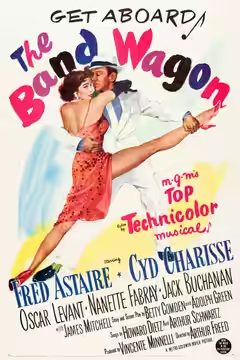
The Band Wagon poster

The Band Wagon

1953 · Minnelli and Freed again, older and drier, with Astaire dancing in a shoeshine parlour.

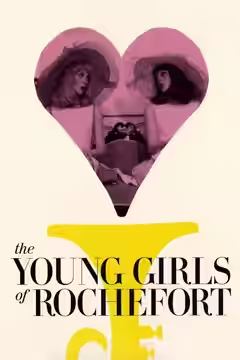
The Young Girls of Rochefort poster

The Young Girls of Rochefort

1967 · Kelly in France once more, in Jacques Demy’s pastel town full of coincidences.