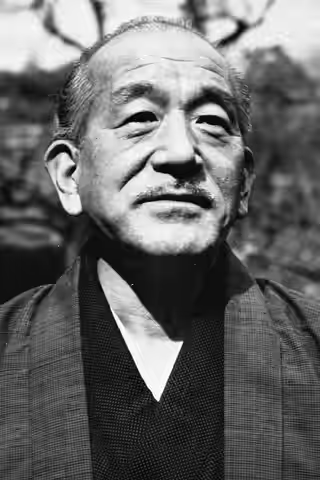
Yasujirō Ozu makes ordinary family neglect hurt without making anyone a monster. We recommend his patient, closely observed dramas, though the repeated domestic situations can sometimes feel too neatly arranged.
Fi1m perspective
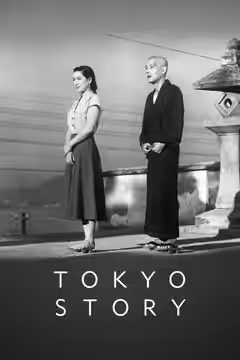
An ageing couple visit their grown children, and nobody has to behave outrageously for the visit to hurt. In Tokyo Story (1953), Yasujirō Ozu makes the children's small discourtesies increasingly difficult to excuse. We squirmed because we recognised the convenience of treating a family obligation as somebody else's problem. It is an exceptional family drama, even if its deliberate pace needs some adjustment at first.
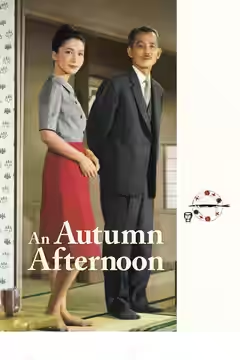
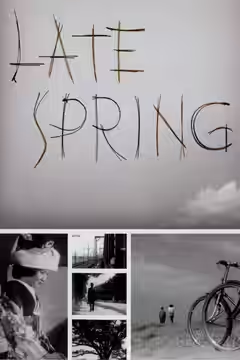
His early work included silent student comedies, crime films and socially conscious dramas. I Was Born, But... (1932) is a comedy about children losing faith in adult authority. From Late Spring (1949), his post-war work settled almost exclusively on contemporary family dramas. Marriage and family dispersal occupy Early Summer (1951); his final film, An Autumn Afternoon (1962), returns to a widower and daughter. The colour comedy Good Morning (1959) should discourage any notion that he became uniformly solemn.
The camera usually sits low and stays still, with people often facing it directly as they speak. With cinematographer Yuharu Atsuta, a collaborator through the last twenty years of his career, Ozu refined images that give us time to look at the person talking. Brief cutaways to objects, landscapes and interiors set the pace between scenes. We are allowed to consider a remark rather than being hurried towards the next piece of business.
In Tokyo Story, the writing with Kōgo Noda matters as much as the camera's position. The children's ingratitude remains mild enough to be defensible, and the screenplay never insists that a failure of care proves a rotten character. Chishū Ryū and Setsuko Hara give finely judged performances within that restraint. Ozu keeps our attention on the ordinary business of spending time together, rather than supplying a speech to tell us whom to blame.
The later films can look schematic when familiar domestic difficulties recur, and the distinctions between them ask for close attention. Nor would we pretend that Tokyo Story immediately makes its slow pace seem necessary. Start with it, but give it an evening without interruptions.
Biography
Yasujirō Ozu was a Japanese film director and screenwriter. He began working at the Shōchiku Motion Picture Company in Tokyo in 1923 as an assistant cameraman and directed his first film in 1927. He made many silent films, including comedies, in the late 1920s and early 1930s before turning to more serious subjects.
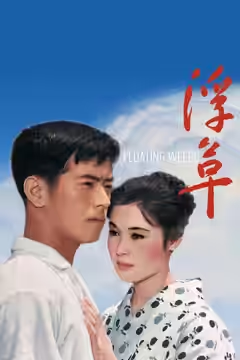
Ozu is known for films such as Late Spring (1949), Tokyo Story (1953), on which he also worked as screenwriter, Early Summer (1951), Floating Weeds (1959) and An Autumn Afternoon (1962). His work often examined family relationships and generational change. He died in Tokyo on 12 December 1963.