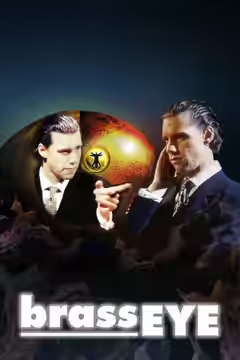
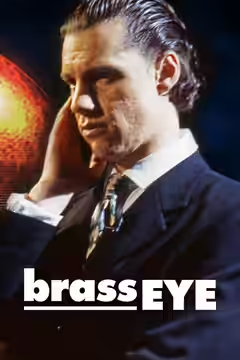
Chris Morris in a dark suit pointing forward with his right hand
Series review

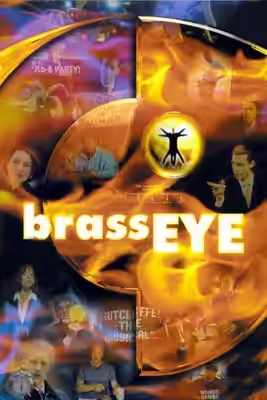
Brass Eye

1997 · Created by Chris Morris · Series · 30m

In a sentenceEveryone speaks fluent nonsense and nobody has the decency to look uncertain

Christopher Morris leads an ensemble comedy that uses television’s own conventions as its material. Across six half-hour episodes, he appears as Christopher Morris, Ted Maul and other characters, with Mark Heap playing Simon Hottrin and Dr. Zeus Spofforth. The cast’s roles include doctors, dinner-party guests and an American vox pop. Hugh Dennis plays Dr. Balb Kubrox, Ian Gelder plays Dr. Jonathan Kwattes and Richard Briers appears as himself. Michael Cumming directs the series, which Morris writes, with music credited to Jonathan Whitehead and Morris.

Fi1m review

Christopher Morris’s Brass Eye is fiercely funny television satire, with performances precise enough to make nonsense sound official. Its sustained aggression can wear us down, but the jokes earn the discomfort.

Television has a practised way of making a sentence sound important before anyone has checked whether it makes sense. Brass Eye is fiercely funny about that habit, and sufficiently exact about how it works to be unsettling. Christopher Morris writes it and Michael Cumming directs, with neither offering much reassurance between jokes. We recommend it with one caveat: the sustained aggression can become tiring. Its six half-hour episodes deserve more attention than a casual run through the lot would allow.

Morris, playing Christopher Morris and Ted Maul among others, understands how much authority comes from delivery. He gives nonsense the weight of something that has already been checked by people too important to name. We found Ted Maul funny and oddly intimidating. The force of Morris’s speech makes questioning him feel, briefly, like an error on our part. It is a precise performance, and its severity makes the ridiculous material harder to brush aside.

Mark Heap, as Simon Hottrin, Dr. Zeus Spofforth and other characters, is valuable because he makes the effort of remaining plausible funny in itself. His restraint gives Morris’s forcefulness something to work against. Hugh Dennis, playing Dr. Balb Kubrox, also understands that a ridiculous name does not require a ridiculous performance. Cumming keeps the cast committed to these people, so that the comedy does not collapse into a competition to be noticed.

Jonathan Paul Green’s production design helps that commitment: the surroundings seem to take their occupants as seriously as they take themselves. We are never being invited to admire how cheerfully makeshift a comedy set can be. Cumming uses that credibility well, allowing the people to grow absurd without making the programme around them seem embarrassed. The attention paid to appearances matters, because a visibly careless spoof would give us an easy reason to dismiss everyone in it.

Gary Dollner’s editing keeps the jokes arriving quickly enough that some register only after the next has begun. There is pleasure in keeping up, though a second viewing helps with the details. Jonathan Whitehead and Morris’s music also sounds thoroughly convinced that this is important television. Its seriousness is funny because it gives the performers still more support when their words deserve none, and helps sustain the pretence even when the writing has become extravagantly absurd.

The limitation is in how consistently Morris’s writing applies the same pressure. Once we have learnt to distrust a speaker’s confidence, another vehemently delivered absurdity does not always sharpen the joke. Some stretches allow too little space for a good line before the next demands our attention, and the accumulation becomes exhausting. Aggressive television satire needs an occasional change of pace if it wants us to keep listening closely; Cumming and Morris are sometimes too reluctant to ease off.

Give Brass Eye an episode at a time, especially if the household has different tolerances for discomfort. The comedy asks us to listen closely, and it is easy to miss a good joke while still recovering from the previous one. Save the conversation for afterwards; talking over Morris is seldom a rewarding arrangement.


Critical consensus AI synthesised

3 of 6
Positive
3
Mixed
0
Negative
0
The Guardian
9 March 1997 · Will Self
90*

The critic hails Chris Morris as a television artist of the highest order whose Brass Eye elevates satire to art through its boundless, inventive absurdity. He singles out the show's extended, unflinching scenes of drugged executives and its subversion of television conventions for particular praise.

Read the full review →
Vulture
17 July 2018 · Ramsey Ess
85*

The critic highlights Brass Eye as a prescient satire that exposed media hysteria and celebrity gullibility through absurd, exaggerated news segments. They single out the 'cake' drug episode for its surreal humor, real-world parliamentary impact, and bold approach to sensitive topics.

Read the full review →
Digital Spy
8 June 2012 · Alex Fletcher
90*

The piece celebrates the 1997 series as timelessly sharp in lampooning media panic and exploitative celebrities. It singles out the surreal 'cake' drug segments and silly one-liners for their genius blend of the ridiculous and the truthful, noting the show's lasting relevance.

Read the full review →

Straight answers AI written, from our review

Is Brass Eye worth watching?
Brass Eye is worth watching for anyone who enjoys sharp television satire, and we scored it 86. Christopher Morris and his cast make nonsense sound official with real precision, though the sustained aggression can wear us down over six episodes. Take it one half-hour at a time rather than in a single run.
How long is Brass Eye, and what is it rated?
Brass Eye has episodes of about 30m. It is a comedy series.
Where can I watch Brass Eye in Greece?
Brass Eye is not on any streaming or rental service in Greece at the moment. It is available in 2 other countries; change your country at the top of the page to see where. Availability is checked daily.
How violent or frightening is Brass Eye, and is it suitable for children?
Brass Eye carries a UK 18 certificate and is not suitable for children. The comedy is not violent or frightening in the usual sense; the discomfort comes from Morris's aggressive delivery and material that sets out to unsettle. Households with mixed tolerances for that kind of humour should watch an episode first.
How does Brass Eye compare to The Adventures of Priscilla, Queen of the Desert?
Brass Eye is a cold, aggressive television satire, while The Adventures of Priscilla, Queen of the Desert is a warm, rude road comedy about drag performers. Both rely on people delivering absurdity with a straight face, but Morris wants us unsettled and Elliott wants us in good company. The series is the sharper piece of work; the film is the kinder evening.
What should I watch after Brass Eye?
After Brass Eye, try The Day Today (1994, Fi1m 81): Another dose of broadcast authority, delivered with an equally dangerous straight face. Then Network (1976, Fi1m 86): Television’s appetite for outrage becomes a furious, uncomfortable workplace comedy; and Man Bites Dog (1992, Fi1m 78): A harsher mock documentary that makes the camera crew’s complicity impossible to ignore.

Cast

If you liked this, try…

  1. The Day Today (1994, Fi1m 81)Another dose of broadcast authority, delivered with an equally dangerous straight face.

  2. Network (1976, Fi1m 86)Television’s appetite for outrage becomes a furious, uncomfortable workplace comedy.

  3. Man Bites Dog (1992, Fi1m 78)A harsher mock documentary that makes the camera crew’s complicity impossible to ignore.

  4. The Firemen's Ball (1967) · not reviewed yetA village celebration exposes official incompetence through patiently observed, accumulating embarrassment.

  5. The Thick of It (2005, Fi1m 94)Official language takes another beating, with political survival supplying the panic.

Free account

Know what to watch tonight

Two lists that know where things are streaming, collections you can share, your own score beside ours, and Discover that remembers what you have seen.

  • Want to see, sorted by what is streaming now
  • Seen, with your score out of ten
  • No adverts, ever