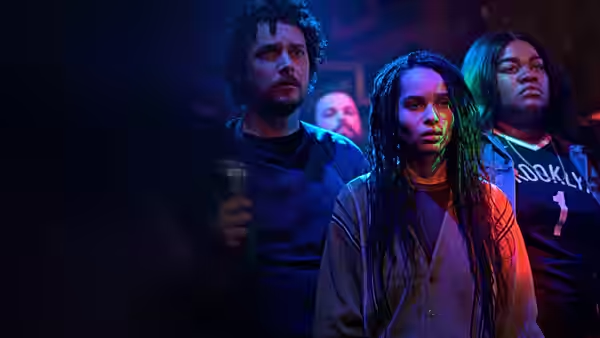
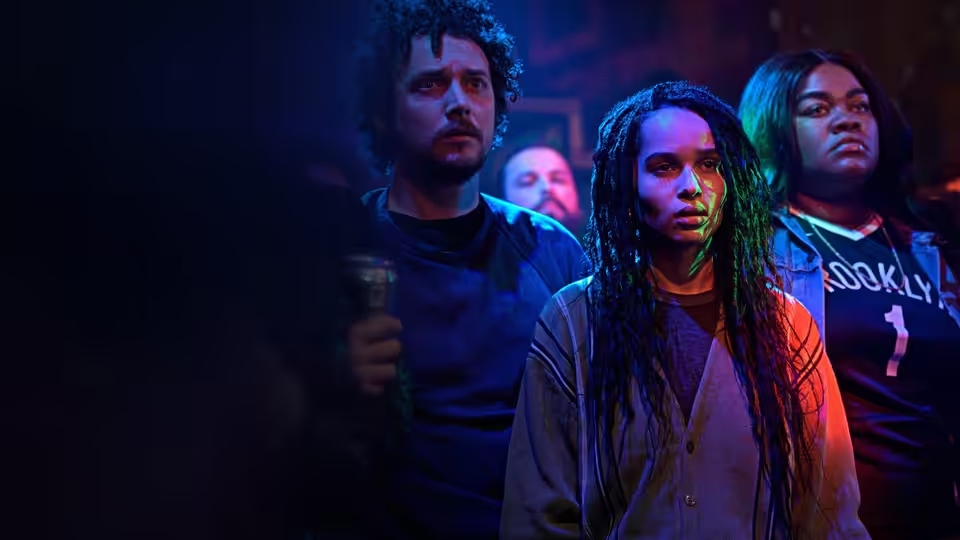
Robyn Brooks (Zoë Kravitz) stands with two companions in blue concert lighting
Series review

High Fidelity

2020 · Created by Veronica West, Sarah Kucserka · Series

In a sentenceWe would happily spend longer in this record shop, provided Cherise got to choose the conversation

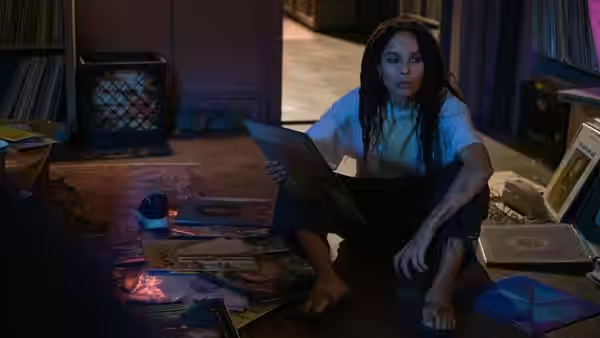
Robyn ‘Rob’ Brooks (Zoë Kravitz) runs a record shop with Simon (David H. Holmes) and Cherise (Da’Vine Joy Randolph), employees who are also her friends. Music is their shared interest, but each brings different concerns to the shop and to the relationships around it. Rob tries to work out what she wants from her life, with her friends offering perspectives that do not always match her own. Simon and Cherise also have lives beyond their place in Rob’s story, complicating a friendship that has to accommodate more than her problems.

Fi1m review

An agreeable record-shop comedy with a less convincing central story, High Fidelity benefits from Zoë Kravitz’s vulnerability and a lively supporting cast. We would stay for the friendship, while wishing Rob would make room for it sooner.

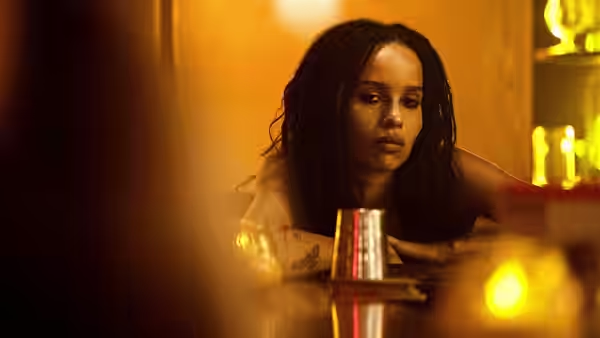
Creators Veronica West and Sarah Kucserka make High Fidelity most persuasive when they let the people in the record shop spend time together. We recommend it for that company, with reservations about the story keeping them there. The series wants to make Rob’s uncertainty interesting without sacrificing her appeal, and Zoë Kravitz is well suited to the task. She suggests hurt without asking us to stop noticing how carefully Rob presents herself. Across ten episodes, though, that tension does not develop enough to sustain the attention it receives.

The performance gives us reasons to remain sympathetic. Rob’s coolness can look like a protective habit, and the vulnerability beneath it prevents her from becoming merely someone pleased with her own taste. There is humour in that self-presentation, too, which helps when her behaviour becomes frustrating. The trouble is how often the writing treats our continued interest as a settled matter. We can enjoy spending time with her and still want the series to examine her more closely.

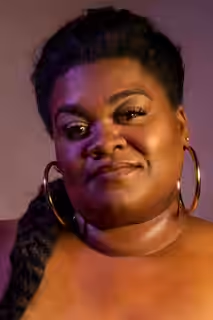
Da’Vine Joy Randolph gives Cherise the energy to interrupt that complacency. Her presence makes the record-shop scenes feel like encounters between people with competing priorities, rather than opportunities for Rob to occupy everybody’s attention. The comedy becomes livelier because someone else has a claim on the conversation. Crucially, Cherise feels worth following beyond her usefulness to the lead. The friendship gives the series a reason to expand, and it is frustrating when Rob’s concerns narrow it again.

We were unexpectedly moved by the episode that gives Simon the focus. David H. Holmes makes him feel like someone whose concerns continue when Rob is not looking, and the change of attention matters. Giving this friend sustained attention allows his own troubles to acquire weight. It also makes us notice how often Rob’s central story circles the same uncertainty without deepening our understanding of her.

With Carmen Cabana on cinematography, the record-shop world is inviting enough that we understand the temptation to linger. The images help establish Rob’s coolness, although the programme sometimes seems too satisfied with having established it. Nathan Larson has the music credit, and the series’ eclectic listening is a consistent pleasure. The range of musical choices makes these people seem curious about something beyond their immediate problems. The music sustains our interest through stretches when the story begins to drift.

As a reinvention, the series makes its strongest case through the friendship of Rob, Simon and Cherise. They seem capable of sustaining a comedy that does not continually need Rob to be its most interesting person. The middle episodes wander, however, and not all that extra time produces a fuller understanding of her. The writing is sympathetic to her confusion but insufficiently demanding about what might follow from it. That leaves some scenes feeling like another visit to a problem we already understand.

There is enough warmth and humour here to make those reservations worth accommodating, particularly if musical taste and difficult friendships are subjects we already enjoy. The supporting cast repeatedly rewards the time spent with them. Give it an evening for the record-shop company, rather than expecting Rob’s story to provide much urgency.

Critical consensus AI synthesised

58
Positive
6
Mixed
2
Negative
2

Most critics find High Fidelity an enjoyable, imperfect reinvention, with praise clustering around the cast and the record-store friendships. Zoë Kravitz earns approval for a funny, vulnerable take on Rob, while Da’Vine Joy Randolph’s comic energy as Cherise wins over even several sceptical reviewers. The music and the fuller lives given to Rob’s friends also help persuade supporters that the series has something of its own to offer.

The spread is wide, however, and the central story is the main dividing point. Supporters find a thoughtful update; less convinced critics see a derivative series whose protagonist and relationships remain underdeveloped, with complaints ranging from meandering middle episodes to a rushed ending. The Hollywood Reporter offers the sharpest dissent, finding the adaptation glum and largely soulless despite its eclectic music and more poignant Simon-focused episode. The disagreement is less about the supporting cast than whether Rob’s story sustains the season.

IndieWire
14 February 2020 · B+ · Steve Greene
83

Greene finds the series a breezy, satisfying adaptation that follows its own rhythm, though its middle episodes sometimes meander. He particularly praises Da’Vine Joy Randolph, whose Cherise brings vital energy to the story.

Read the full review →
Vulture
7 February 2020 · Jen Chaney
70*

Chaney finds the series enjoyable and a worthwhile, if imperfect, reinvention of the original. She especially praises Zoë Kravitz’s vulnerable performance and Da’Vine Joy Randolph’s comic energy.

Read the full review →
Variety
3 February 2020 · Daniel D'Addario
45*

The critic finds the series watchable but too generic and hazy, with an underdeveloped central story. Da’Vine Joy Randolph and David H. Holmes bring welcome texture to the record-store scenes and a standout episode.

Read the full review →
The Guardian
12 February 2020 · Adrian Horton
35*

The review finds the series compelling at times but ultimately hollow and too invested in its protagonist’s performed coolness. It singles out Da’Vine Joy Randolph and the supporting cast for bringing depth and energy.

Read the full review →
The Hollywood Reporter
3 February 2020 · Inkoo Kang
15*

Kang finds the reboot a largely soulless, glum cover that fails to understand the original’s appeal. She praises its musical eclecticism, while noting that the Simon-focused episode offers a more poignant version of what the season attempts.

Read the full review →
Den of Geek
19 February 2020 · ★★★★ · Delia Harrington
80

The review finds the series a wonderful, nuanced update that makes a compelling journey of familiar material. It praises Zoe Kravitz’s performance and the show’s music-rich, vividly realized world, while faulting its rushed, unsatisfying ending.

Read the full review →

Straight answers AI written, from our review

Is High Fidelity worth watching?
High Fidelity is worth watching for its record-shop friendships, music and supporting cast; we score it 70. Zoë Kravitz gives Rob a welcome vulnerability, but her central story repeats itself across ten episodes, so we recommend it more for the company than for the urgency of its storytelling.
Where can I watch High Fidelity in France?
High Fidelity is not on any streaming or rental service in France at the moment. It is available in 38 other countries; change your country at the top of the page to see where. Availability is checked daily.
How violent or frightening is High Fidelity, and is it suitable for children?
High Fidelity carries a US TV-MA certificate, indicating mature audiences rather than children, and has no UK certificate supplied. That rating warrants caution for younger teenagers, but we cannot give a more specific account of violence, frightening material or other adult content from the information available.
How does High Fidelity compare to The Commitments?
High Fidelity is an agreeable record-shop comedy, but we give The Commitments the stronger recommendation for its songs and unruly company. Both make room for musical obsession and colleagues with concerns of their own; the Dublin soul-band film is a little too polished, while the series gives its repetitive central relationship story more time than it earns.
What should I watch after High Fidelity?
After High Fidelity, try The Commitments (1991, Fi1m 82): Musical obsession, bruised egos and colleagues who refuse to remain supporting characters. Then We Are Lady Parts (2021, Fi1m 80): A band comedy whose women have ambitions well beyond being someone else’s confidante.

Cast

If you liked this, try…

  1. Girlfriends (1978) · not on Fi1m yetFemale friendship and uncertain adulthood, with room for people to disappoint each other.

  2. The Commitments (1991, Fi1m 82)Musical obsession, bruised egos and colleagues who refuse to remain supporting characters.

  3. Linda Linda Linda (2005) · not on Fi1m yetA school band offers quieter pleasures in shared taste and tentative friendship.

  4. Lovesick (2014) · not on Fi1m yetOld relationships get another hearing in a comedy that values its friends.

  5. We Are Lady Parts (2021, Fi1m 80)A band comedy whose women have ambitions well beyond being someone else’s confidante.

High Fidelity (2020) review: Warm company, but Rob’s story drifts (France) | Fi1m