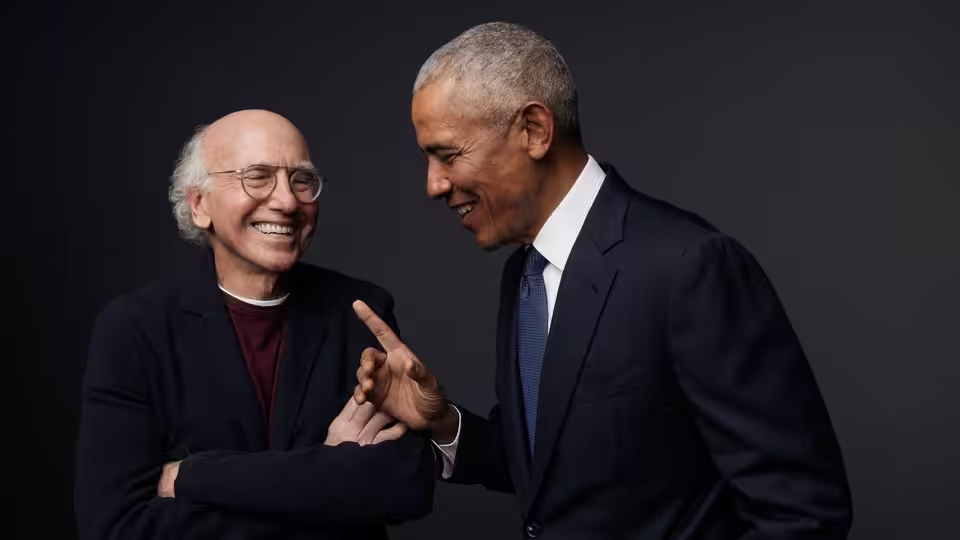
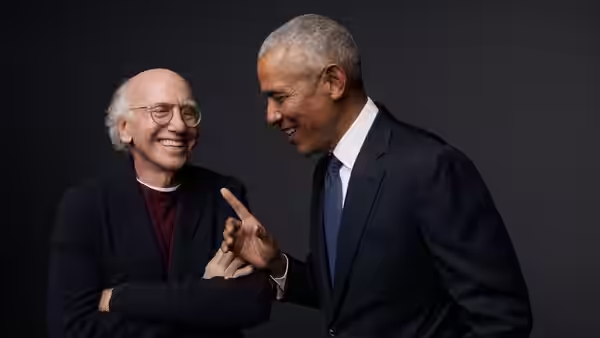
Larry David wanders through American history complaining, and two or three sketches an episode are as funny as anything he has done. The rest go on too long, repeat the one joke, and now and then stop to lecture.
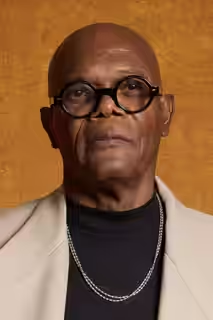
Larry David and Jeff Schaffer, who made Curb Your Enthusiasm together, have made seven episodes in which David is dropped into the moments America likes to tell stories about and behaves exactly as he would at a table for four in Los Angeles. Schaffer directs, the two of them write, and the premise is the whole show: a great man is about to do a great thing, and Larry has a problem with how it is being done. Samuel L. Jackson narrates in the tone of a man reading a school textbook he does not believe. Barack Obama appears as himself to introduce it, and his timing is better than several of the professionals.
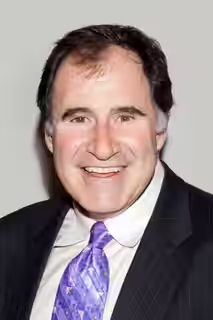
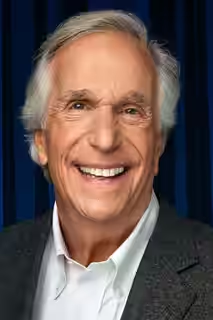
The idea is sound and David’s persona has not aged a day, which is both the pleasure and the trouble. The founders are played by people who know how to stand still while somebody else is funny: Chris Parnell as Benjamin Franklin, Alan Tudyk as Thomas Jefferson, Henry Winkler as John Hancock. Richard Kind turns up as a man named Thomas Watson and is, as ever, a pleasure for the minutes he is allowed. The wigs and waistcoats are more expensive than most of the jokes, and the rooms are dressed with real care, so that the show often looks like a costume drama that has been broken into by a retired television writer.
We laughed hardest, and longest, at a Lincoln sketch that goes on well past the point where any sensible editor would have stopped it, and gets funnier because it does. The reason is not the writing, which is thin, but David’s noises: the groan when a point is lost, the wheeze when he is asked to be gracious, the half-second of silence before he says the thing nobody in 1865 would say. There is a Watergate parody built around Deep Throat that works for the same reason. When the show trusts his face and his breathing it is still the best thing of its kind.
The rest of the time it does not trust them, and it fills the space with more sketch. Every piece has the same shape: the moment, the grievance, everyone turning on him, the cut. The point arrives early and the sketch stays on, so that by the fourth episode we could see the ending of each one from its second line. That is not fatal in a half hour of Curb, where three petty threads are being wound together for a collision at the end. Here there is no collision. Each sketch is a single thread, and when it has been pulled there is nothing left to pull.
Then there are the passages where David stops pretending to be a nuisance and starts telling us what he thinks about the country. The closer the show gets to the twentieth century, and to Jurnee Smollett-Bell’s Rosa Parks, the less sure it seems about whether it is allowed to be funny, and it settles for being right instead. Those are the flattest stretches of the seven episodes, and we say that as people who broadly share the opinions. Meaning to say something is not the same as saying it, and a sketch that has an argument is usually a sketch that has run out of jokes.
The smaller parts fare better than the speeches. Kaley Cuoco, as a widow called Gloria, and Colton Dunn, as Dominic the soup server, both get more out of a single look at Larry than the script gets out of a page. Rich Fulcher, as an aide to Tilden, has one exchange we are still thinking about a week later.
The reviews so far are split roughly down the middle, from warm to withering, and we find ourselves in the dull position of agreeing with the middle. Watch the first episode. If the Lincoln sketch makes you laugh out loud, carry on, one episode at a time, with a day between them. Seven in a row and the wheeze stops being a joke and starts sounding like a symptom.