Andrew Davies cuts George Eliot’s enormous novel down to six brisk hours and keeps most of what matters. The town looks lived in, the marriages hurt, and Juliet Aubrey and Patrick Malahide make the worst of them the best thing in it.
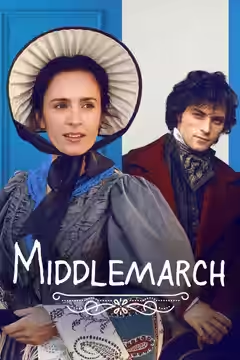
George Eliot’s Middlemarch is a novel about a whole town, and nobody who has carried the thing on a train would call it brisk. Andrew Davies has made it brisk. His adaptation, directed by Anthony Page and produced by Louis Marks, runs six episodes of an hour, and it moves through courtships, deathbeds, elections and bankruptcies at a steady trot without ever looking hurried. It is a good, intelligent, well-cast piece of television drama, and what it loses in the cutting it mostly makes up in the playing.
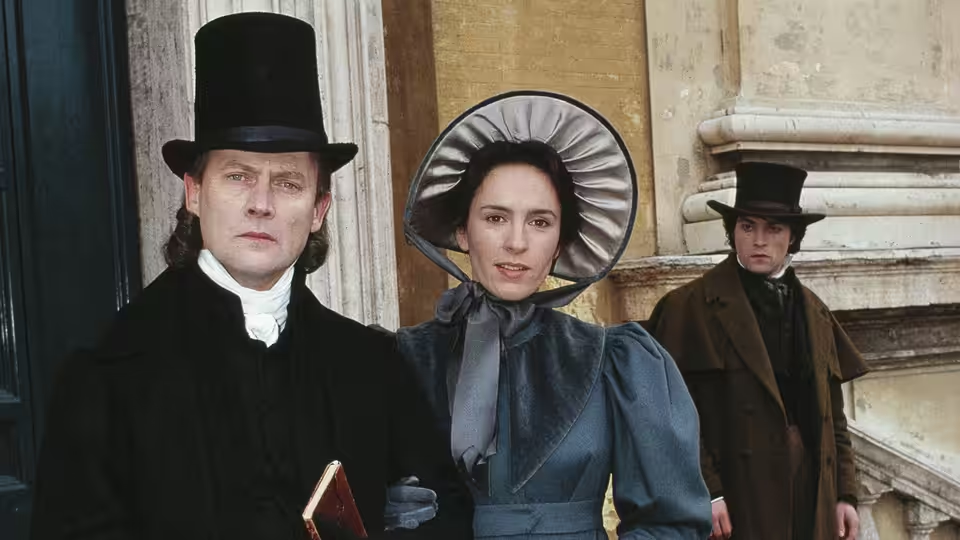
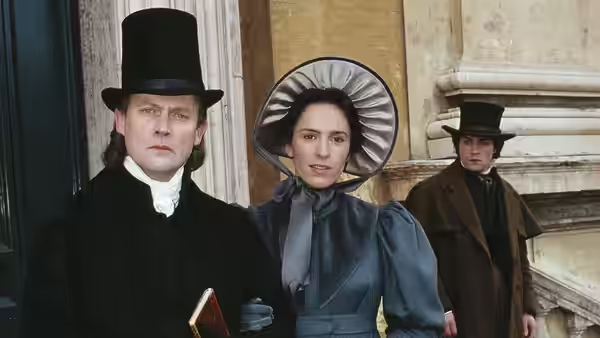
The heart of it is Dorothea Brooke and the man she chooses. Juliet Aubrey plays Dorothea as a young woman who wants to be useful and has been given nothing to be useful at, and she lets us see the error coming long before Dorothea does. Patrick Malahide’s Casaubon is the surprise. The clergyman is written as a dry stick, and Malahide plays him as a dry stick who knows it, a man who has spent his life on a book he will never finish and has begun to suspect as much. We expected to dislike him and found instead that we pitied him, badly, from the first scene of their honeymoon in Rome, where Dorothea wants to talk and he wants to be left alone with his notes. It is the kind of marriage that has no villain in it, and both actors understand that.
The second marriage is the one Davies writes with the most relish. Douglas Hodge gives Dr. Tertius Lydgate a proper doctor’s arrogance, the conviction that he is cleverer than the town and will therefore be forgiven by it, and Trevyn McDowell’s Rosamond Vincy is pretty, pleasant and quite immovable. Their scenes together are small and awful: a conversation about money in which neither person hears the other, and both leave believing they have won. Peter Jeffrey’s Bulstrode, the pious banker who holds the purse strings, is played with a stillness that makes everyone else in the frame fidget.
Brian Tufano shoots the town as a working place rather than a view. The streets are muddy, the interiors are lit from windows and candles, and the rich houses are no brighter than the poor ones, only larger. Page directs without fuss, keeping the camera at eye level and letting scenes run long enough for the actors to change their minds mid-sentence, which in this material is where the drama is. The editing keeps the four or five plots turning over so that no strand is away for long, though Fred Vincy’s troubles with his uncle’s will suffer most from the rota, and Jonathan Firth has to sketch in a whole reformation of character in about four scenes.
What the series cannot do is reproduce Eliot’s narrator, the voice that forgives everybody and lets nobody off, and that is the real cost of the cutting. Without it, the generosity has to come from the actors, and most of them supply it. Michael Hordern’s Featherstone, dying slowly and enjoying the audience, and Robert Hardy’s Arthur Brooke, standing for Parliament on principles he cannot quite remember, carry the comedy, and both are funnier than the lines alone would be. Simon Chandler’s Rev. Farebrother is the decent man of the piece and the one the camera could have stayed with longer.
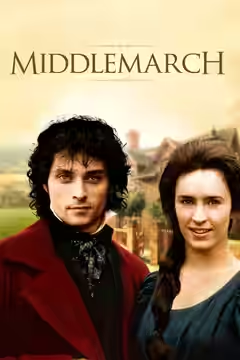
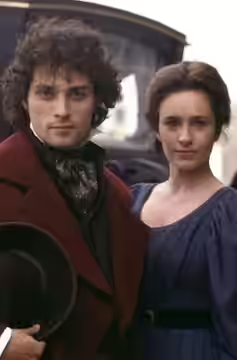
Rufus Sewell is top of the billing, and Will Ladislaw is the role that gives him least to do. Sewell has the hair, the scowl and the look of a man who has been wronged by somebody, and Davies gives him speeches about art and reform that sound like position papers. The attraction between Will and Dorothea has to be mostly in the eyes, and it is, but we never quite believed he was her equal, which the story needs us to believe.
Set against the run of long costume serials, this is a cleaner, drier, less upholstered example than most, and the better for it. It does not swoon over the furniture and it does not stop to explain itself. Give it six evenings rather than one; the town is built to be visited a street at a time, and the marriages are easier to bear with a night’s sleep between them.