A college hockey romance that is sweeter than it is steamy and kinder than it is clever. The leads are likeable, the housemates are better company still, and eight episodes would have been six in a stricter edit.
Louisa Levy’s series takes the fake-dating romance, a plot older than talking pictures, and gives it to a hockey captain and a music student in a shared house full of empty bottles. Elle Kennedy, whose novels it comes from, is among the producers, and the arrangement shows: the story is faithful to its source and unhurried about it. The result is pleasant, good-natured, frequently funny and about two episodes too long. It carries a 15 certificate, which it uses.
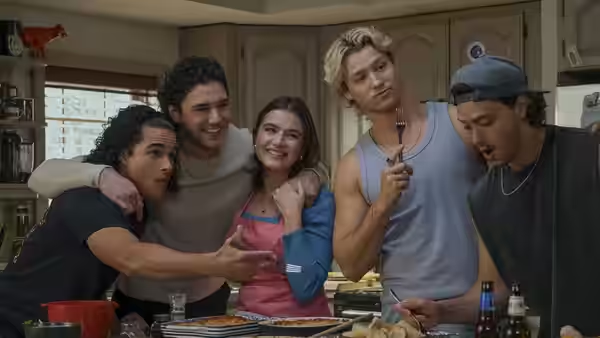
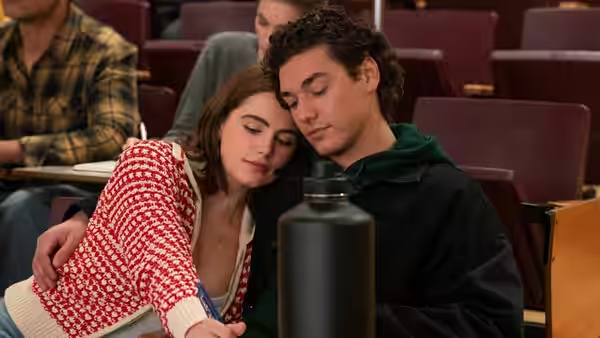
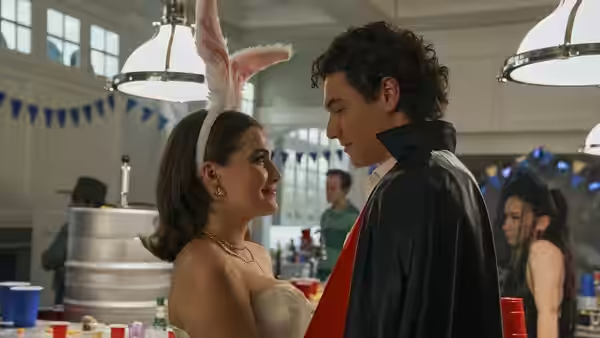
The pairing works. Ella Bright plays Hannah with a guardedness that reads as good sense rather than coldness; she is the one person in the house who checks the door is locked. Belmont Cameli gives Garrett the ease of a boy who has never had to ask twice for anything, and the series is at its best when it lets him find out what it is like to be turned down. Their tutoring scenes, two people at a kitchen table with a textbook and a running argument, are better written than anything on the ice. Stephen Kalyn’s Dean supplies most of the laughs, a rich boy so pleased with himself that it comes round to being charming, and Jalen Thomas Brooks and Antonio Cipriano give the house a lived-in rhythm of insults and toast.
Colin Hoult and Nick Thomas shoot the house in warm amber and the rink in a flat, unforgiving white, so that the boys look their age at home and older, harder and less interesting at work. Dan Hermansen dresses the house with hockey tape on the door frames, a couch nobody chose and a fridge that is mostly beer, and it is the one set that feels like people live in it. Charlene Akuamoah puts Hannah in layers she can hide inside and Garrett in the team’s own kit, on and off duty, which tells us what he is before he says a word. Keegan DeWitt’s score is light guitar and a little synth, and it has the manners to step aside whenever a song is doing the work.
What does not work is the hockey. There are four directors on eight episodes, Erica Dunton, Silver Tree, Sam Bailey and Dawn Wilkinson, and four editors, Lisa Robison, Gordon Rempel, Nicole Brik and Nathan Easterling, and the games betray the committee. They are shot in close-up and cut so fast that no play ever develops; we see faces, then a goal, then faces. For a series that sells itself on a sport, we never once understood whether the team was any good. Chad Willett’s Coach Jensen shouts and Steve Howey’s Phil Graham glowers from the stands, and both are asked to carry more weight than the scenes around them can bear.
The sex is another matter. There is a great deal of it, and it is shot at length and with some care, and it is less charged than the scenes in which the two of them sit fully dressed and talk. The series knows this, we think, because its best episode is almost entirely conversation. We were moved, more than we expected to be, in the scene where Hannah tells Garrett about her past, which we will not detail. Bright plays it looking at the table and Cameli does the hardest thing an actor in a romance can do, which is to listen without reaching for her. The writing there, by a team of seven, is spare and unshowy, and the series handles the subject with a seriousness the surrounding episodes do not always earn.
The tone is the recurring problem. A scene of real hurt will sit beside a scene of Dean falling off a table, and the joins show. By the sixth episode we had begun to count what was left, not because we disliked anyone but because the plot had already told us where it was going and was taking the long road there.
As adaptations of romance novels go, this is honest work: it wants what the books want and does not pretend otherwise. It is not as sharp as the best of the genre and it is a good deal kinder than the worst. Watch it in pairs of episodes, with someone who will enjoy the housemates as much as the couple, and do not expect to learn anything about hockey.