Peep Show makes private cowardice painfully funny, with David Mitchell and Robert Webb giving every excuse its due. The relentless embarrassment can become tiring, but the writing and the performances make it worth the discomfort.
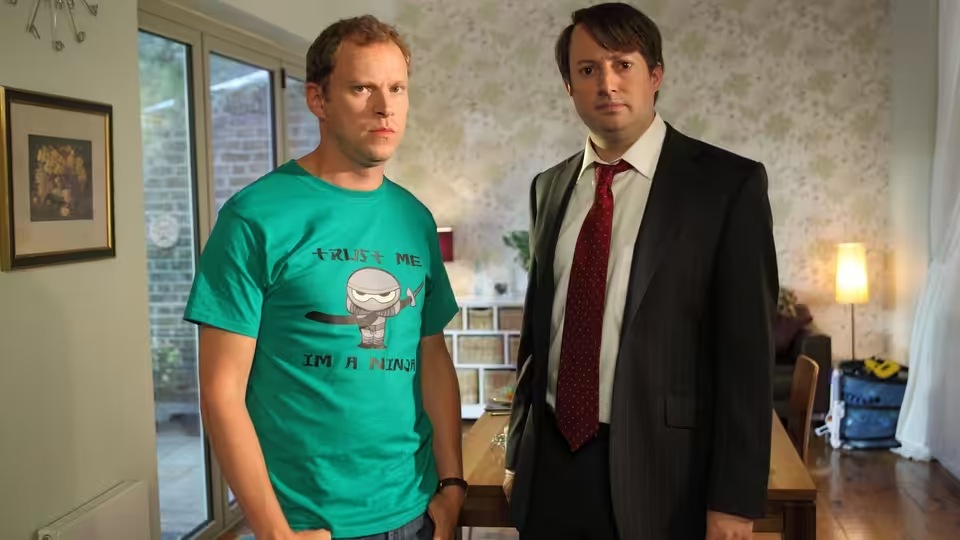
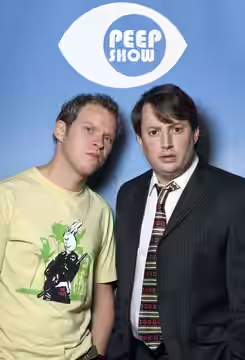
Peep Show is an excellent comedy about the effort people put into excusing themselves. David Mitchell’s Mark Corrigan and Robert Webb’s Jeremy Usborne share a home, while point-of-view camerawork and internal narration give us access to things a conventional conversation would leave politely concealed. Writers Sam Bain and Jesse Armstrong make that access funny enough to overcome the discomfort it causes. The strain is part of the pleasure, though we would hesitate to recommend several episodes in a row.
The camera puts us close to whoever is being looked at, so an ordinary exchange can feel like an examination we have not prepared for. Directors Tristram Shapeero and Jeremy Wooding work within a format that gives faces an unusual amount to do. A neutral expression can become threatening when the voice in our ear is busy interpreting it for its own convenience. The point-of-view technique keeps affecting the joke for as long as the conversation lasts.
Bain and Armstrong are particularly good at the private excuse that seems persuasive for just long enough to embarrass its owner. The narration lets a thought develop in all its selfish detail, with no obligation to make the person thinking it seem admirable. We laughed, then felt uncomfortably recognised. Hearing somebody justify themselves while watching them try to look reasonable makes it difficult to pretend that only these two men have ever behaved like this.
Mitchell makes self-consciousness look exhausting, down to the effort apparently required to complete a sentence. His precise delivery suggests a man checking each word for the possibility that someone might object to it. Webb brings a looser confidence to Jeremy, allowing a flimsy explanation to sound sufficient. They are well matched because neither performance needs to ask for our affection before making us laugh.
Olivia Colman, as Sophie Chapman, is especially valuable to a comedy so dependent on what can be read into a face. Her reactions give the central pair something harder to manage than their own accounts of themselves. Matt King makes Super Hans funny without seeming to wait for permission to be odd. The supporting performances matter because the programme would soon become monotonous if Mark and Jeremy were the only people capable of surprising us.
The limitation is how readily embarrassment becomes the expected destination. Once we begin waiting for an encounter to become intolerable, some of the pleasure of discovering how it gets there has already gone. Across nine series, the format can feel repetitive, and the closeness that makes individual exchanges so effective gives us few opportunities to relax. At 25 minutes an episode, however, there is usually enough restraint in the running time to stop the discomfort becoming a chore.
A comedy about flatmates could settle for reassuring us that it is good to have someone around. Here, simply having company is enough to make somebody’s day more difficult, and the writers find a considerable number of ways to demonstrate it. The actors keep those difficulties funny without making the household seem any more appealing. Start with one episode, and allow a little quiet afterwards.