James Nesbitt keeps Run Away involving even when its twists become difficult to believe. Family secrets give the mystery some weight, but melodramatic handling and clichéd dialogue restrict its appeal to those already fond of this sort of thriller.
Run Away is a decent, uneven family mystery whose cast makes its less believable turns easier to tolerate. Adapted from Harlan Coben’s novel, it has eight episodes in which to turn a father’s distress into a succession of questions about the people closest to him. The appeal is straightforward: we want an answer, then another complication makes us want the next one. It keeps that process moving briskly enough, although we occasionally wish it would spend longer with an emotion before introducing another surprise.
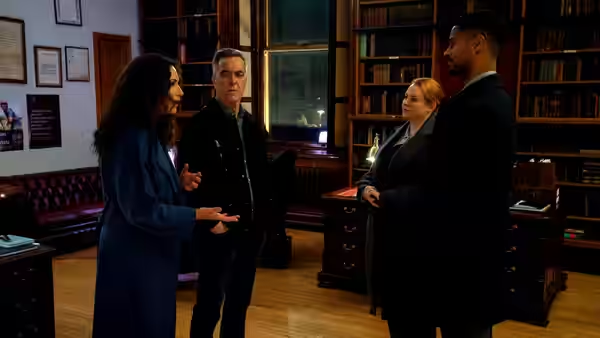
James Nesbitt plays Simon Greene, and his distress supplies a reason to care that the plotting cannot provide on its own. He makes the parental fear convincing without requiring us to believe every development surrounding it. Ruth Jones, as Elena Ravenscroft, is another reason to stay: her performance holds our attention even when we have begun to question the story. The ensemble is less consistent elsewhere, and the weaker passages leave the stronger actors doing too much of the work.
The writing, credited to Tom Farrelly, Amanda Duke, Daniel Brocklehurst and Charlotte Coben, works best when family secrets have consequences beyond supplying another surprise. The buried trauma gives the mystery some weight, and helps explain why the series remains involving despite its improbabilities. We are interested in what people have kept from one another and what it costs them. The trouble comes when the next revelation matters more than making the behaviour around it plausible.
Directors Isher Sahota and Nimer Rashed understand how much this sort of programme depends on forward movement. The editing contributes to a melodramatic tone that the performances do not always withstand, even while the plot hurries us towards another question. There is too little relief from the insistence that each development matters enormously. Some quieter handling would make the family disclosures easier to take seriously.
We were irritated by the hospital dialogue: its stock phrases make distressed people sound as though they are reciting other thrillers. Luke Richards supplies the music, but no score could make those exchanges convincing. The writers need to give the actors fewer words here. When Nesbitt has already made the distress credible, spelling it out again only gives us time to notice how it has been written.
The violence is harder to dismiss. We winced at its gruesomeness, which interrupts the comfortable pleasure of following a twisty mystery with something nastier. That discomfort gives the danger force, though it also makes the more preposterous turns harder to shrug off. Once the series has asked us to take suffering seriously, we become less patient with its melodrama.
The family-secret thriller depends on our willingness to suspect almost everyone, and there is pleasure in surrendering to that habit here. Anyone who needs each development to survive close questioning will have a less agreeable time. Eight episodes is a fair commitment to a mystery this uneven. Try it for Nesbitt and Jones if a few unlikely turns will not spoil the evening.