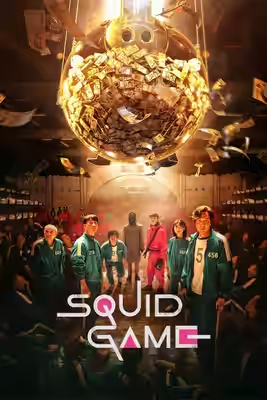
Hwang Dong-hyuk’s deadly competition drama earns its shocks through the desperation of its players and the cruelty of its children’s games. The speeches can be blunt, but the fear and fellow feeling are hard to shake.
Squid Game is a gripping, sometimes over-explained drama about people who cannot afford to walk away from a terrible offer. Writer-director Hwang Dong-hyuk puts financially desperate contestants into lethal children’s games, then makes the prospect of winning money disturb every relationship between them. The cruelty has a purpose, and for much of the series it is enough to watch what people will accept when their alternatives have narrowed. We recommend it, with a warning that neither its violence nor its speeches are used sparingly.
The opening Red Light, Green Light sequence establishes how well this can work. We were horrified, because a game built around a rule children can understand becomes a means of killing adults who badly need the prize. Lee Hyung-deok’s cinematography keeps the danger from becoming an invitation to admire the violence, and Nam Na-young’s editing makes waiting for the next punishment exhausting. Hwang allows the horror of applying those rules to desperate people to do much of the work.
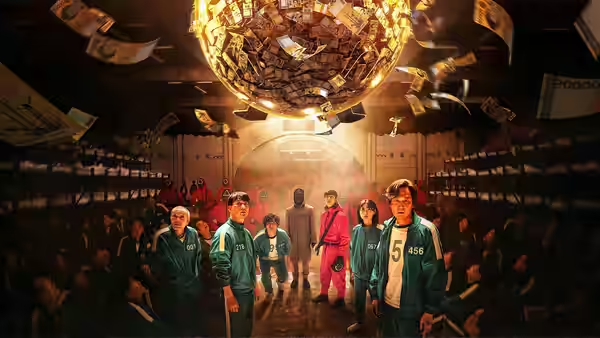
Chae Kyoung-sun’s production design keeps the association with childhood uncomfortably present during the violence. The reminder of play makes the killing harder to dismiss as ordinary action spectacle, even when the competition has us absorbed. The music credited to Jung Jae-il, Park Min-joo and Kim Sung-soo adds to that unease, although the contests are frightening enough without musical persuasion. More telling still is the attention paid to the practical work behind the violence, the routine organisation required to keep this entertainment functioning.
Lee Jung-jae gives Seong Gi-hun enough vulnerability to make his financial desperation painful to watch. We care how he fares, because the performance makes needing the money credible even when accepting the risks seems unthinkable. Park Hae-soo as Cho Sang-woo and Hoyeon as Kang Sae-byeok make the questions of trust feel personal, giving us reasons to follow the alliances beyond their usefulness in the competition. Hwang is persuasive when he lets these relationships carry the pressure of the prize money.
The writing is less assured when Hwang pauses to tell us what the competition means. Dialogue about inequality can become so direct that the characters sound as though they are delivering speeches, after the games have already made the point. Some character development is thin enough that the actors have to supply complexity the script has not earned. The material about shifting alliances is usually stronger, because there is a specific person to lose faith in and an immediate cost to getting that judgement wrong.
There is also a fair objection to the pleasure the series takes in devising ordeals while condemning the people who organise them. We do not think it entirely escapes that problem, but the dreary business of running the games matters. By attending to the work behind the killing, Hwang shows how many ordinary tasks are needed to keep the cruelty going. Within the deadly-competition genre, that is a useful emphasis, giving us something to consider beyond which contestant might survive the next round. Choose it for the people under pressure, and be prepared for how much punishment accompanies them.