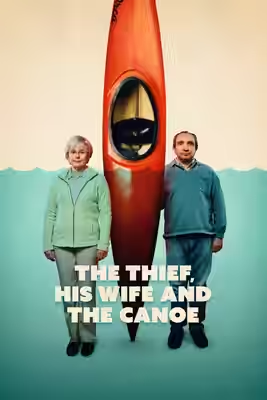
Chris Lang’s four-part account of the canoe man is a marriage drama in a crime drama’s clothes, and Monica Dolan’s Anne is the reason to watch it. The comedy and the misery do not always sit together, but when they do, it stings.
The story of John Darwin, who paddled out of Seaton Carew in 2002 and was officially dead by teatime, is so well known that any dramatisation starts with a problem: everyone on the sofa already knows the ending. Chris Lang, who created Unforgotten, and director Richard Laxton solve it by not making a thriller at all. The Thief, His Wife and the Canoe is about a marriage in which one person has all the ideas and the other has to live with them. It is good, often funny, and in its best scenes it is quietly awful. We recommend it with reservations about tone, and none about its leading lady.
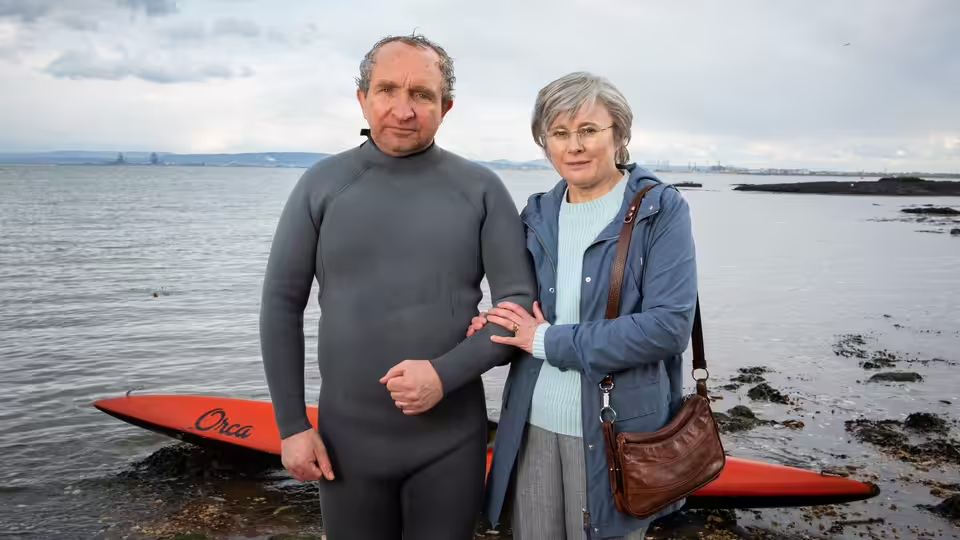
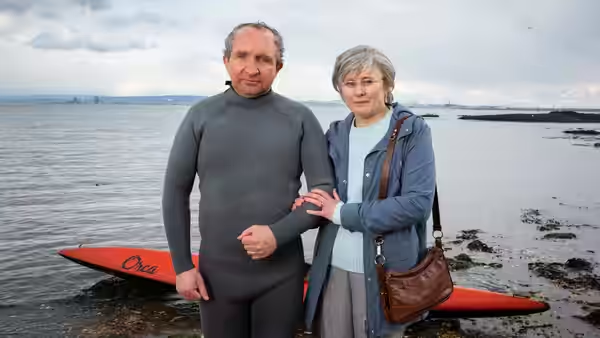
Eddie Marsan plays John as a small man who believes he is a large one. He lectures Anne on compound interest while hiding in a bedsit. He draws diagrams. He is pleased with himself in the way of a man who has never once been told no by anyone he respected, and Marsan plays it without a wink, which is the right decision. The joke is that John thinks he is the hero of a caper, and the series never agrees with him.
Monica Dolan is the series. Her Anne is a woman who says yes because saying no would mean a scene, and then has to keep saying yes for years. Watch her on the phone to the insurance company, or in the doorway when the police arrive, her hands finding things to do. The sequence that got to us comes in the first episode, when Mark Stanley’s Mark breaks down at the kitchen table over a father he thinks is in the sea, and the cutting takes us through the wall to where that father is listening. We felt sick, and then angry at a man in a cardigan in a way we had not expected to be. Dolan’s face across that table, holding a lie she already regrets, is the best acting in the series and it is not close.
Sergio Delgado shoots the town in flat grey winter light, the sea the same colour as the pavement, and keeps the houses dim and brown. Claire Kenny’s production design gives us two adjoining homes that could not be more ordinary, which makes the hidden door between them funnier and worse each time it opens. Richard Cooke dresses John in beige and Anne in the cardigans of a woman who has stopped buying clothes. Harry Escott and Ben Pearson’s score is a plucked, jaunty thing that keeps nudging us to laugh, and it is where the series shows its nerves. James Taylor and Barry Moen’s editing, cutting between the two sides of the wall, does the same job with far more tact.
The tone is the trouble. Lang writes the Darwins as a sitcom couple, and some of the exchanges, John explaining his scheme, Anne asking the sensible question, are pitched for a laugh in a way that stops them sounding like people. The real woman had two sons who thought their father was dead, and the series knows this is the heart of it, but it keeps leaving that heart to go and watch John being daft. Four episodes of 47 minutes is also a stretch for a story with one idea, and the middle sags. The police strand, with Lois Chimimba’s DC June Ayoade and Karl Pilkington’s DC Phil Bayley, is thin; Pilkington is drily effective, but the pair are there to move things along rather than to be anyone.
The second half goes where the headlines went, and we will leave it there, except to say that Stanley and Dominic Applewhite, as the sons, give the back end its weight. Against the run of British true-crime dramas, which tend to make their criminals either monsters or masterminds, this one is honest. The Darwins are neither. They are a couple in a seaside town who did something stupid and then could not stop.
Watch two episodes a night rather than all four. The comedy wears thin in one sitting, and Dolan deserves to be seen with a clear head.