Series review

Vladimir

2026 · Directed by Francesca Gregorini, Josephine Bornebusch, Robert Pulcini, Shari Springer Berman · Series · 15

In a sentenceRachel Weisz makes a convincing case for keeping professors away from their own imaginations

Drama

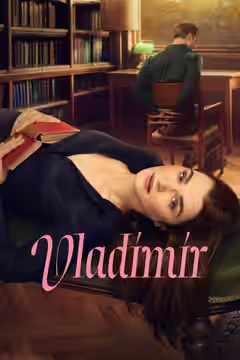
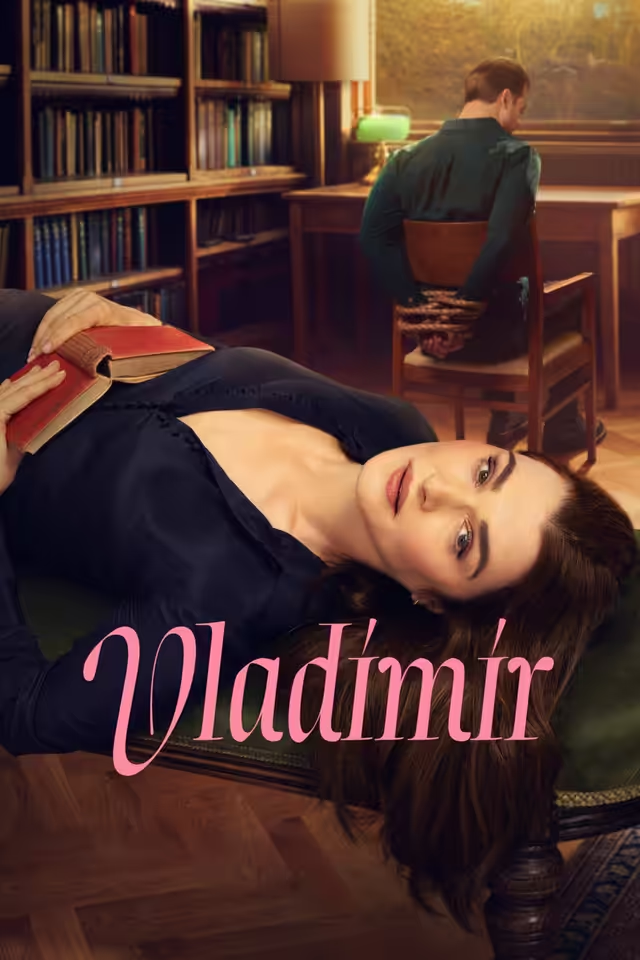
Rachel Weisz plays M, a professor whose midlife crisis brings desire and ambition into conflict with questions of morality. Her account of events includes first-person narration and frequent fantasies, placing what she wants alongside what she tells herself about it. As she unravels, sexual politics and judgements about behaviour become part of the story she tells. Leo Woodall plays Vladimir, with Jessica Henwick as Cynthia, Ellen Robertson as Sid and John Slattery as John. The eight-part drama is adapted from a novel by Julia May Jonas.

Plays from YouTube when you press play; nothing loads from them until then.

Fi1m review

Rachel Weisz keeps Vladimir amusing through some uneven storytelling. Her professor’s midlife crisis is worth trying if difficult people are your kind of company, though the frequent fantasies grow repetitive.

Vladimir is worth considering for Rachel Weisz, provided an uneven midlife-crisis comedy sounds like an acceptable use of eight episodes. Adapted from Julia May Jonas’s novel, it follows a professor whose desire makes her an unreliable guide to her own behaviour. The attraction is the chance to hear an intelligent woman explaining herself without having to accept her explanation. Weisz makes that compelling, but the series keeps interrupting her with fantasies that become less revealing as they accumulate.

Leo Woodall has the title role, though the professor is the more rewarding character. Weisz plays M with enough comic energy to keep her failings from becoming a solemn case study. We laughed at M’s fantasies, largely because Weisz makes the professor’s loss of composure so amusing. There is pleasure in watching an articulate person make such a poor job of explaining herself. The performance lets us enjoy her company without insisting that her judgement deserves our respect.

The first-person narration is crucial, since it lets M present her own account of desire and ambition. Matthew Capodicasa and Jeanie Bergen are among the writers, and the material is sharpest when it leaves us to notice what her account cannot quite justify. Its handling of morality and sexual politics is less assured when the themes begin to feel like subjects for discussion. We need to understand what these questions cost M, not merely recognise that they are difficult.

Cinematographers Tim Orr and François Dagenais, with production designer Sharon Lomofsky, help give the fantasies their heightened presentation. The choice makes sense for a programme so firmly attached to one woman’s wants: everyday restraint would hardly serve the comedy. Yet these passages too often repeat the fact of her desire when we are ready to learn something else about it. Their frequency makes them progressively less effective.

Editors Tim Streeto, John Grenham, Ken Eluto and Meg Reticker face a recurring problem of rhythm. A fantasy can interrupt an awkward situation entertainingly, but repeated interruptions make it harder for that situation to develop. Across eight episodes, the pace is uneven enough for us to start anticipating the next diversion rather than worrying about M. That is a substantial limitation in a series which depends on our willingness to stay with her account.

The midlife-crisis comedy has plenty of room for bad conduct, and Vladimir is right not to make its protagonist agreeable. It is less persuasive when it hesitates to follow her into anything messier. The writing sometimes seems anxious to keep us on her side, although Weisz is funny enough to remain watchable when we disapprove of M. We would have welcomed more of the discomfort that her performance is capable of producing.

A taste for academic comedy will help, though M’s job is less interesting here than her capacity to talk herself into trouble. Anyone hoping for a sustained examination of sexual politics should lower that expectation. Try it for Weisz, and allow yourself to stop if the fantasies wear thin.

Critical consensus AI synthesised

5 of 6
Positive
3
Mixed
1
Negative
1
The Hollywood Reporter
5 March 2026 · Angie Han
80*

The critic praises the series as a boldly prickly, fascinatingly slippery deconstruction of desire that is brainy and lusty. It elevates the source material into something knottier and more insightful through its antiheroine’s voice and psychological dissection.

Read the full review →
Variety
5 March 2026 · Alison Herman
55*

The critic finds the Netflix series an imperfect translation of the novel that fails to fully deliver on its ambitions despite strong elements. Weisz is magnetic and the episodes often amusing as farce, but pacing, fantasy sequences, and casting choices undermine the hothouse subjectivity.

Read the full review →
Radio Times
11 March 2026 · James Hibbs
40*

The critic calls out the series for cheating the audience with a misleading high-stakes opening that is quickly hand-waved away as a misunderstanding. Performances (especially Weisz) and the exploration of morality and sexual politics are strong, but the plotting tactic feels unforgivable.

Read the full review →
Collider
5 March 2026 · 8/10 · Taylor Gates
80

The critic praises Rachel Weisz's pitch-perfect comedic performance as a flawed, ambitious professor in this Netflix miniseries, noting sharp writing and effective use of the female gaze. They single out the show's tendency to play it too safe and avoid fully embracing its weirder, messier potential as a key shortcoming.

Read the full review →
NME
5 March 2026 · Nick Levine
80*

The critic finds the steamy midlife crisis comedy rollicking and infectious, with frequent fantasy sequences and a heightened tone that soon becomes engaging. They single out Rachel Weisz's energetic performance as the protagonist for praise while noting the show's smart ambiguity.

Read the full review →
Digital Spy
5 March 2026 · Laura Jane Turner

The critic finds the series entertaining despite its flaws, praising Rachel Weisz's central performance as the unravelling professor as the standout element that carries the show. They single out the first-person narration and Weisz's anti-hero portrayal for making the chaotic story watchable, while noting issues with unlikeable characters and uneven handling of themes like cancel culture.

Read the full review →

Cast

If you liked this, try…

The Chair poster

The Chair

2021 · Academic self-importance gets a brisker comic treatment, with institutional pressures attached

Young Adult poster

Young Adult

2011 · Another difficult woman confuses wanting someone with having a claim on them

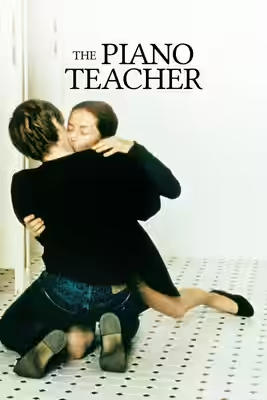
The Piano Teacher poster

The Piano Teacher

2001 · A much harsher study of desire, shame and professional authority

In the House poster

In the House

2012 · For the dangerous pleasure of turning other people’s lives into material

All That Heaven Allows poster

All That Heaven Allows

1955 · An older woman’s desire meets social disapproval, with far greater tenderness