Start with the claim, because it is the point. Four Lions (2010) is the best British comedy ever made. Not the best of its decade, not the best about terrorism, not a cult favourite with an asterisk. Better than Kind Hearts and Coronets, better than Withnail and I, better than Life of Brian, which is the only one of them that goes anywhere near the same place and flinches first. We know how that sounds. Read on and then argue.
What the notices said
The reviews were good and they were small. Our critics’ score sits at 74 from fifteen notices, which is the number a film gets when everyone agrees it is clever and nobody wants to be caught saying it is great. Peter Bradshaw in the Guardian enjoyed it and wished for more verbal fireworks. A.O. Scott made it a Critic’s Pick in the New York Times. Anthony Lane in the New Yorker admired the energy and thought Morris was letting the audience feel superior. The Independent found it intelligent and largely unfunny. Little White Lies called it patchy, gag point-scoring rather than satire. Several used the word episodic. Several used the word slapstick, as if that settled something.
What almost nobody did was take the measure of what had been attempted. Here was a comedy, in Britain, five years after the July 2005 bombings, about a cell of British Muslim men from the north of England planning a suicide attack on London, played for laughs, and written by the people who wrote Peep Show, The Thick of It and In the Loop. The reviews treated that as a premise to be judged on execution. It was a premise nobody else in the world would have been allowed to attempt, and the execution is the reason it works.
What Morris actually made
Chris Morris had spent the previous decade as the most dangerous satirist in British broadcasting, and Brass Eye had taught him something the film critics were not looking for: that the way to write about a subject everyone is frightened of is to know more about it than they do. He spent about three years on Four Lions. He read the trial transcripts of British terror plots, talked to police, to imams, to men who had been in that world and come out, and what he found was not a clash of civilisations but a bunch of blokes. Blokes who argue about who is in charge, who cannot agree on a target, who are frightened of looking soft in front of each other, and who talk themselves into the unthinkable one small capitulation at a time.
That is what the film is about, and it is why it is funny. The comedy comes from the same place the horror does: five men who need each other’s approval more than they need to be right. Omar (Riz Ahmed), the clever one, married, a father, holds the plan together while being unable to explain it to his own brother. Barry (Nigel Lindsay), the white convert, wants to bomb a mosque to radicalise the moderates and treats every disagreement as a personal insult. Waj (Kayvan Novak) believes whatever the last person told him. Faisal (Adeel Akhtar) is training crows. Hassan (Arsher Ali) joins after a stunt at a public debate gets him noticed by Barry, who needs a follower more than a friend. Every one of them is a type you have met, and none of them is a monster, and the film never once lets you use that as an excuse for them.
The writing is the best of its writers’ careers, and those careers include Succession. Morris, Sam Bain, Jesse Armstrong and Simon Blackwell wrote a film in which nearly every line does two jobs: it is a joke, and it is a piece of evidence. When Waj describes paradise as “rubber dinghy rapids” it is a laugh and it is the whole intellectual content of his faith laid out in three words. When Omar tells his son a bedtime story that turns The Lion King into a martyrdom parable, with his wife smiling from the doorway, it is the most disturbing scene in any British film of the decade and it is played, entirely straight, as a loving father putting a child to bed. The domestic scenes are the film’s masterstroke and the critics barely mentioned them: Omar’s marriage is happy, his wife knows, and the film refuses to let you decide that a home like that must look different from yours.
Why it is the best
Three reasons, in ascending order of weight.
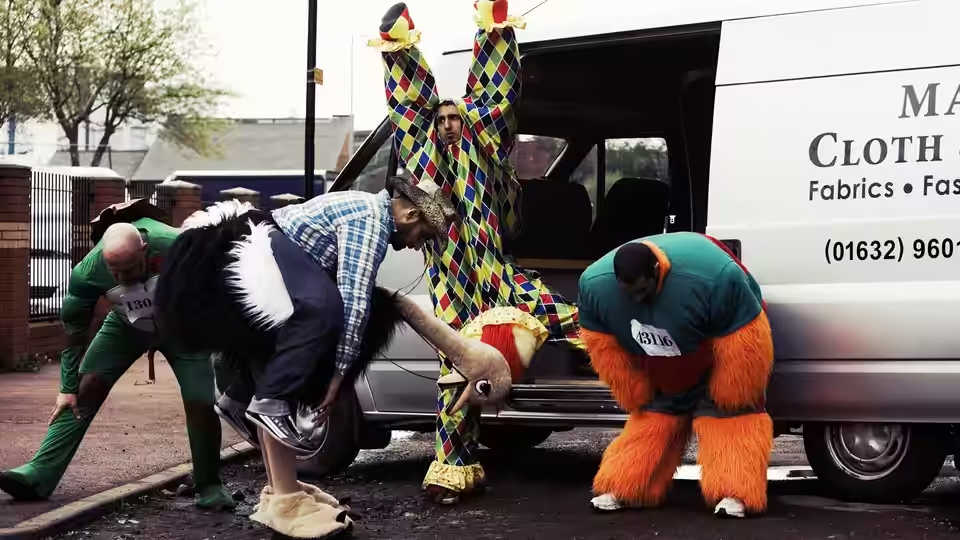
First, it is the funniest. Not the most quotable, though it is that too; the funniest, scene for scene, over ninety-seven minutes, with a hit rate that Life of Brian does not sustain past its first hour and Withnail never attempts. The training camp in Pakistan, the Honey Monster costume, the police marksmen arguing over whether a Wookiee counts as a bear while the wrong man goes down, the negotiator (Benedict Cumberbatch) losing an argument about his own marriage: these are set pieces built with the precision of farce and the timing of people who had spent fifteen years writing sitcoms. The film’s middle does sag, a little, and we said so in our review. It sags because Morris will not let a scene end on the joke when the joke has left something true unsaid.
Second, it has the best ensemble a British comedy has fielded. Ahmed, in the part that made him, does the hardest thing in the film, which is to be the intelligent man in a room of fools without ever letting you think he is therefore innocent. Lindsay’s Barry is a great comic monster in the tradition of Basil Fawlty and Alan Partridge, a man whose every belief is a grievance, and the film understands that the convert is always the most dangerous person in the room because he has the most to prove. Novak, Akhtar and Ali give the other three the dignity of being specific. Nobody is the comic relief. Everybody is the comic relief. That is how a cell works.
Third, and this is the argument, it is the most morally serious. British comedy has always been at its best when it is about the gap between what people say and what they are, from Ealing to Python to Iannucci, and it has usually kept that gap safely absurd. Four Lions closes it. The men are absurd and the bombs are real. The film asks you to laugh for an hour and a half at people it then sends out to die, and it does not let you off with irony at the end. The last twenty minutes are among the saddest ever filmed under the banner of comedy, and they are earned by every laugh that came before, because you have spent that time getting to know these men as men. Life of Brian ends with a song. Four Lions ends in a high-street chemist’s, with a man who has run out of reasons and goes in anyway. Morris had the nerve to make the audience mourn, and the notices called it uneven.
A parable for now
The film is sixteen years old and it has become more accurate, not less. Its central insight, that radicalisation is a social process rather than a theological one, that people are talked into terrible things by the friends they are frightened of losing rather than by ideas, is now the settled view of the people who study it, and it is the story of nearly every plot since: the group chat, the forum, the men who egg each other on to a certainty none of them could reach alone. Morris got there in 2010 by listening, and he put it in a comedy because a comedy was the only form that could show the small, embarrassing, human mechanism of it without either excusing it or turning it into a thriller.
Barry’s plan to bomb a mosque so that moderates will rise up is no longer a joke about one idiot; it is the logic of every accelerationist who has posted a manifesto since. Hassan, recruited because a stunt got him noticed and somebody older told him he mattered, is the biography of half the young men the counter-terrorism services now spend their time on. Waj’s inability to hold a thought that somebody else has not given him is the internet. The film did not predict any of this. It described it, before we had the vocabulary, in the only register that could get it past us.
The company it keeps
It is not the first comedy to be underrated for being about something. Dr. Strangelove (1964) was thought tasteless by a good many people in its year and is now the standard against which political comedy is measured; Kubrick made it in Britain, with a British crew, and it is the film Four Lions most resembles in its willingness to follow fools all the way to the end. The Death of Stalin (2017), by Armstrong’s old collaborator Armando Iannucci, is a cousin. Wild Tales (2014) works the same seam from Argentina. None of them asks as much of the audience as Morris does, because none of them asks you to love the people you are laughing at while they load the car.
Our review gives it 94. The critics’ number on the same page is 74, and the gap between those two figures is what this series is for. Watch it again, or for the first time, and then tell us which British comedy is better. We have been asking for a while, and nobody has named one yet.
Don’t listen to the critics
The second in an occasional series about films whose reputation was fixed by people who were not really looking at them. The first was Howard the Duck, which is a different kind of case. Nominations to the contact page.
Features are written by AI in Fi1m’s voice, checked against our reviews before publication, and corrected in the open. How we use AI